 |
| Lviv. The Regional Psychiatric Hospital |
Until the 18th century the suffering lived at monasteries, but most were left face to face with their illness. What does a hospital look like where the afflicted are helped to find themselves again and return to normal life? Recalling the facts of the Soviet past, when undesirables were pinned with terrible diagnoses and forcibly sent to madhouses, the mere thought of a psychiatric hospital can leave you stunned. In its size and the design of its facade the main building can be compared to a palace in the French Renaissance style. Into the construction of the building — with its projecting bay, inner courtyard, bell tower and dormer windows — the architect A. Kun put his strength and his soul.


 |
| Lviv. The Regional Psychiatric Hospital. The main building |
Along with medicines, patients can heal their souls in the chapel of St Joseph. In 1996, through the efforts of the medical staff and Lviv sculptors, the statue of the Mother of God, destroyed during the Second World War, was restored.

 |
| Lviv. The Regional Psychiatric Hospital. The main building |
Students of the Lviv Medical University gain experience at the hospital, and the lobby is adorned with busts of the luminaries of medicine — the Nobel laureate I. P. Pavlov and the Ukrainian psychiatrist, Academician V. P. Protopopov. In front of the main building a fountain with a round basin has survived, which people here call the fountain of dreams.

 |
| Lviv. The Regional Psychiatric Hospital. The fountain of dreams |
Across the grounds, amid ancient trees, the medical buildings are scattered. The image of the "yellow house" is alive to this day, and the tradition of painting the walls of asylums for the mentally ill in the colour of a sickly state has not changed.


 |
| Lviv. The Regional Psychiatric Hospital. The medical wards |
Why do people end up in the nuthouse? Personal troubles and severe depressions, brought on by many causes, lead a patient to the psychiatrist. Doctors can make a diagnosis and prescribe treatment, but to rid a person of loneliness and of difficult situations is beyond their power.


 |
| Lviv. The Regional Psychiatric Hospital. Concrete fences |
At the beginning of the 20th century, as medicine developed, the number of patients did not fall, and new wards appeared, lined up in a circle at the threshold of a large park zone.


 |
| Lviv. The Regional Psychiatric Hospital. The medical buildings |
Some of the green specimens are marked with information plaques. And although the patients do not stroll in numbers along the avenues of the century-old park or listen to the birdsong from the benches, even through a window nature heals the soul and helps a person come to know himself.


 |
| Lviv. The Regional Psychiatric Hospital. The park zone |
Flower planters of various shapes add to the atmosphere of this green healer notes of serenity and grace.


 |
| Lviv. The Regional Psychiatric Hospital. Flower planters |
In the psychogenic therapy ward there was a club where the members of a rehabilitation theatre of miniatures gave performances. The building's facade is decorated with a mosaic depicting flowers — the symbol of life and joy — along with masks, a lyre and a violin. Sometimes mental disorders hide behind the mask of other illnesses, and beneath the masks of normality hides an affliction that calls for delicacy. The violin of ceramic pieces reminds us that the human psyche is like violin strings: as you touch them, so they will sound.

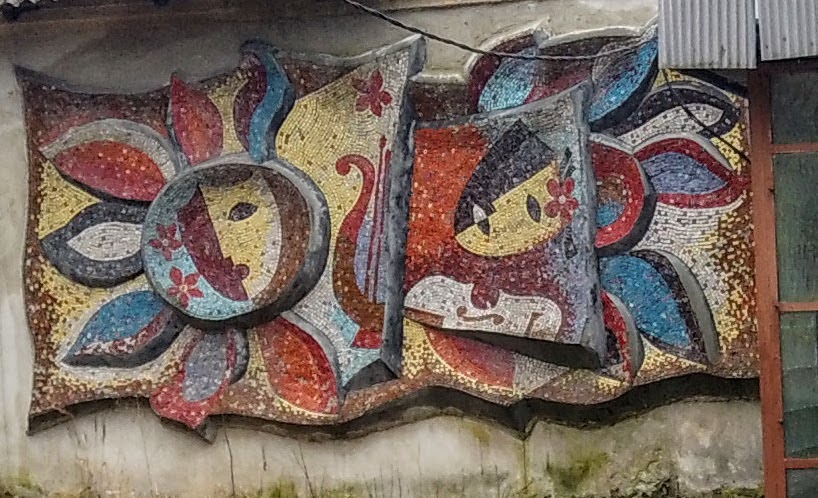 |
| Lviv. The Regional Psychiatric Hospital. The club and the mosaic |
Art gives birth to new emotions in the pessimistic and the self-doubting. Gloomy concrete fences have been brightened with murals on a life-affirming theme.
 |
| Lviv. The Regional Psychiatric Hospital. A mural on the fence |
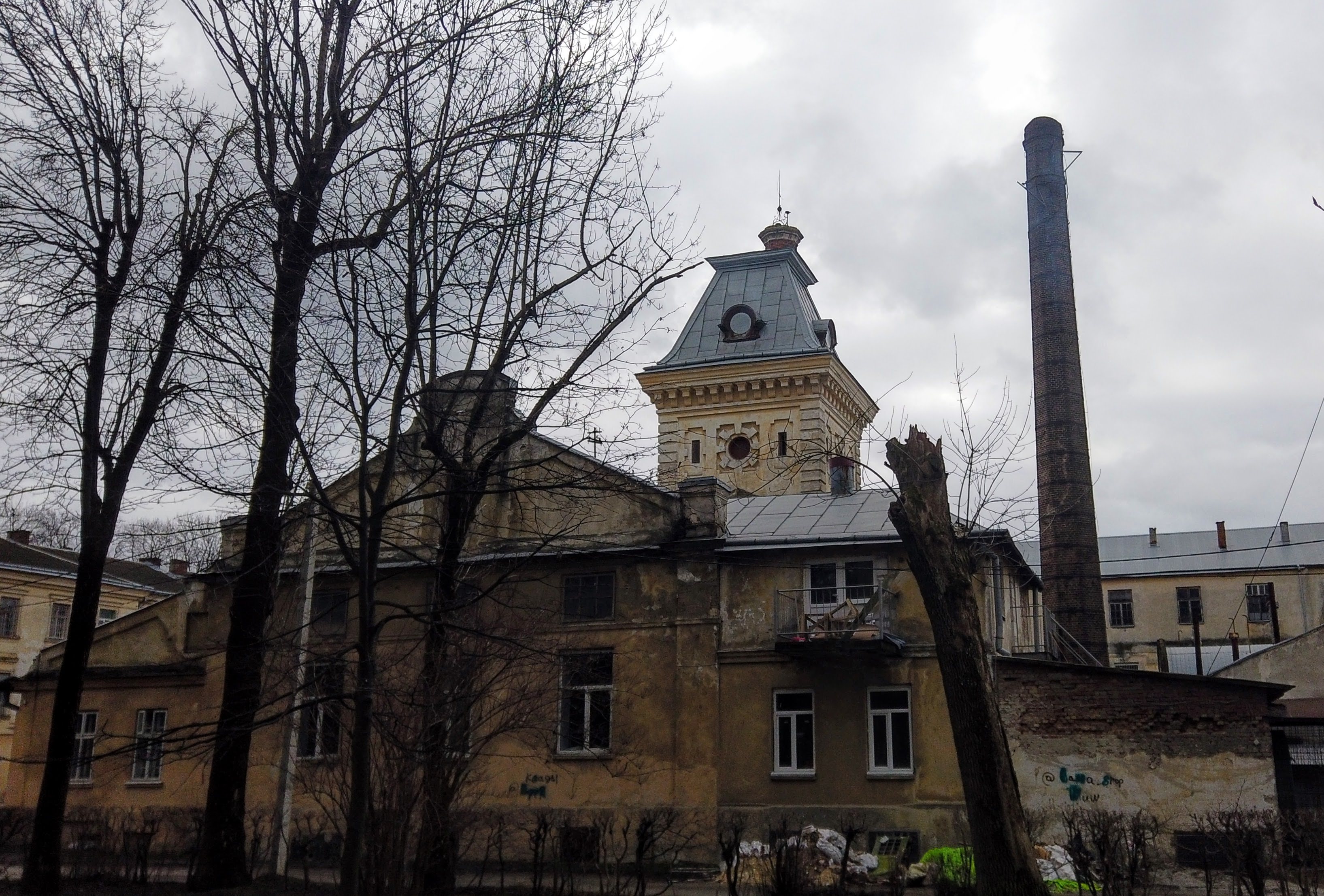
At first the medical institution, like a self-contained settlement, had its own railway branch, vegetable gardens, a livestock farm, a sausage workshop, a bakery, sports grounds and even a cemetery. The utilities of this miniature town have their own watchtower.


 |
| Lviv. The Regional Psychiatric Hospital. The utility block |
The purpose of the saddest building on the hospital grounds is announced by stucco moulding depicting funeral wreaths.

 |
| Lviv. The Regional Psychiatric Hospital. The morgue |
The old water tower of 1905, by the architect Alfred Zakharevych, no longer serves faithfully and well, but it rises above the hospital town like a sentinel of the hospital's history.
 |
| Lviv. The Regional Psychiatric Hospital. The water tower |
Its contemporary is the stone arch over the entrance on the eastern side.
 |
| Lviv. The Regional Psychiatric Hospital. The entrance gate |
In 2006 there were plans to open a museum of Lviv architecture on the hospital grounds, as a memorial stone attests. A slightly strange place for a museum city, where masterpieces of architecture stand at every step.
 |
| Lviv. The Regional Psychiatric Hospital. The memorial stone |
Clearly the treatment buildings of the regional psychiatric hospital, too, are in need of repair and restoration, in order to preserve one of the important architectural pages in the history of Lviv.

 |
| Lviv. The Regional Psychiatric Hospital. The medical wards |
This story is also available in Ukrainian: Львів. Психіатрична лікарня. Архітектура, мистецтво та природа для душевного здоров'я

No comments:
Post a Comment
Leave your impression