 |
| The "Tatariv" signpost on the H09 road |
The first stop is on the suspension bridge thrown across the Prut. At this spot a high cliff on the right bank descends into the water, and the river runs up against a spur of the Yavirnyk ridge, overcoming the rapids and, a little further on, merging with the mountain river Zhenets.

 |
| The bridge over the Prut |
Entry into the Carpathian National Nature Park by vehicle is chargeable; for the walker on foot, entry is free. Here is the starting point for those wishing to conquer the Yavirnyk ridge.
Information boards introduce the history of this nature monument, its flora and fauna, along the whole distance to the waterfall, and remind you of the rules of conduct in the protected zone. The road runs along the bed of the Zhenets, which is fed by numerous mountain streams. Gazebos allow the traveller to rest, have a bite to eat, and take shelter from the sun's rays or the rain.

 |
| The Zhenets tract. Gazebos and information boards |
The wish of the owners of the elite cottages that have stuck themselves into the Carpathian massifs — to pave everything over in asphalt — is understandable, but the forces of nature punish those who have flouted the laws of the Universe. On the bank of the Zhenets the asphalt surface has slid down the slopes, and notices on the posts warn of the dangerous state of the road.


 |
| The Zhenets tract. The road |
The swift little river, about 8 kilometres long, will brook no obstacles and hurries to race down to the rushing Prut. The turbulent currents slide over the stone boulders, proving that water will always wear away stone.


 |
| The Zhenets River |
The next stop is by the chapel and the memorial sign to the Fighters for Ukraine's Freedom.
 |
| The chapel and the memorial sign to the Fighters for Freedom in Ukraine |
Further on, a scene unfolds that testifies to Mother Nature's rejection of those who pay no heed to her ways. In spring the river went on the rampage, and the flood knocked down the fence of the forest residence of a former head of our state. The waters penetrated into the living quarters built on the left bank of the Zhenets. It is said that people have lived in the Zhenets tract since long ago, and on this plot the inhabitants noticed inexplicable phenomena and connected what was happening with the influence of evil spirits. When the time came to sell the plot, no new owner could be found — nobody wanted to settle in such a frightening place. When our helmsman acquired the homestead, even the local workmen turned down the offer to display their craft. The wooden mansions in the Hutsul style were built by visiting craftsmen who knew nothing of the wiles of the unknown entity. After the visit of the mountain torrent, the lordly chambers stand unfit for living in and disrupt the harmony of the pristine forest.


 |
| The Zhenets tract after the flood |
After the checkpoint with its barrier, the asphalt road turns into a dirt track, and there are still about 3 kilometres to walk to the Zhenets Huk. At the wooden crossing over the Zhenets, an eco-educational trail begins, leading up to the Zalim polonyna with its alpine meadows and the 10-metre Narynetskyi waterfall.
 |
| The Zhenets tract. A signpost |
No Carpathian attraction is complete without a kolyba and the local delicacies. Tinctures on all sorts of herbs and roots are sold right on the roadside. Here the river slows its flow, as if gathering strength for the stages ahead, letting you make out its clearness and its shallow depth. The vast massifs of the Gorgany accompany this blue artery from its beginning to its confluence with the Prut. In this protected place you may meet a hare, a fox, a roe deer, a hedgehog, a squirrel, a salamander, a viper and other inhabitants. It is said that wolves, wild boar and lynx not infrequently make the rounds of their domains.


 |
| The Zhenets River |
Yet another board hammers home, once again, to untidy visitors of the park the ban on leaving litter, lighting fires, smoking, picking flowers, frightening the wildlife and making noise.
 |
| The Zhenets tract. An information board |
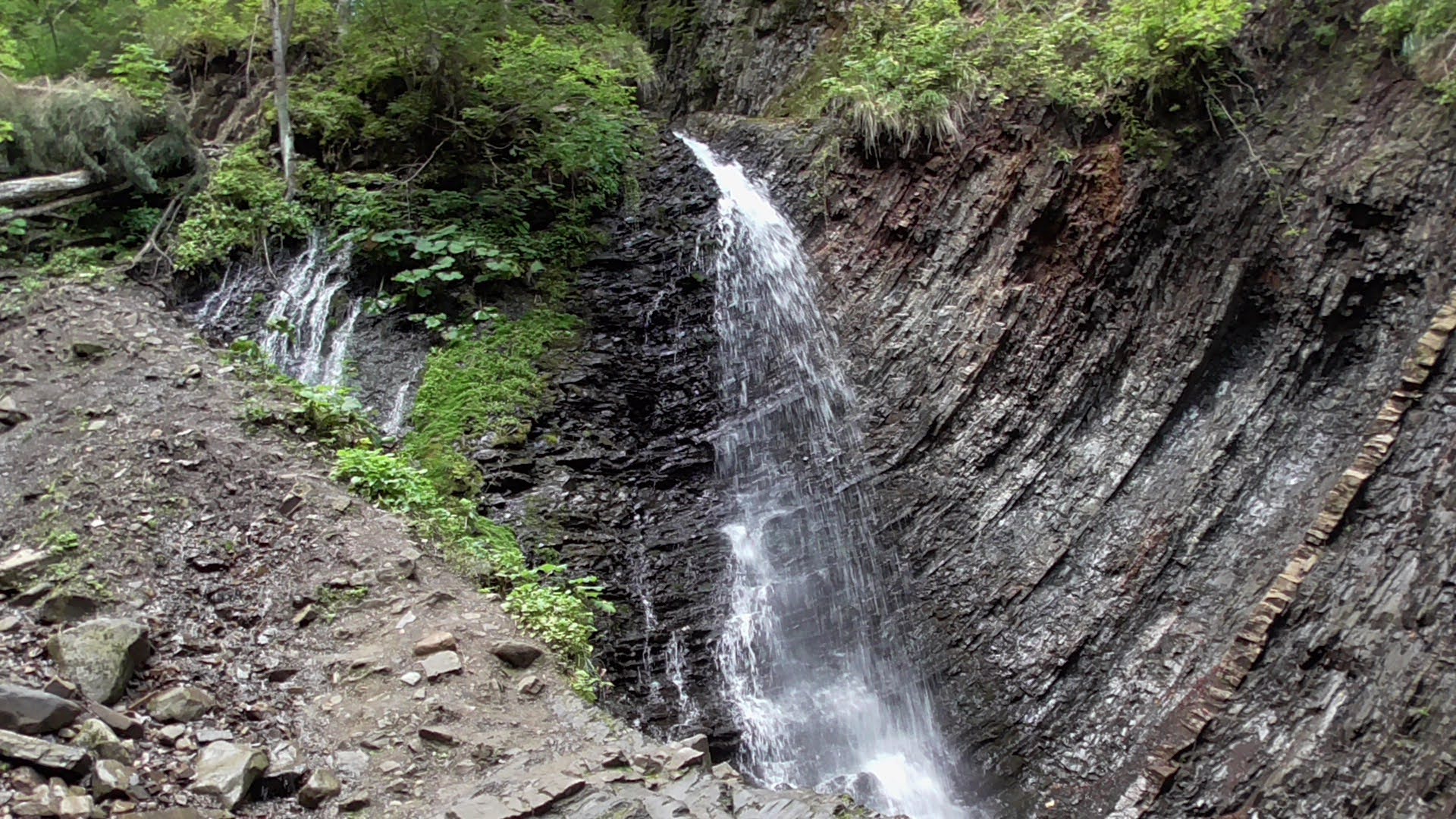
The only thing allowed to bubble, murmur and rumble here is the waterfall, which is why it is called the Huk (the Roar). This vertical waterfall was formed in the middle of the 20th century by the raging of an untamed torrent that caused a collapse of the mountain monoliths. Using the 15-metre drop between levels, the glittering avalanche of water crashes down with a roar, breaks against the stones in a spray, and races into the riverbed in a pulsing stream.

 |
| The Zhenets Huk |
It is never uncrowded by the Zhenets Huk. Enchanted tourists, after their striking photographs against the backdrop of this natural monument, move on to the kiosks selling tea, coffee and tinctures, so as to linger a while longer by the Huk and delight in its beauty and its power. You do not want to leave; watching running water is one of the three things you can gaze at endlessly. The waterfall lies at a height of 900 metres above sea level, and the difference in altitude along the way from the starting point was about 200 metres. The distance from the H09 road is about 6 km.
Coordinates: 48°23'25"N 24°29'51"E
This story is also available in Ukrainian: Женецький Гук. На воду, що біжить, можна дивитися нескінченно

No comments:
Post a Comment
Leave your impression