Since 2020, Prosiana has belonged administratively to the Synelnykove district. The distance to the regional centre is 150 kilometres, and to the district centre — 88 kilometres. The settlement arose in the 1880s beside a railway station, and the lands rich in harvests of millet gave it its name. Grain growing prompted the construction of one of the country's largest grain elevators. The grain store, with modernised equipment and a single-load capacity of 195 thousand tonnes, is among the TOP-10 linear elevators of Ukraine.
 |
| Prosiana. The grain elevator |
On the southern side of the village stands one of the largest processors of kaolin ore in Europe — the Prosiana Kaolin Plant.
 |
| Prosiana. Production buildings of the kaolin plant |
In 1882, the geological surveyor Medvedev discovered deposits of kaolin raw material in these parts. The first kaolin-processing plant in the Russian Empire was built in Prosiana. For 100 years the enormous enterprise developed and gathered momentum; its output was exported abroad and was in demand. New deposits were opened up and the most powerful production lines were put into operation.

 |
| Prosiana. Production buildings of the kaolin plant |
In recent years the industrial giant has fallen out of its working rhythm, and on the plant's grounds, amid heaps of brick and half-ruined workshops, a lull and desolation prevail.
 |
| Prosiana. Abandoned buildings |
In the plant's workers' canteen, the interior has not changed over the past 20–30 years. In years gone by, this catering establishment fed a large workforce. Unfortunately, in 2021 the low-priced eatery ceased operating.

 |
| Prosiana. The canteen |
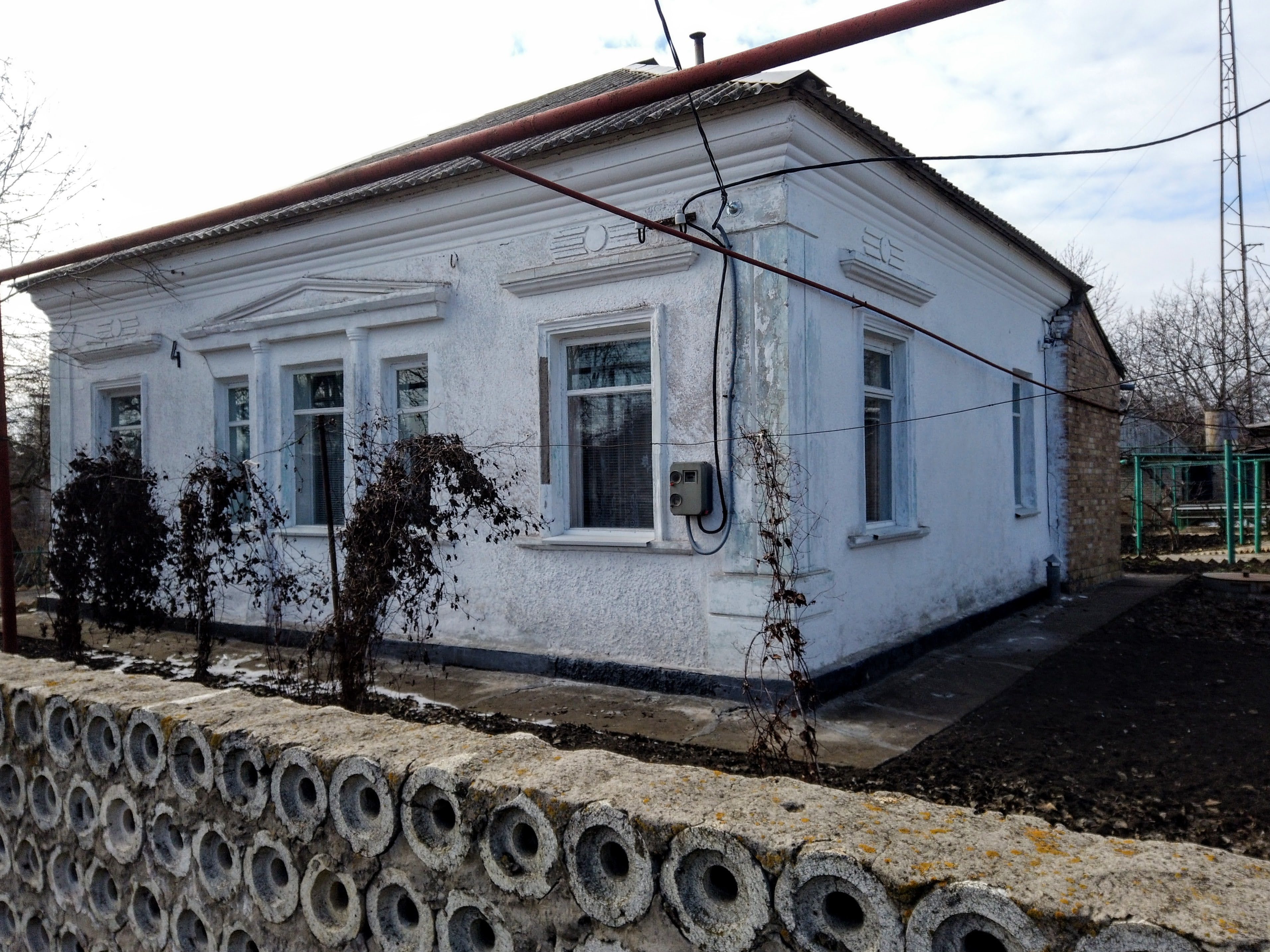
The housing stock in this village of five thousand inhabitants consists of the private sector, panel and brick five-storey blocks, and Stalin-era apartment houses of the 1940s–1950s. If you walk not along an asphalt street but along a dirt road, you get a sense of the mass from which kaolin was formed. The white clay is used in the production of porcelain, faience, paper, plastics, roofing materials, and cosmetic and pharmaceutical products.

In the private sector, the residents of the homesteads cheerfully clucked, barked, quacked and, of course, meowed at me. Prosiana has an unheard-of number of cats; they are everywhere — on windowsills, on wells — it seems that every furry, purring creature has come out to greet the traveller.


Seven five-storey blocks were built in the mid-1980s, during the village's period of economic upturn.


 |
| Prosiana. Residential development |
On Myru Street, the two- and three-storey houses have unusual designs, some with through-passage entrances. If they were painted and put in order, the buildings would not have lost their former appeal.

Myru Street, with its 1950s Stalin-era houses, is quiet, sunny and deserted. It seems that life stopped several decades ago. On the grounds of every house there are boreholes and wells — an indispensable life-giving source. Two of the houses have curved outer walls.


 |
| Prosiana. Myru Street. Residential development of the 1950s |
On the shabby walls, signs bearing the street's old name still remain.
 |
| Prosiana. Myru Street. A sign with the street's old name |
For 20 years the village has gone without a centralised water supply. The population uses water of less-than-the-best quality from wells and boreholes drilled in every yard.
 |
| Prosiana. Wells and water boreholes |
A school was built in 1954, and in 1978, during the baby boom, another wing was added.

 |
| Prosiana. The school |
In 1980, in honour of the 1980 Olympics, the educational institution was expanded by yet another wing.
 |
| Prosiana. The school. A commemorative plaque marking the construction of an academic wing |
Healthcare reform led to the closure of some hospital departments, and part of the medical facility's sound buildings stand empty.

 |
| Prosiana. The outpatient clinic |
Strengthen your health, gather strength and vigour — urges a slogan on the fence that separates the hospital from the stadium.

 |
| Prosiana. The stadium |
The large park looks neglected, and the war memorial is in need of restoration.


 |
| Prosiana. The war memorial in the park |
On the central town square, the department store and the house of consumer services have been split into small retail outlets, and part of the buildings stand empty.

 |
| Prosiana. Tsentralna Street. Shops |
At the market, satisfactory trading conditions have been created, but despite the morning hour, the market rows were empty.
 |
| Prosiana. The market |
Far from every village market has its pavilions decorated with mosaic panels. It never even occurred to the Prosiana merchants that they were destroying someone's work when they nailed cables and electrical fittings to the wall. The electrical installation work was presumably authorised by the bosses, and no one stopped the heavy-handed vandal. The wheeler-dealer 1990s have not yet ended in people's minds, while in artistic development we are degrading on every count.
 |
| Prosiana. A mosaic on a trade pavilion |
One more picture can be assigned to the Soviet past and destroyed with the clear conscience of a decommuniser. Whoever attached a fence and a canopy to the panel made of little pieces of ceramic tile has no idea that on the wall is a depiction of a page from the village's history.

 |
| Prosiana. The market. A defaced mosaic |
It seems that some 40 years ago monumental artists worked in Prosiana, whose works can still be seen on the walls of the buildings. Some of the mosaics are half-ruined.


 |
| Prosiana. Mosaic panels |
On the building of the village council and the post office there is an interesting picture devoted to the stages in the development of the postal service and to the ways of delivering correspondence in different eras — from the carrier pigeon to communication in space.
 |
| Prosiana. A mosaic on the building of the village council and post office |
Residents need to post a multitude of buy-and-sell notices, and part of the panel is pasted over with advertisements and offers, even though a special board has been set up for the purpose.
 |
| Prosiana. The notice board |
The Palace of Culture is decorated with stained-glass windows and bas-reliefs.


This village hearth of culture impresses with its size and decorative embellishments. The ornamental and narrative decorative compositions of coloured glass are executed to a high standard. The architect and designer was Volodymyr Borysovych Iholkin. Part of the translucent pictures has been lost during boisterous parties and choreographic exercises. Through the embrasures one can take in the central square, where a fountain and flowerbeds have been laid out.

 |
| Prosiana. The Palace of Culture. Stained-glass windows |
A large building with an auditorium seating 680 is not easy to maintain. Thanks to the directors of the Palace of Culture and of its creative ensembles, cultural life in the palace has not faded; clubs and studios operate there, and the amateur performers achieve excellent results.


 |
| Prosiana. The Palace of Culture |
To Dnipro, Synelnykove, Chaplyne, Pokrovsk you can travel by the passenger train Avdiivka-Kyiv and the suburban train Avdiivka-Chaplyne from the Prosiana railway station named after Pryklonsky.
 |
| The Prosiana railway station named after Pryklonsky |
Local roads of local significance T-04-06 and T-04-27 pass through the village. Two or three times a day, buses run to Pavlohrad, Pokrovske, Dnipro and Synelnykove.
 |
| Bus service from Prosiana |
My thanks to all the residents and passers-by for their warmth and hospitality.
This story is also available in Ukrainian: Просяна. Селище, в якому було все найбільше, найперше, незвичайне і красиве

No comments:
Post a Comment
Leave your impression