More than once I have heard the notion that if you have seen the sights of Lviv, that is quite enough for one's general education, and there is no point going to other towns of the region in search of something new. I will never agree with that. For me every settlement of the Lviv region is singular and unique. And Drohobych won my heart at once, with its history and its atmosphere.
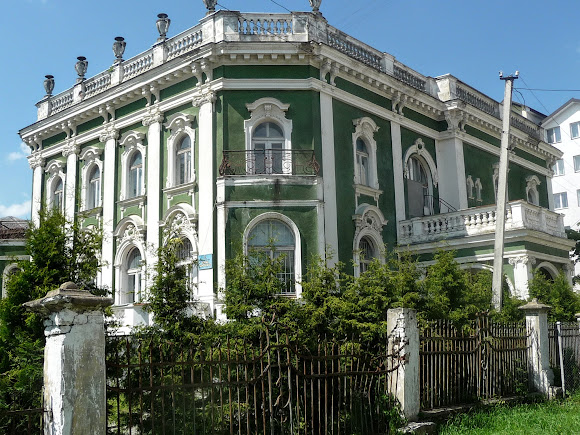 |
| Palace of Arts |
A walk through Drohobych can be both a romantic promenade and an enlightening tour. I began my acquaintance with the city at the junction of Lesia Ukrainka, Ivan Mazepa and Stryiska Streets, where the Monastery of the Holy Apostles Peter and Paul stands.
 |
| Monastery of the Holy Apostles Peter and Paul. Mosaic depiction of the martyrs Severian Baranyk, Yakym Senkivskyi and Vitalii Bairak |
Built in 1828 and consecrated in 1831, it became the successor of the monastery of the Basilian Fathers of St. Josaphat, known since the 18th century.
It was then, in 1775, that the first Ukrainian gymnasium in Drohobych was set up in the monastery, as a plaque on the church attests.
The Greek Catholic Church was persecuted by the Bolshevik authorities from 1939 onwards, when the western regions of Ukraine were incorporated into the USSR.
Many priests and monks were put to death in the torture chambers of the NKVD, and during Pope John Paul II's visit to Ukraine in 2001 three of them were beatified.
We see the portraits of the martyrs on a mosaic panel covering the whole wall.
The NKVD prison, in which about 3,000 residents of the city perished, was housed in the neighbouring building.
 |
| The I. Ya. Franko Pedagogical University |
Today it is the I. Ya. Franko Pedagogical University, an architectural monument of 1913.
 |
| The I. Ya. Franko Pedagogical University |
Drohobych has more than a dozen educational institutions where one can be trained in technical, humanitarian, spiritual, medical or musical fields. The students were in the pre-examination period, and they were basking in the May sun on the porch. Youth... If there are many young people, then the city too is young — although its known founding date is the 11th century! And since 1238 it has held the status of a town.
 |
| Police station |
From the 18th century until the First World War, Drohobych was part of Austria-Hungary.
 |
| School No. 4 |
In the interwar period it belonged to Poland.
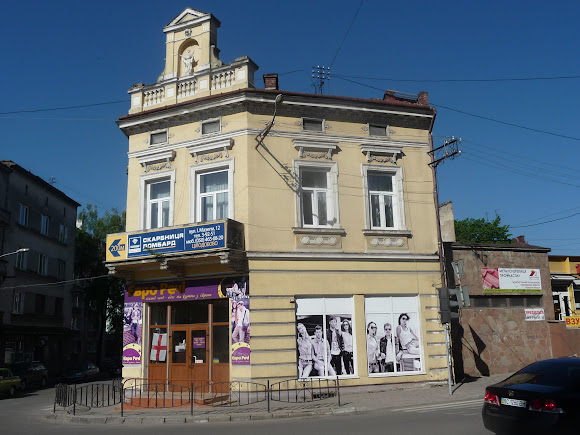 |
| A building on Mazepa Street |
Sadly, in the nearby resorts of
Morshyn (40 km) and
Truskavets (10 km) the travel agencies do not offer a trip to the second-largest city of the Lviv region in size and economic development. And what a pity! In a single day you cannot, of course, see all the monuments of history and architecture, but I still managed a few.
 |
| A building on Mazepa Street |
The centre of cultural and spiritual life is the Yurii Drohobych Lviv Academic Music and Drama Theatre. Why 'Lviv' is not quite clear to me, but I can rate the actors' performance most highly, for I saw the play 'The Kaidash Family', on a forever topical theme, when the theatre was on tour in Morshyn.
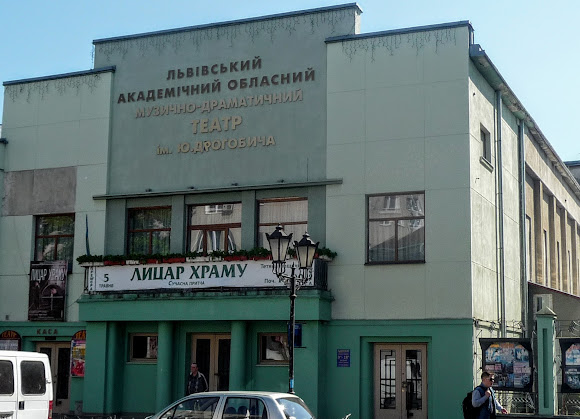 |
| The Yu. Drohobych Music and Drama Theatre |
The land of Drohobych gave birth to, raised and inspired our Kameniar — the Stonecutter. I. Ya. Franko received his first schooling at a 'normal' school in 1864—1967.
 |
| Administration of the Sambir-Drohobych Eparchy of the UGCC. The former school where I. Ya. Franko studied |
I stepped into the Cathedral of the Holy Trinity, built in 1690.
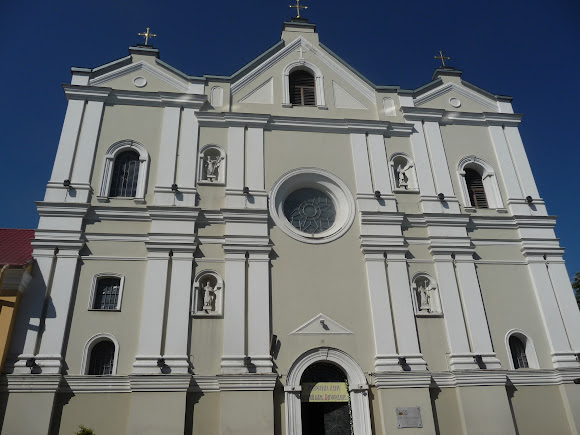 |
| Cathedral of the Holy Trinity. 1690 |
At the end of the school year, seven-year-old children took their First Communion in the church for the first time. I had already seen such a sacred rite in Truskavets. In these parts children are prepared for such a significant event, and it stays in everyone's memory.
 |
| Cathedral of the Holy Trinity. 1690 |
The monument to our short-story writer V. S. Stefanyk, who finished the gymnasium in Drohobych, has been placed, to my mind, in a not very convenient spot, beside a shop and a hairdresser's.
 |
| Monument to V. S. Stefanyk |
Every building is a story with its own secrets, which can be guessed from the ornaments, the decorative moulding, the bas-reliefs and the coats of arms of the former owners.
 |
| School No. 3 |
It is a pity that the artistic decoration of the buildings was for the most part destroyed by those who came to raze 'the whole world down to its foundations'.
 |
| Zhupna Street, 3. Architectural monument. 1903. |
All the main streets converge on Market Square.
 |
| Market Square |
The town received Magdeburg rights in the 15th century.
 |
| Pidvallia Street. The arch |
The frame of the historic centre is the development of the mid-19th century, when the oil boom struck Drohobych.
 |
| Zhupna Street, 4 |
After an important source of raw material was discovered in the surroundings, black gold flowed in a river to Europe, and the town gained a new round of economic growth.
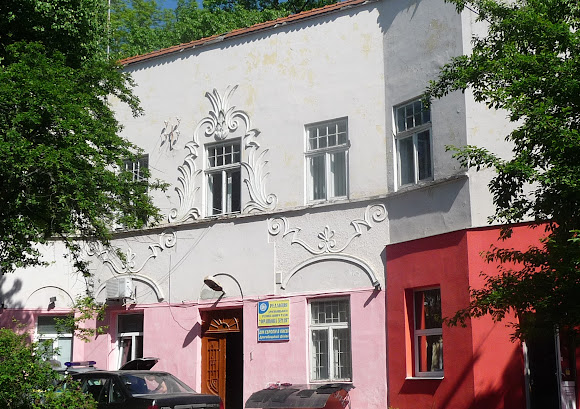 |
| Editorial office of the 'Frankova Zemlia' radio |
In the centre of the square stands the town hall with a clock that showed the correct time.
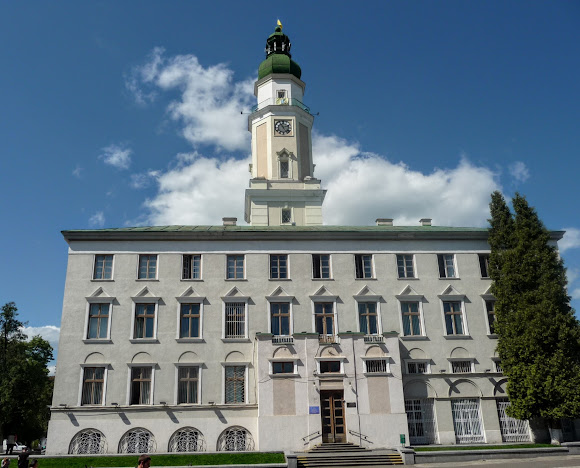 |
| Town hall. City council |
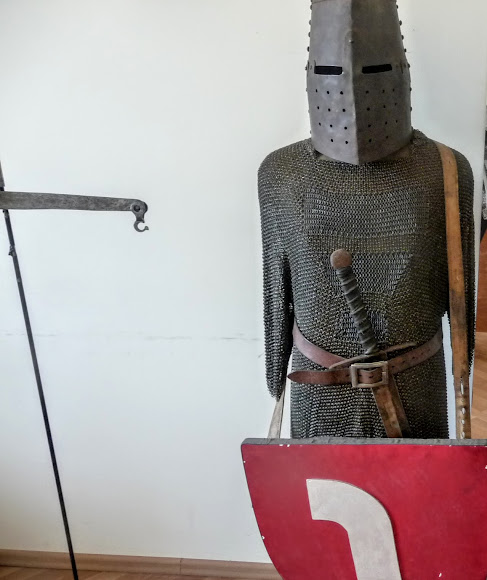
And for those who, while trading on the square, used incorrect instruments to measure the length and weight of goods, there was a special 'place of shame', as well as a pillory for criminals. Which devices were used for weighing can be seen at the exhibition of scales in house No. 13 on Market Square.
The founder of the display, Anatolii Zaderetskyi, offers free of charge a chance to view his collection of old exhibits.
St. Bartholomew's Church is a historical landmark of national significance from the 14th-15th centuries.
 |
| Church of the Holy Apostle Bartholomew |
Uniting two architectural styles, Gothic and Baroque, the church has preserved its architectural features. The patterned design on the wall, made of brown, red and grey brick, catches the eye.
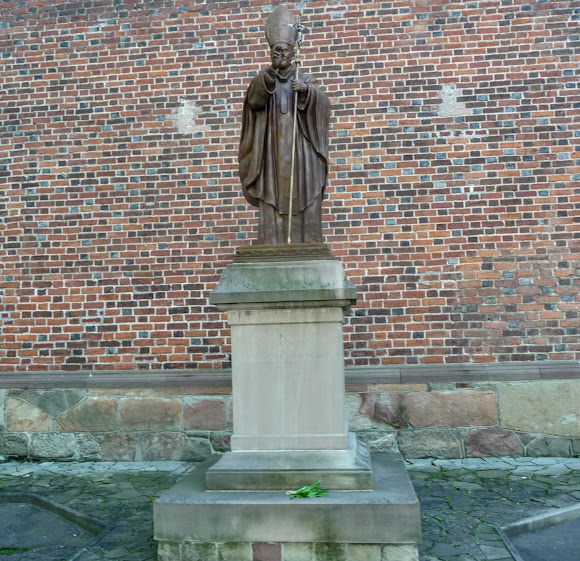 |
| Church of the Holy Apostle Bartholomew. Monument to Pope John Paul II |
The bell tower served the function of a defensive tower.
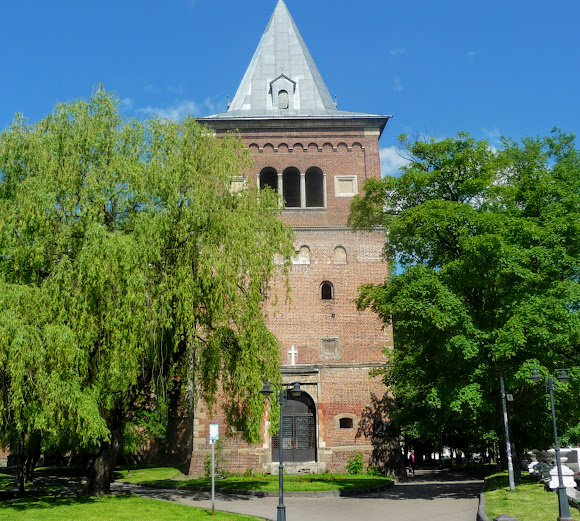 |
| The bell tower |
In the public garden — a natural monument of the 19th century — stands a sculpture of Yurii Drohobych: doctor of medicine, philosopher, humanist and a native of the town. As a professor at the University of Krakow in the 15th century and an expert in geography and astrology, he may have taught the student Nicolaus Copernicus.
 |
| Monument to Yurii Drohobych |
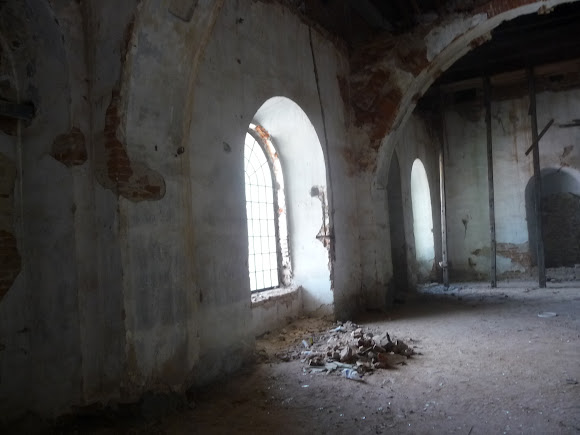
The Choral Synagogue, built in 1865, was one of the town's twenty synagogues and one of the largest in Europe. It is now under reconstruction. The facade has already been restored, and the architectural cornices renewed.
 |
| The synagogue |
I asked the workman who was carrying out the repairs for permission to enter, explaining that I had never seen how these places of worship are arranged inside. As a rule, outsiders are not allowed onto the building site, but the door was opened for me. Before my eyes there opened a picture of a room almost entirely in ruins.
There is still no end of work to be done.
The workman showed me where I could walk and told me the history of the synagogue.
Under the Nazis there was a stable here; in Soviet times, salt storehouses.
Lootings and arson turned the place of worship into ruins.
The fascist occupiers shot Jews right in the streets. Among the victims was the talented writer and artist Bruno Schulz, whose world fame came to him posthumously.
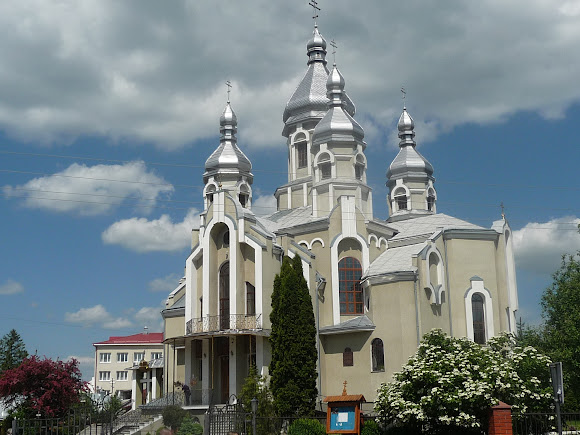
Drohobych is a city of different religious denominations, with a great many places of worship. Not far from the synagogue, on the same Pylyp Orlyk Street, the Orthodox Church of the Dormition of the Most Holy Mother of God was built in 1995.
 |
| Church of the Dormition of the Most Holy Mother of God. UAOC |
Almost 1,400 monuments to Taras Shevchenko have been erected around the world. The image of the poet as a young man is very fitting for a city of youth. The pedestal is made in the shape of a lyre, because lyricism was always present in the Kobzar's work.
After several hours of travelling, now in the sweltering noon, I rested a little in one of the parks. Next to me on the bench sat a couple of very venerable years, enjoying the quiet May day and the fresh green of the park. How pleasant it is to look at couples who have kept their support for one another. Youth? Yes — and the matter has nothing to do with age at all.
I asked the people of Drohobych how to get to the wooden churches. Unexpectedly, the elderly gentleman and lady rose to their feet, explaining the way along the not-quite-straight city streets. In detail, yet very clearly, not interrupting but complementing each other, they told me how best to find the road. I do not know who among the visitors, and when, was ever left without an answer to the question 'where is it?' or 'how do I get there?' in Lviv or the region, of which I have had to read in the media and hear in everyday talk. I am becoming ever more convinced that these are ugly myths. People always kindly point the way to me and help me, for which I am grateful to the people of Halychyna.
Overhearing our conversation, a man who was also resting in the park came up to me. He offered to walk me there, since there are three wooden churches and the road is not as near as it seems.
 |
| Church of the Exaltation of the Holy Cross. 1661 |
The Church of the Exaltation of the Holy Cross was built in 1661 on the site of its burned-down predecessor.
 |
| Church of the Exaltation of the Holy Cross. 1661 |
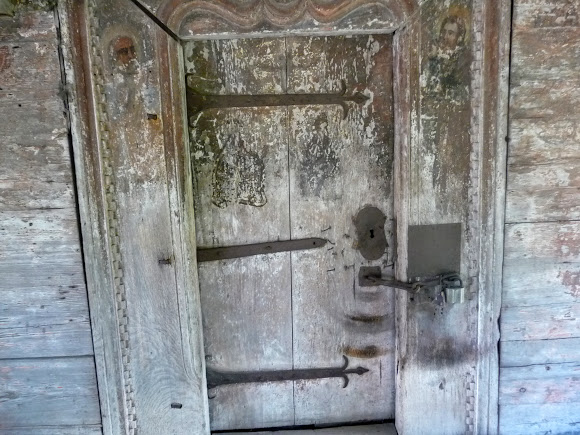
It has preserved wall paintings and various inscriptions, and an iconostasis.
The entrance to the church is low, so that you enter not with your head held proudly high, but with a bow.
The historical and architectural monument is under restoration and is opened only on 27 September, for the church's patronal feast. The 25-metre-high bell tower was of a defensive character.
 |
| Church of the Exaltation of the Holy Cross. 1661. Bell tower |
My guide turned out to be an expert on wooden architecture and had even written a book about old wooden churches. When he happened to overhear my question in the park, something even stirred in his soul — how could he not tell someone interested in a subject so close to him and so well studied. Volodymyr told me that he had been baptised in the oldest working wooden church in Ukraine. I guessed at once that it is St. Michael's church in
Svaliava on Bystryi, for I had discovered it for myself.
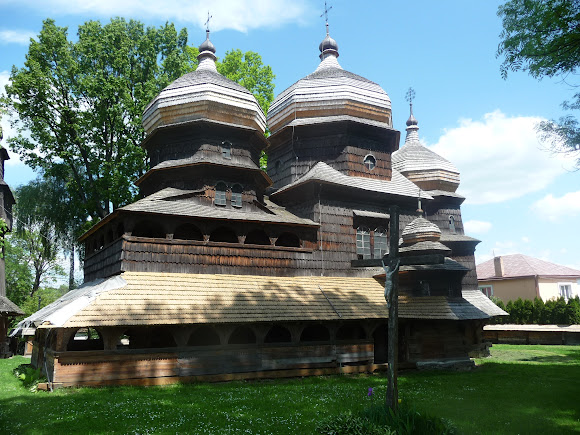
We came up to the Orthodox Church of St. George, which was not built but assembled without a single nail.
 |
| Church of St. George. UNESCO World Heritage |
This monument of Galician sacred architecture of the 15th-16th centuries has the status of a UNESCO World Heritage Site. Admission is paid — 20 hryvnias.
 |
| Church of St. George. UNESCO World Heritage |
Restoration work is now under way, and scaffolding stands inside.
The preserved iconostasis, wall paintings and decorative ornament are all now rare museum pieces, and photography inside is forbidden.
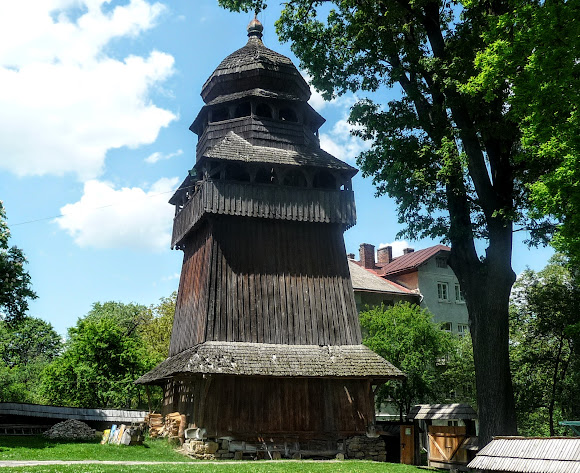 |
| Church of St. George. UNESCO World Heritage. Bell tower |
You can climb up to the choir loft by a narrow, steep staircase, which is blocked by some sort of props. But from above I saw that on the glade local artists were displaying their works depicting the sights of Drohobych.
There remained one more wooden church, but I already knew how to find it, and I thanked Volodymyr for the interesting tour. It is great good fortune to meet a knowledgeable person and to hear from them fascinating details of local lore. Solonyi Stavok Street, on which the Church of St. George stands and along which I set off further, arose on the site of a salt lake into which a salt river flowed. In the old days there was a field beside the lake. On one terrible day it collapsed into the earth together with the people working on it. Those who survived turned to a hermit monk for advice on how to save themselves from further collapses. He advised them to build a church on this spot. Such is the story of how the shrine came to be.
I walked a little further along Solonyi Stavok and, quite unexpectedly, came upon the former saltworks — the oldest enterprise, which has never ceased its work since the 13th century and still produces table salt to this day.
There is a saying: 'No salt in Drohobych — none in Europe.'
I don't know, but to my mind it is no longer possible on these ruins to evaporate the necessary product from the brine, the deposit of which lies right here.
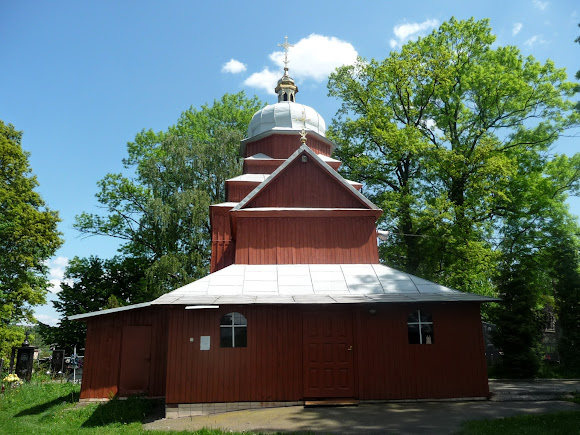
To the Church of St. Paraskeva I walked along streets already familiar to me, admiring once again the churches of St. George and of the Exaltation of the Cross, compared with which the third wooden church was quite a youngster, dating only from 1815.
 |
| Church of St. Paraskeva. UAOC. 1815 |
Built on the site of a burned-down one, known since the 15th century, it was closed during the years of Bolshevik rule.
Now the shrine belongs to the Orthodox community.
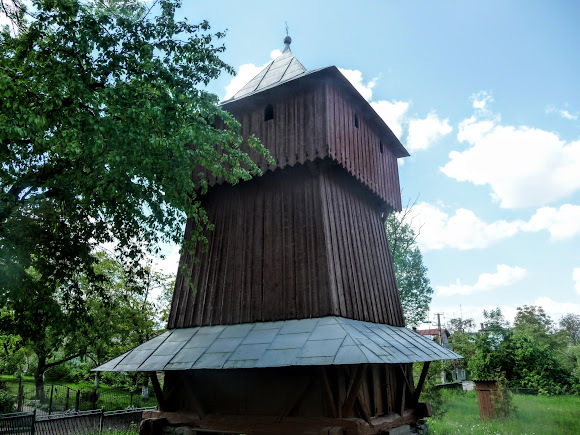 |
| Church of St. Paraskeva. UAOC. Bell tower |
Making my way back to the railway station, I walked around the city for another two hours, examining new and old buildings, each unlike the next.
 |
| School No. 5 |
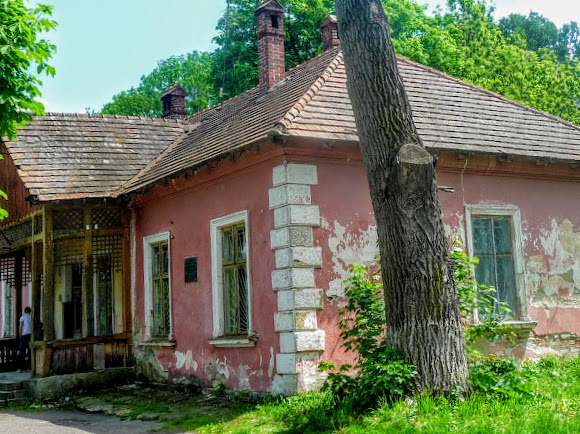
Although it is impolite to peer at people's windows, in Drohobych the villas have window openings of different shapes, and it is impossible not to pay them attention.
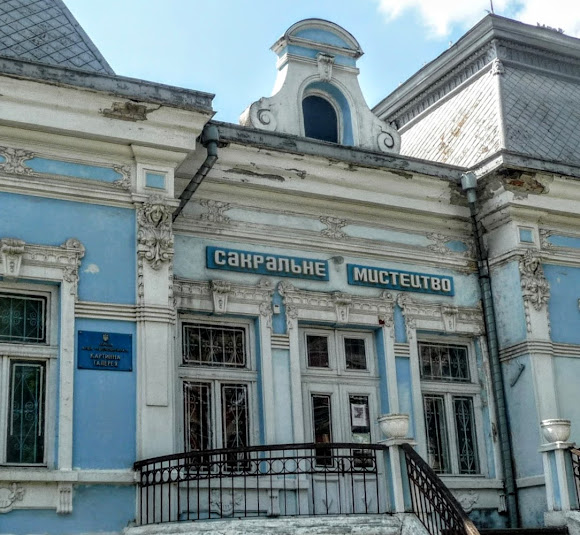 |
| Art gallery |
 |
| A building on Taras Shevchenko Street |
In my account of the city there is less than half of what I saw in a single day.
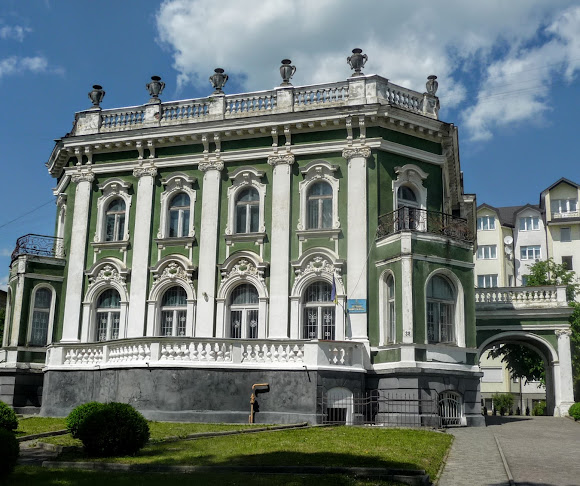 |
| Palace of Arts |
And I saw far from everything that is beautiful and interesting in this Subcarpathian district centre.
 |
| Lesia Ukrainka Street. The house of Severyn Chuprun, conductor, composer and public figure |
I walked along the streets and thought: what did I know about Drohobych before the trip?
 |
| Drohobych. Lesia Ukrainka Street |
It turned out that very little.
 |
| Drohobych. War memorial |
All I could recall was 'Drohobych' sausage. But the kind sold in other towns under that name cannot compare, even in appearance, with the sausages made in Drohobych — to say nothing of the recipe, the variety and the technology of production. Since I could not buy a magnet or a souvenir to remember the city by, I bought some of the famous poliadnytsia, because the very next day I was returning home with wonderful impressions and a tasty treat from Halychyna.
 |
| Monument to the Fighters for Ukraine's Freedom |













No comments:
Post a Comment
Leave your impression