Drohobych, the second-largest city in the Lviv region, increasingly attracts travellers. The Market Square and
the ascent of the Town Hall clock tower,
an excursion to the saltworks and the museums, and a look at the architecture of the wooden churches, one of which is entered in the UNESCO register of monuments, together with other sacred buildings, all form part of the
one-day tourist routes. The streets of the homeland of Drohobych sausages and the capital of oil-rich Galicia are full of secrets and legends.
 |
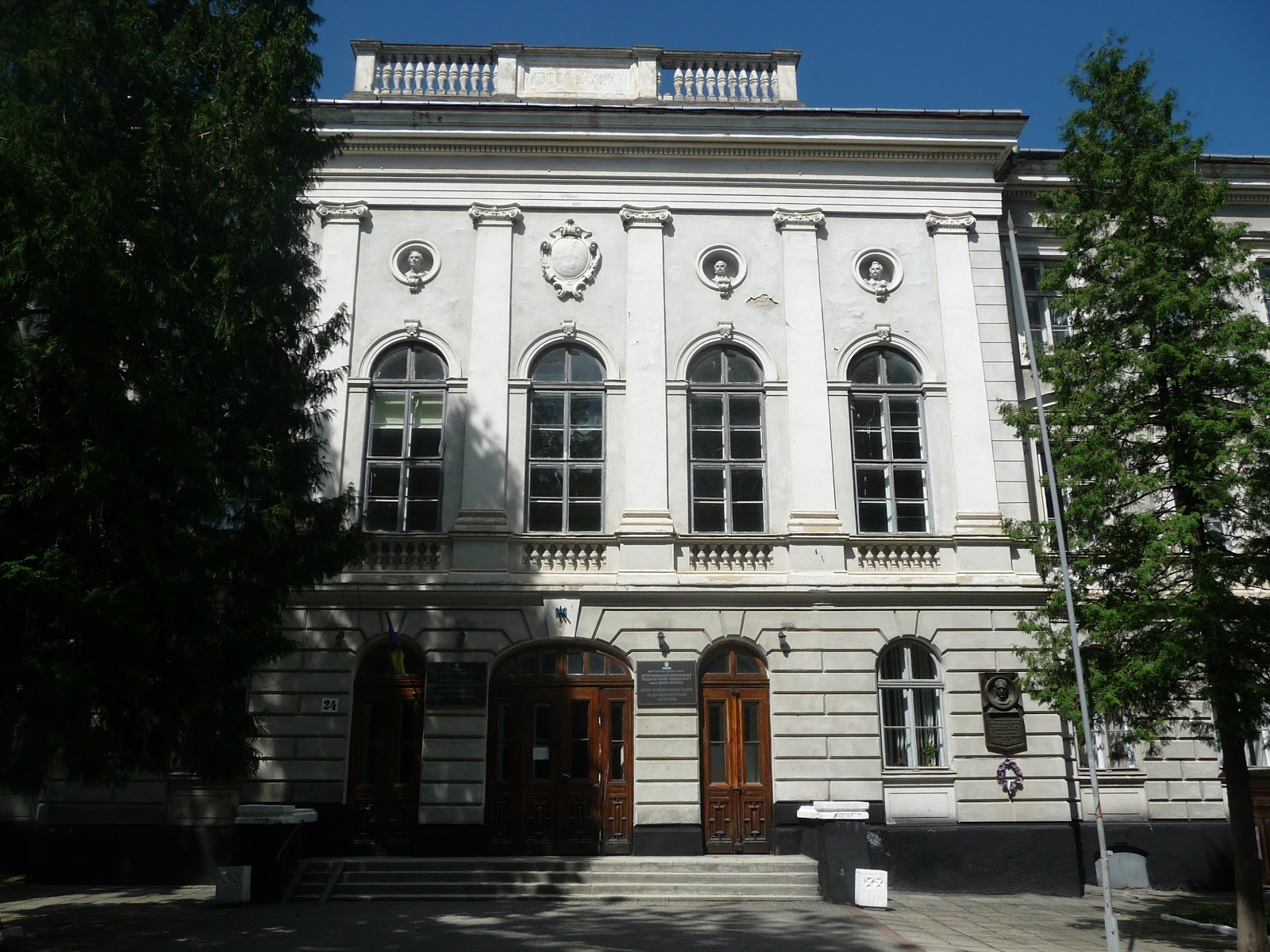
| Ivan Franko Street, 24. The I. Ya. Franko Pedagogical University |
It is no wonder that mysticism and mystery pervade the works of the writer and artist Bruno Schulz.
 |
| Yurii Drohobych Street, 12. The house of Bruno Schulz. An architectural monument |
Special attention is deserved by the villas, palaces and townhouses built at the turn of the 19th and 20th centuries during the oil boom, which belonged to the local high society.
 |
| Mickiewicz Street, 9. A residential building, early 20th century. An architectural monument |
179 residential buildings have the status of an architectural monument of local significance.
 |
| Zhupna Street, 3. The 1870s. An architectural monument |
On the facade of the three-storey palazzo of the lawyer Heinrich Rosenbusch, the owner's initials "HR" have survived. Before the Second World War the mansion belonged to the oilman Tarnavsky. Today the building at 22 Stryiska Street is occupied by a police station and the SBU.
 |
| Stryiska Street, 22. Early 20th century. An architectural monument |
The townhouse at 8 Ivan Mazepa Street dates from the mid-19th century and belonged to the lawyer Friedman. Sadly, its original decoration of floral ornament is crumbling, while a pizzeria's outdoor terrace clutters the flow of the street and hinders the viewing of these historic objects.
 |
| Ivan Mazepa Street, 8. 19th-20th centuries. An architectural monument |
In front of the villa of Gerschderfer, the gymnasium's owner, the most beautiful garden of exotic plants was laid out. Flowering magnolias still surround the mansion, built in 1900, at 16 Ivan Franko Street.
 |
| Ivan Franko Street, 16. A palace of 1900. An architectural monument |
The owner of the sumptuous building at 3 Ivan Franko Street was the obstetrician Getlinger.
 |
| Ivan Franko Street, 3. 1900. An architectural monument |
The ancestral seat of the Gartenberg barons was the house with a Statue of Liberty at 36 Ivan Franko Street. After the aristocratic family moved away, the palace was taken over by the county administration.
 |
| Ivan Franko Street, 36. 1903. An architectural monument |
The two-storey villa with a wooden veranda and balcony at 32 Lesya Ukrainka Street is occupied by the Drohobych District Court.
 |
| Lesya Ukrainka Street, 32. Early 20th century. An architectural monument |
On the same street, house No. 38, with half-timbered structures, is known as the Halpern villa. Before the Second World War it was home to Hausmann, the owner of a brickworks. After the war the mansion was taken over by A. M. Saburov, who headed the NKVD of the Drohobych region and took part in the repressions against Ukrainians.
 |
| Lesya Ukrainka Street, 38. Early 20th century. An architectural monument |
The Lialka villa bears the name of its house-owner, the magistrate's secretary Ya. Lialka. The three-storey building at 70 Lesya Ukrainka Street houses the prosecutor's office.
 |
| Lesya Ukrainka Street, 70. 1903. An architectural monument |
The two twin houses, Nos. 128 and 130, have identical designs and belonged to the Kushnar family, members of the Ukrainian police in the days of the ZUNR.
 |
| Lesya Ukrainka Street, 128. The 1920s. An architectural monument |
 |
| Lesya Ukrainka Street, 130. The 1920s. An architectural monument |
Shevchenko Street was formerly called Panska (Lords') Street, and original manorial houses have survived on it. A teaching block of the Drohobych I. Ya. Franko University occupies the former palace of the Spitzmann oil magnates. The villa took its name from the burgomaster Raymund Jarosz — who was also the owner of the Truskavets resort — and who lived here in the days of Polish rule.
 |
| Shevchenko Street, 23. Early 20th century. The Jarosz villa |
After the heroine of the novella "Spring" by Bruno Schulz, an architectural masterpiece at 38 Shevchenko Street is named the Bianka villa. In this richly decorated, Baroque-style palace of arts the "Drohobychchyna" museum has opened.
 |
| Shevchenko Street, 38. Early 20th century. The Bianka villa |
The exhibition of the museum's art department, a picture gallery, is housed in a small early-20th-century palace where the town's distinguished guests were once received and where, in Soviet times, newlyweds were solemnly married.
 |
| Sichovykh Striltsiv Street. Early 20th century. The picture gallery |
The residential building at 11 Mickiewicz Street is notable in that Bruno Schulz's fiancee, Josefina, taught there.
 |
| Mickiewicz Street, 11. Early 20th century. A residential building |
In 1903 the deputy burgomaster Jan Niewiadomski completed the construction of a two-storey house with a mansard at 4 Zhupna Street, 100 metres from the Town Hall. One of the most prestigious townhouses, it is adorned with a rectangular tower and sculptures of gods.
 |
| Zhupna Street, 4. 1903. A residential building |
The Landau villa is listed at 14 Tarnavskoho Street. During the years of the Nazi occupation it was occupied by Felix Landau, the commandant of the German police. At the master's order, Bruno Schulz painted one of its rooms with drawings on fairy-tale themes. Some of these wall paintings are kept in the "Drohobychchyna" museum.
 |
| Tarnavskoho Street, 14. The Landau villa |
Over more than a century of history, the villas and palaces of Drohobych have changed owners and purposes, but the story of these architectural gems is preserved, and the buildings look well cared for. Most of them have received the status of an architectural monument of local significance and are tourist attractions of this district centre of the Lviv region.
 |
| Ivan Franko Street, 11. 19th-20th centuries. An architectural monument |


No comments:
Post a Comment
Leave your impression