"How can I not love you, my Kyiv!"
I had a few hours and a wish to stroll through the capital.
Which route to choose? There was no need to think for long — one known from books, films and paintings. Coming out of the metro at Kontraktova Square station, I set off along Andriivskyi Descent.
 |
| Andriivskyi Descent |
Today this street, second in popularity only to Khreshchatyk, holds the status of an urban-planning landmark, yet it began back in the days of Kyivan Rus as a narrow neck of land between Castle Hill and Uzdykhalnytsia. The passage was probably dug along the path of least resistance, which is why the street has a curving shape that lends it mystery and singularity.
 |
| Andriivskyi Descent. Tenement house. 1914. |
They say there is a gateway to the astral plane here.
 |
| Andriivskyi Descent. The "Koleso" Theatre |
In the 18th century it was widened so that traders could drive through on carts loaded to the top with goods. From those times comes the saying: "What falls off the cart is lost." Nowadays stalls of overseas wares are set up right on the pavements. But you can also find original work, when artists and masters of applied art put up their displays. Foreign mass-market goods have no place here, to my mind.
 |
| Andriivskyi Descent |
The girl on the mural also has slightly Eastern features. Were it not for the wreath, you would hardly guess that she is our Ukrainian beauty.
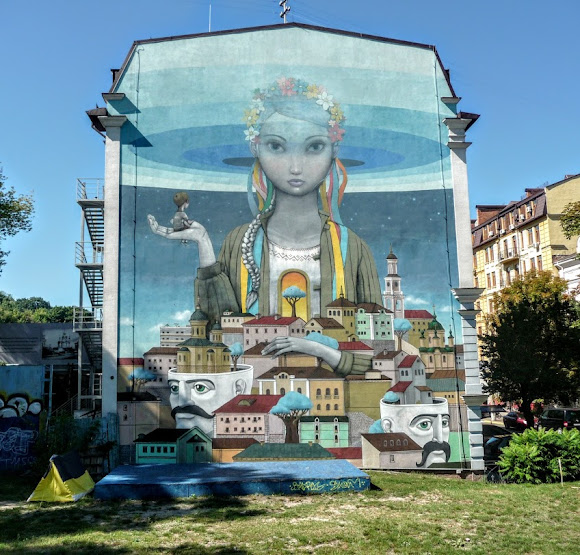 |
| Andriivskyi Descent. The "Revival" mural |
Not a building here but a whole epoch in itself.
 |
| The "Kanapa" restaurant-salon with a Ukrainian pre-revolutionary menu |
The legendary street took on its present appearance at the turn of the 19th and 20th centuries, during a spell of intensive building.
 |
| Andriivskyi Descent. "Richard the Lionheart's Castle" |
Its residents were members of the capital's intelligentsia.
 |
| Andriivskyi Descent. Ivan Kavaleridze Museum-Workshop |
In house No. 13, the "House of the Turbins", where Mikhail Bulgakov lived for 13 years, a literary-memorial museum has been opened. When there are many visitors, entry is limited. Naturally, I waited about 30 minutes, since I could not fail to step into the home of the writer who revealed, in the figure of Margarita, the very essence of the female soul. Perhaps hallucinogens helped him in this. And by the sculpture of the novelist and playwright there is a crowd of people eager to be photographed beside him on the bench. One feels like telling the admirers: "But he is a monument!"
 |
| Andriivskyi Descent. M. S. Bulgakov House-Museum |
The difficult terrain of this 700-metre street could not but leave its mark on the design of the buildings.
 |
| The "Vozdvyzhenskyi" Hotel |
 |
| Andriivskyi Descent. A building of 1901 |
St. Andrew's Church was built in the middle of the 18th century on the hill where, according to legend, in the 1st century AD the Apostle Andrew the First-Called blessed these lands. The Orthodox church is currently under restoration, and it has no bell tower, for the ringing might awaken the sea that vanished at the command of Saint Andrew.
 |
| St. Andrew's Church. 1753. UAOC |
"But Kyiv is impossible without Podil,
Like Saint Volodymyr without his cross.."
In this church, built in the Baroque style and adorned with exquisite decoration, the heroes of M. Starytsky's play "After Two Hares", Pronia Prokopivna and Svyryd Holokhvastov, were meant to be married. The sculptural composition on Podil is dedicated to the unforgettable actors who played so brilliantly in the film of the same name — Marharyta Krynytsyna and Oleh Borysov. Once again, persistent tourists want to keep the couple company at the very moment when Holokhvastov proposes to Pronia.
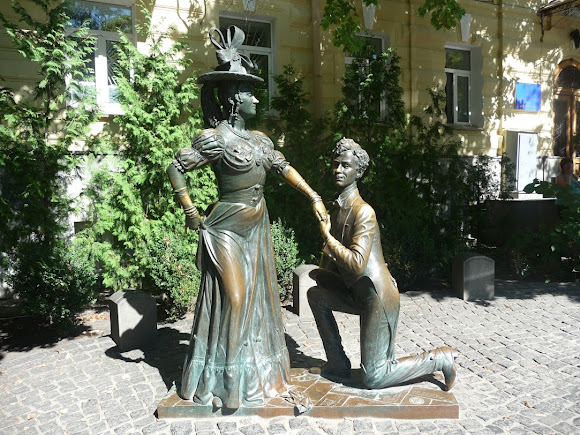 |
| Monument to the heroes of the play "After Two Hares", Pronia Prokopivna and Svyryd Holokhvastov |
From Andriivskyi Descent I moved on to Volodymyrska Street to see the remains of the foundation of the first stone church of Kyivan Rus.
 |
| Foundation of the Church of the Tithes |
The rich decoration of the church was plundered by enemies, and Batu Khan's army destroyed it completely. Centuries later, during excavations, fragments of mosaics and fresco painting were found.
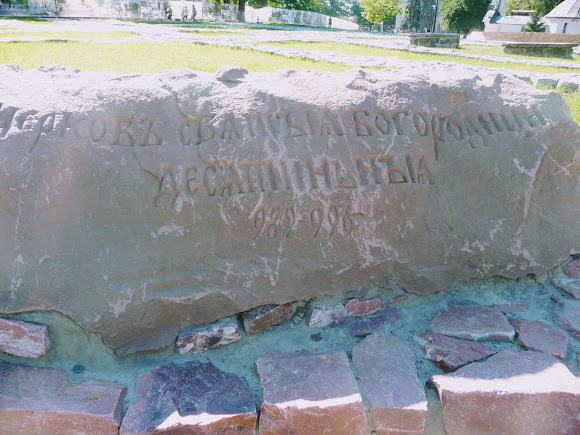 |
| Foundation of the Church of the Tithes |
The remains of the foundation are laid out beside the National Museum of the History of Ukraine, which dates back to 1899 and has become a treasury of archaeological artefacts.
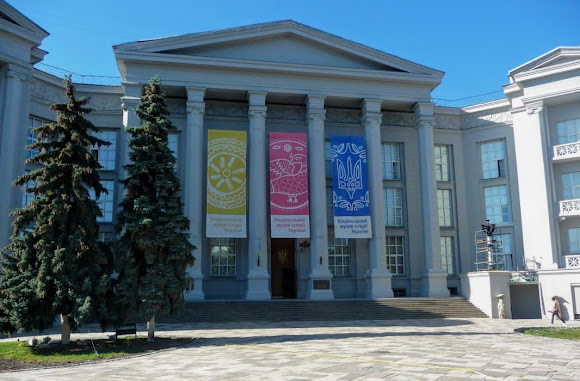 |
| National Museum of the History of Ukraine |
The Church of St. Nicholas was built in 2007, but it is so low that it does not look pompously modern.
 |
| St. Nicholas Church. 2007. UOC-MP |
The domes of St. Andrew's Church rise above it and seem to lift the sky.
 |
| St. Andrew's Church. UAOC |
Having walked along Velyka Zhytomyrska Street,
 |
| Main Directorate of the State Emergency Service of Ukraine |
 |
| Velyka Zhytomyrska Street |
I turned into a side lane and came out at a quiet park of modern sculpture and installations, with the feeling of stepping out of the noisy city into an atmosphere of art culture.
 |
| The "River of Love" installation |
 |
| The "Rain" installation |
But even greater delight was stirred by the utterly incredible, fairy-tale sculptures decorated with multicoloured mosaic.
 |
| Landscape Alley |
 |
| Landscape Alley |
What is there not to be found on Landscape Alley: fountains shaped like animals, unconventional kerbs and flower beds, all sorts of children's playgrounds.
 |
| Landscape Alley |
Original benches, thoughtfully provided with rugs and cushions, invite you to sit down and admire the panorama of the city.
 |
| Landscape Alley |
"And your mighty chestnut trees,
the chandeliers of Spring,
still bloom, mighty as of old,
and guard my childhood dreams."
The former defensive ramparts, wastelands and dull courtyards have been transformed, thanks to patrons and talented sculptors, into a wonderful place to rest.
Having walked along Desyatynna Street,
 |
| The "Spiritual Treasures of Ukraine" Museum |
 |
| Secondary School No. 25 named after V. G. Belinsky. Architectural landmark. 1939. |
I continued my walk on the historic St. Michael's Square, which arose in the 12th century on the site of ravines filled in with earth.
 |
| Kyiv. St. Michael's Square |
The square did not always bear this name, but now its original one has been restored to it.
 |
| Ministry of Foreign Affairs of Ukraine |
 |
| Monument to the victims of the Holodomor of 1932–1933 on St. Michael's Square |
The earliest St. Michael's Cathedral was raised at the beginning of the 12th century in honour of the Archangel Michael, patron of Kyiv, and served as a burial vault for the princes.
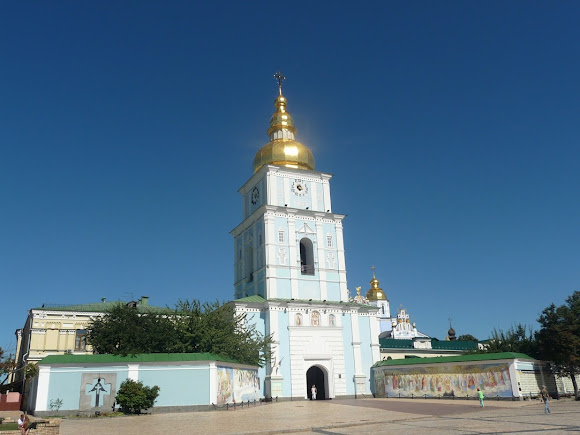 |
| St. Michael's Golden-Domed Monastery |
The shrine had to endure countless enemy raids, plunderings and rebuildings, but disaster struck in the 1930s, when the decision was taken to demolish the cathedral.
 |
| St. Michael's Golden-Domed Cathedral. 1999. UOC-KP |
In 1999 the restored church was opened and the mosaic frescoes, which had been kept in the Hermitage, were returned.
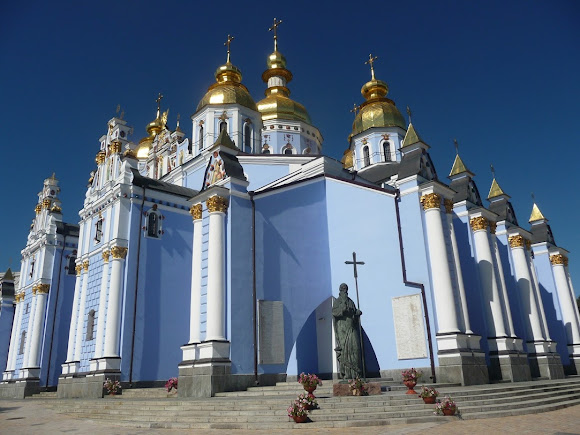 |
| Kyiv. St. Michael's Golden-Domed Cathedral. 1999. UOC-KP |
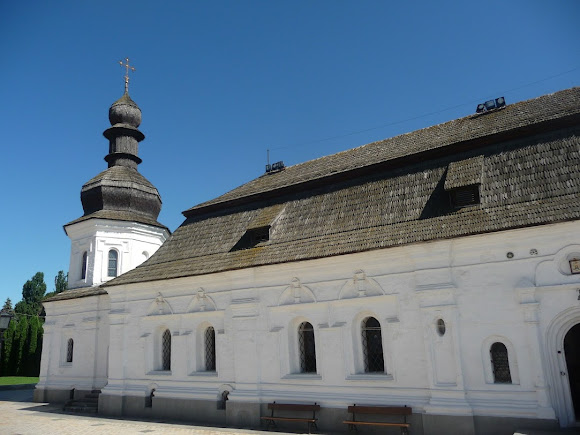 |
| Refectory of St. Michael's Golden-Domed Monastery. 1713. |
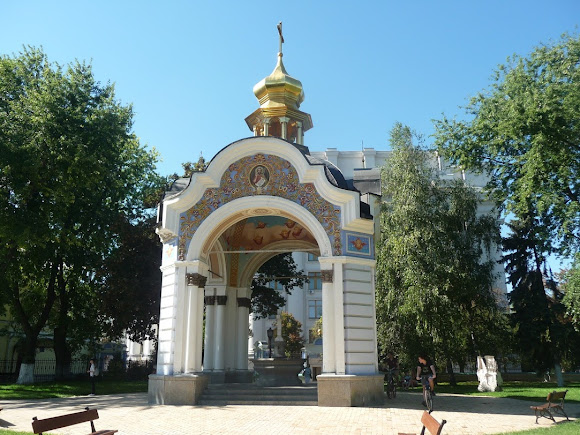 |
| St. Michael's Golden-Domed Monastery. Fountain |
On St. Michael's Square in 1996, after long years of oblivion, the restored monument to Princess Olha, Saints Cyril and Methodius, and the Apostle Andrew the First-Called was unveiled.
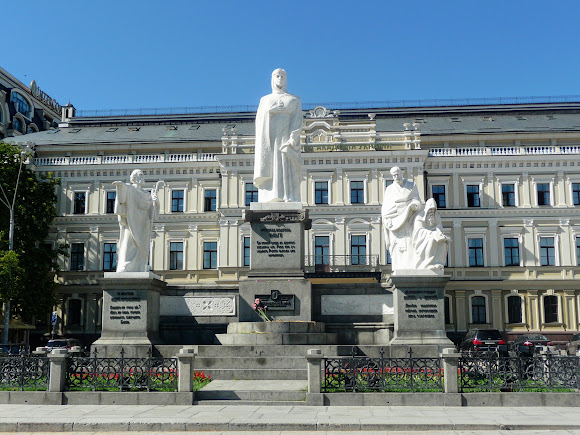 |
| Monument to Princess Olha, Saints Cyril and Methodius, and the Apostle Andrew the First-Called |
Princess Olha is the only woman to have headed our state; she ruled after the death of her husband, Prince Ihor, had a strong character and preserved the sovereignty of the state.
 |
| Monument to Princess Olha, Saints Cyril and Methodius, and the Apostle Andrew the First-Called |
The brothers Cyril and Methodius are the creators of Slavic writing. I noticed that in Zakarpattia these saints are especially revered; there is a theory that they baptised the Tysa region a hundred years earlier than Prince Volodymyr baptised Kyivan Rus. In Mukachevo and near Svaliava I have already seen monuments to our enlighteners.
 |
| Monument to Princess Olha, Saints Cyril and Methodius, and the Apostle Andrew the First-Called |
The Apostle Andrew the First-Called, spreading the Christian faith across the Scythian lands and sailing up the Dnipro, came ashore and foretold the rise of Kyiv: "Upon these hills the grace of God shall shine, and a great city shall stand here."
 |
| Monument to Princess Olha, Saints Cyril and Methodius, and the Apostle Andrew the First-Called |
From here it is a stone's throw to another ancient square — St. Sophia Square, with the monument to the Hetman of Ukraine, Bohdan Khmelnytsky, erected on it in 1888.
 |
| St. Sophia Square |
 |
| The former tenement house of the St. Sophia Metropolitan's courtyard |
 |
| Monument to Bohdan Khmelnytsky, 1888 |
Entry to the museum-reserve is limited by time, but I managed to get onto the grounds before closing.
The nineteen-domed St. Sophia Cathedral is an architectural landmark inscribed on the UNESCO World Heritage List. It was built in 1037 by Yaroslav the Wise in honour of the victory over the Pechenegs. From the unplastered sections of the wall one can judge the original appearance of the church.
The Metropolitan's House was built in 1730 and is an example of palatial architecture.
 |
| The "St. Sophia Cathedral" Museum-Reserve. The Metropolitan's House |
Museum exhibitions are now housed there.
On the grounds of the reserve you can see various installations. "The Lady with the Dog" is easy to recognise. But some are far too clever, and I could not work out how they relate to St. Sophia.
The trees, on the other hand, I liked very much.
 |
| The "St. Sophia Cathedral" Museum-Reserve. A century-old ash |
 |
| The "St. Sophia Cathedral" Museum-Reserve. Paulownia tomentosa |
I wandered through the city and not once had to resort to the paraphrased proverb "Your tongue will lead you around Kyiv." My enlightening tour of the capital ended in the park on St. Volodymyr's Hill, where the monument to St. Volodymyr stands and a wonderful view of the Dnipro and the city opens up.
A rest in the gazebo was the final stage of my promenade through the capital.
 |
| St. Volodymyr's Hill. Gazebo, 1870 |
"Here the arches of bridges will gleam,
here the windows of palaces will shine...
And a city on the height will rise,
beautiful and mighty,
to stand for a thousand years."




No comments:
Post a Comment
Leave your impression