"You, my town of Selydove,
A flower in the Donetsk land,
Selydove, Selydove —
A beacon of miners' glory!"
The town's anthem.
I happened to be in Selydove on business — a small mining town in the Donetsk region.
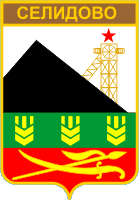
Ears of wheat, Cossack sabres, a slag heap and a pithead frame — the images on the coat of arms of the elements that make up the town's way of life.
In the 1770s fate cast here some Zaporizhian Cossacks who were moving towards the Kuban and, while crossing the Solona River, stayed for the winter camp.
 |
| Selydove. The Solona River. |
The otaman was named Selyd, and from him comes the town's name. The legend, it seems to me, is a little far-fetched, because there are other versions too. This one is probably the more historically significant. The town's founder, beside the Kyiv — Dnipro — Donetsk highway, peers from his watchtower towards the Crimea, watching for the approach of the infidel janissaries. Now, at his post, he also has to keep an eye on the road to Donetsk, thirty kilometres away.
 |
| Selydove. The monument to the Cossack Selyd. |
And his comrades listen to the dumas of a kobzar. The Cossacks are every one of them an otaman, and where there are three Cossacks, you can even elect a hetman.
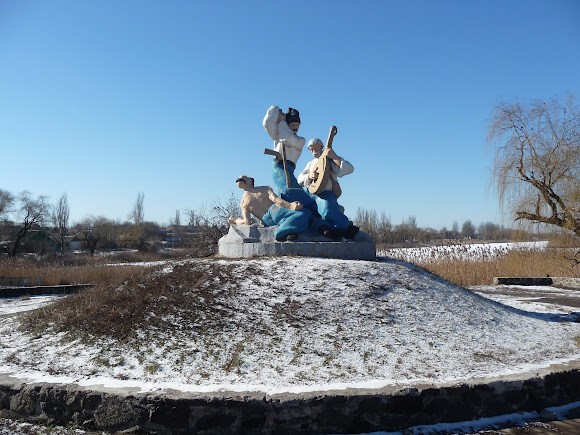 |
| Selydove. The monument to the kobzars. |
The peak of Selydove's development came in the years 1950-1970, as it did for the whole industrial region of eastern Ukraine.
Were it not for a few imported cars that caught my eye, and the signs of banks and little shops on the main street, the sense of having stepped fully back into that already forgotten era would never have left me.
 |
| Selydove. A building on Hoholia Street. |
In recent years the town has become a front-line one; fighting is going on 10 and 20 km from here.
The situation could not but affect the movement of people: many residents have left their native places, while displaced people have found temporary shelter in the town. Many people who, by the will of fate, ended up on the other side of the front come here on ordinary everyday errands. Some to the bank, some to the pension fund.
 |
| The Church of St Panteleimon on the hospital grounds, in the adapted premises of a former medical ward |
Judging by the size of the town council building, there are offices enough for those in power.
 |
| Selydove Town Council |
But how the problems of the town's twenty thousand residents and of the displaced are being solved can be seen with the naked eye.
The "Stalinkas" on the main street were built in the mid-1950s.
 |
| A building on Miners' Glory Boulevard, 1955. |
In those days the enterprises handed out flats for free. In 60 years of use the buildings have not been spoiled with repairs, yet the utility tariffs are just as exorbitant as in elite housing.
One of the town's first schools is closed and derelict.
And on the facade of this school, 60 years ago, the architect wished to summon pupils to knowledge, decorating it with an ornamental element.
How many schoolchildren now pick up a work of fiction or a textbook? The internet has become the source of knowledge, only the level of learning has not risen because of it. On the other hand, over the time of the fighting the children of the town and its surroundings can tell from the sound of the cannonade the type of artillery weapon and the distance from which the firing is coming.
 |
| Selydove. The gymnasium. |
The work of Vladimir Mayakovsky — who equated Lenin with the party and told the little ones "What Is Good and What Is Bad" — the people of Selydove, one must suppose, know well.
 |
| Selydove. The monument to V. V. Mayakovsky. |
There are not so very many monuments in the country to the poet-satirist-humanist-futurist. Yet here, in a five-storey residential district of this mining town, a street is named in his honour.
 |
| Selydove. The monument to V. V. Mayakovsky. |
After the ninth grade, the young people of Selydove and all its surroundings can study at the mining college. It is characteristic of the coal region that parents who work in dangerous conditions underground, at depths of up to a thousand metres and more, and receive for it a wage that does not match the hard labour, send their children to learn mining trades at the local "Cambridge", so as to continue the miners' dynasty.
 |
| Selydove. The mining college. |
From the accounts of many graduates I know that the studying is not hard; only the utterly lazy or illiterate fail to get through the programme. The lecturers drag everyone through to a diploma. Only this is far from always to the good of the future engineering and technical workers, who swell the army of talentless specialists, do not know the most elementary things, and call their college the "bottle" one.
The enterprises of the "Selydivvuhillia" production association have been stagnating for many years now; some have closed after industrial accidents, others barely breathe.
 |
| The monument to the fellow townsmen who died — miners, Chornobyl liquidators, internationalist soldiers |
The workers' numerous strikes do not lead to their demands being met. And the burning little star on the pithead frame — a symbol of the plan being fulfilled and therefore of good wages — has remained only on the town's coat of arms.
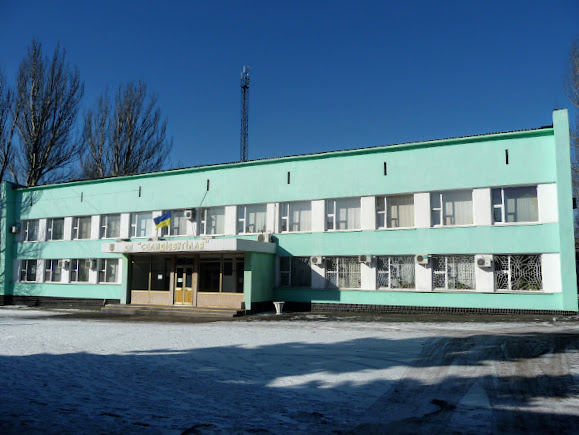 |
| The "Selydivvuhillia" production association |
But for now the guard of labour still has people to be proud of and to spur on to their thankless work.
 |
| Selydove. The board of honour. |
The centre of culture that once bore the name of the leader of the proletariat is in a very sorry state. The columns with capitals that triumphantly adorn the entrance have already cracked, and the niches are left with only the pedestals for their sculptures.
 |
| Selydove. The House of Culture. |
Most likely these were statues of labourers, or perhaps of leaders. On the facade there survives the stucco of stylised vines twining around the emblem of the coal workers of the USSR era. Of the three doors, painted proletarian red, two are shut fast. But despite the boarded-up windows, in the House of Culture children and young people take part in clubs and sections.
 |
| Selydove. The House of Culture. |
I know that in the music school, too, there are talented teachers and promising young performers.
The park of culture and leisure covers around 20 hectares, which for an industrial town in the steppe zone is very good.
 |
| Selydove. The park of culture and leisure. |
Sadly, everything here is neglected and half-ruined.
 |
| Selydove. The park of culture and leisure. |
I met almost no one, and there were no children on the playground.
On the edge of the park, beyond the ruins and the rubbish dumps, there is a common grave and a monument. But the fact that 60 unknown liberating soldiers and one partisan, who died in September 1943, are buried there is not stated on the gravestone.
In the town centre the "Zirka" (Star) military memorial takes up a large area. On the memorial plaques are the names of the defenders of the Donbas during the Second World War. Here order is kept.
In the southern part of the town, in a small public garden, only a sculpture of a soldier rises on a pedestal. There is not a single mention that in 1921 sixty-nine fighters for Soviet power were buried in a common grave here, and only two of their names are known. And yet, without knowing the past, it is impossible to appreciate the present and to build the future.
A MiG-17 aircraft has been placed here in memory of the local pilots and of the 23-year-old O. L. Kolesnykov, a native of Selydove, who carried out the last ramming attack of the Second World War in April 1945 over the Oder. It is a wonder that the aircraft has not yet flown off to land somewhere at a scrap-metal collection point.
 |
| Selydove. The MiG-17 aircraft monument. |
Crossing the little bridge over the legendary Solona River,
I came up to the bus stop, where students of the Selydove college were already waiting for their transport. They burst into the bus in a single living torrent of unspent energy, and the whole way to Pokrovsk not one of them gave up a seat to the other passengers. Perhaps no one ever told them "What Is Good and What Is Bad"? These sixteen-to-eighteen-year-olds are the very future of the towns and villages, of the region and of Ukraine. And that future depends on them, and on whether they will have work, on what kind of houses they will have to live in, on how and where they will be able to spend their leisure, in what schools their children will study and on what playgrounds they will play.



No comments:
Post a Comment
Leave your impression