Patsykiv. A 17th-Century Cossack Church in the Rain
I had long heard of the old monastery church in Patsykiv, in the Ivano-Frankivsk region, and had seen a small photograph of the sacred building. For two years I looked at the map and wondered how on earth to get there.
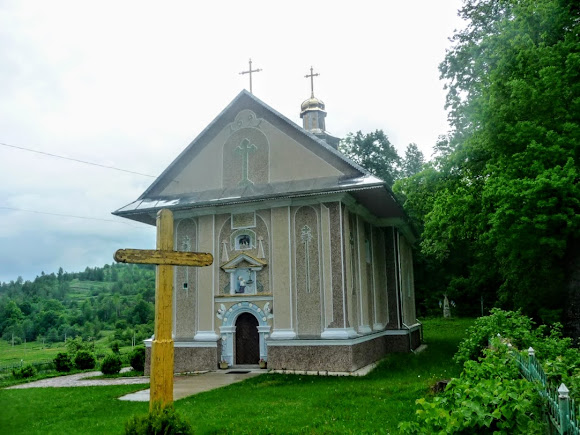
Patsykiv. The Church of the Dormition of the Most Holy Mother of God. OCU. 1691.
The journey involved several changes. From Morshyn — to Bolekhiv,
Bolekhiv, Ivano-Frankivsk region. Ivan Franko Square.
in the district centre I waited about 30 minutes for the bus to Vyhoda,
The village of Vyhoda, Dolyna district, Ivano-Frankivsk region.
and from Vyhoda to Patsykiv on foot. And it was just as well it was on foot — only, in Dolyna pitch-black clouds suddenly swept in. The approach of that wet blanket did not frighten me, and I did not change my plans. And a fellow passenger on the bus reassured me that the great cloud had already moved off behind the mountain.
I believed her, since she was from the village of Staryi Mizun, from the Carpathian back country. And there live real molfars, who can hear the mountains, walk upon the clouds and use lightning as a weapon.
In Vyhoda I set off southwards, recalling the local saying "to walk as far as to Patsykiv", which hints at a long road. My first stop was by the Orthodox wooden Church of the Nativity of the Most Holy Mother of God.
A characteristic trait of the Boikos, an ethnic group of Ukrainians who inhabit the Dolyna district among other places, is their religiosity.
Besides the great number of churches, everywhere you come across roadside chapels,
Vyhoda. The Church of the Nativity of the Most Holy Mother of God. The bell tower.
small chapels in people's yards, sculptures of saints and crosses raised to the glory of God.
Patsykiv. The cross commemorating the abolition of serfdom in 1848.
At the crossroads, statues of the Virgin Mary bless those passing by on wheels and on foot.
Vyhoda. The sculpture of the Most Holy Mother of God beside the school.
About how the Boikos preserve their history, about their culture and crafts, I learned at the Dolyna "Boikivshchyna" museum.
Patsykiv. A wooden chapel.
Tellingly, in olden times it was the women of this people who were the warriors, something like Amazons. Those who bear the widespread surname Boiko have true-born Boikos for their great-great-grandfathers.
I did not manage to escape the rain, and it accompanied me the whole journey, sometimes dully sifting down as through a sieve, sometimes easing off a little.
And then it poured as from a bucket, frightening in its suddenness. It is not for nothing that such downpours of water are called here a "raptivka".
When the heavens opened, I sheltered now in the school,
now in the music school.
The settlement of Vyhoda was founded on the lands of Patsykiv, of which the village forms a part.
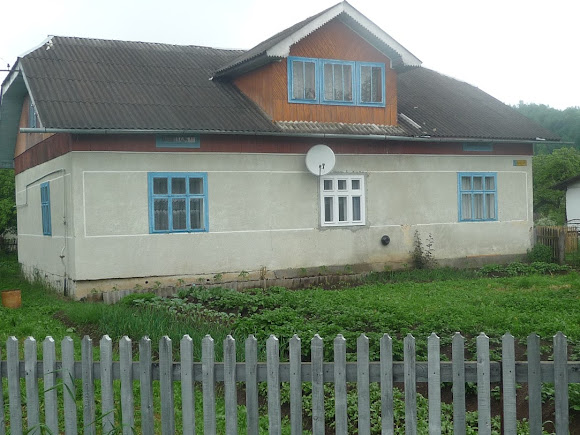
The boundary runs roughly by this house.
In the middle of the 19th century the Austrian Baron Popper built a steam sawmill, whose raw material was floated down the swift mountain rivers from the richest Carpathian forest tracts. The people of Patsykiv, whose main occupations had been farming and animal husbandry, gained jobs at the capitalist's enterprise. In the 20th century the logging trade and timber processing, laid down by the Austrian, became the main industries of the district.
Vyhoda. The "Uniplyt" timber mill.
I walked along the main street, Shevchenko Street, skirting the puddles,
Patsykiv. The "Nadiia" stadium.
and looked over the various houses.
Patsykiv. Shevchenko Street.
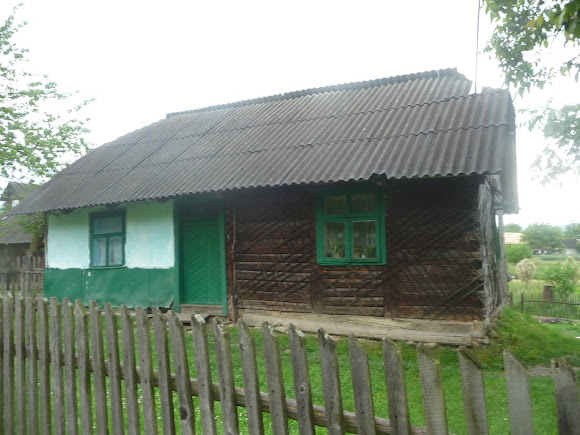
Many of them were decorated with wooden details or painted designs.
Patsykiv. Shevchenko Street.
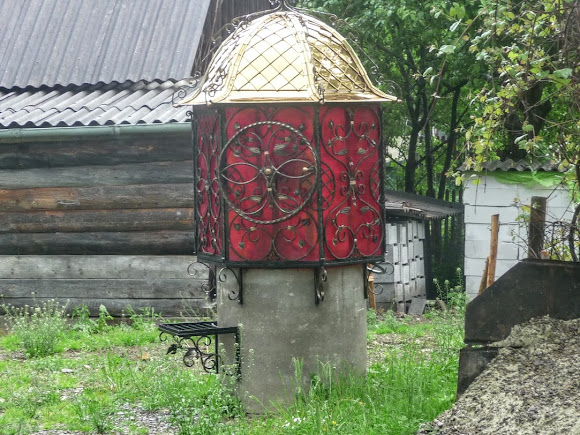
In every yard there is its own special well.
Cultural and educational life in this small Subcarpathian village was already quite developed by the end of the 19th century, and in 1896 a "Prosvita" society was founded.
Patsykiv. Shevchenko Street. The People's House.
The present-day hearth of culture has not gone out either.
I waited out another burst of the Carpathians' weeping in a little shop.
Already from here I could see the Church of the Dormition of the Most Holy Mother of God up on the hill.
A settlement on this spot was known in pre-Christian times and became part of Kyivan Rus when Prince Volodymyr the Great united the lands of the Eastern Slavs.
At one time their owner was a Moravian lord named Patsyk — and that is where the village's name comes from.
In pre-Christian times a monastery was founded on the hill.
The pagan monks knew how to heal with Carpathian herbs and honey.
The first Christian priest was Kashuba, a disciple of Cyril and Methodius, who acquainted the monks with the teaching of Christ.
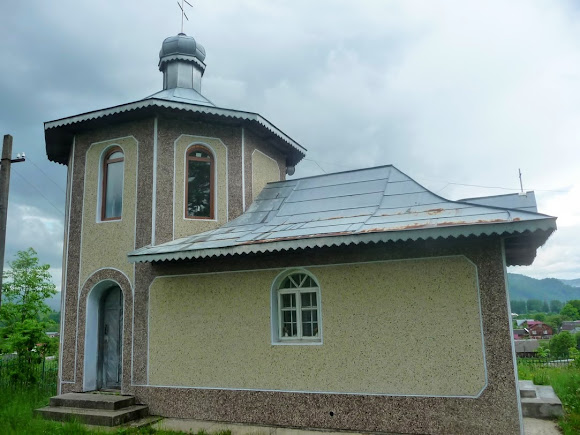
In the 17th century a stone Church of the Dormition of the Most Holy Mother of God was built.
In 1691 the first service was held.
And although the monks in time moved to the Hoshiv Monastery, the church was long still spoken of as a monastery church.
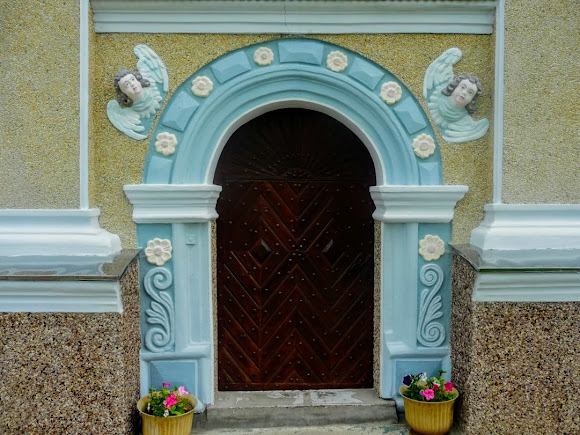
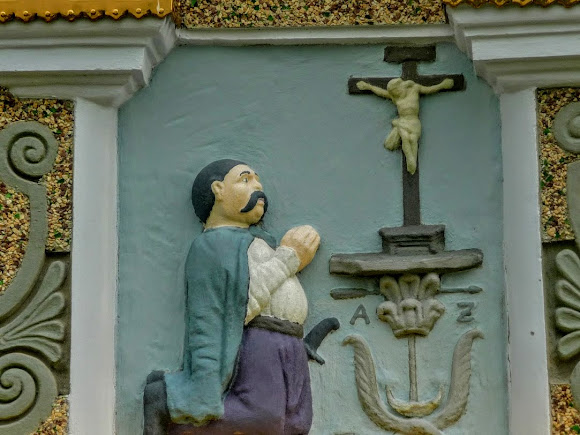
The walls of the shrine are adorned with curious stucco work.
A Cossack repents before the crucifix.
It is known that the people of Patsykiv took part in the war of liberation led by Hetman Bohdan Khmelnytsky against the Polish nobility. The church is also called the Cossack church. I wonder what the letters "A" and "Z" with a crossbar stand for?
Beside this architectural monument stand two crosses — an Orthodox one and a Catholic one.
The Royal Doors, as a valuable exhibit, are kept in the Sheptytsky National Museum in Lviv.
Behind the church stands a monument to the Fighters for the Freedom of Ukraine.
Beyond the fence, in the thick of the forest, lies the cemetery.
Local people, digging graves, would find underground passages that once connected the church and the fortified monastery.
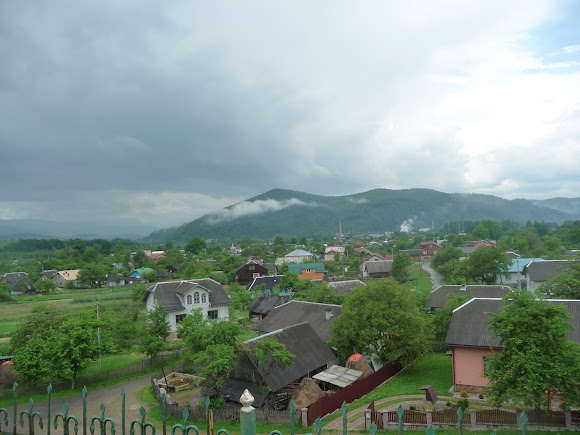
The site for the defensive structure was chosen for good reason, because from here everything is visible as if in the palm of your hand.
Naturally, the view that opens out is wonderful too.
On the advice of a local man I met along the way, I walked to the house of the church's administrator, hoping that they would open it for me. I came up to the gate, but found no bell. Evidently that day was not my lucky one. However much I called for the master of the house, no one, alas, came out to me.
The way back, as always, seemed shorter.
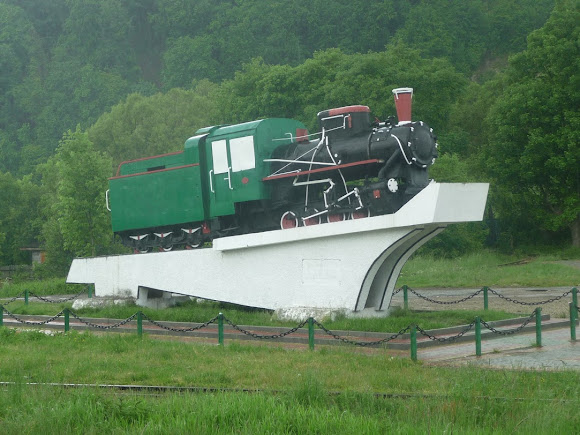
In Vyhoda I came up to the monument to the narrow-gauge steam engine "Zozulka", which for many years worked in the logging industry and has now been set on a pedestal as an exhibit.
And its veteran brother has not yet gone into well-earned retirement and carries tourists along the excursion route "Carpathian Tram".
The walk in the rain to Patsykiv had come to an end.
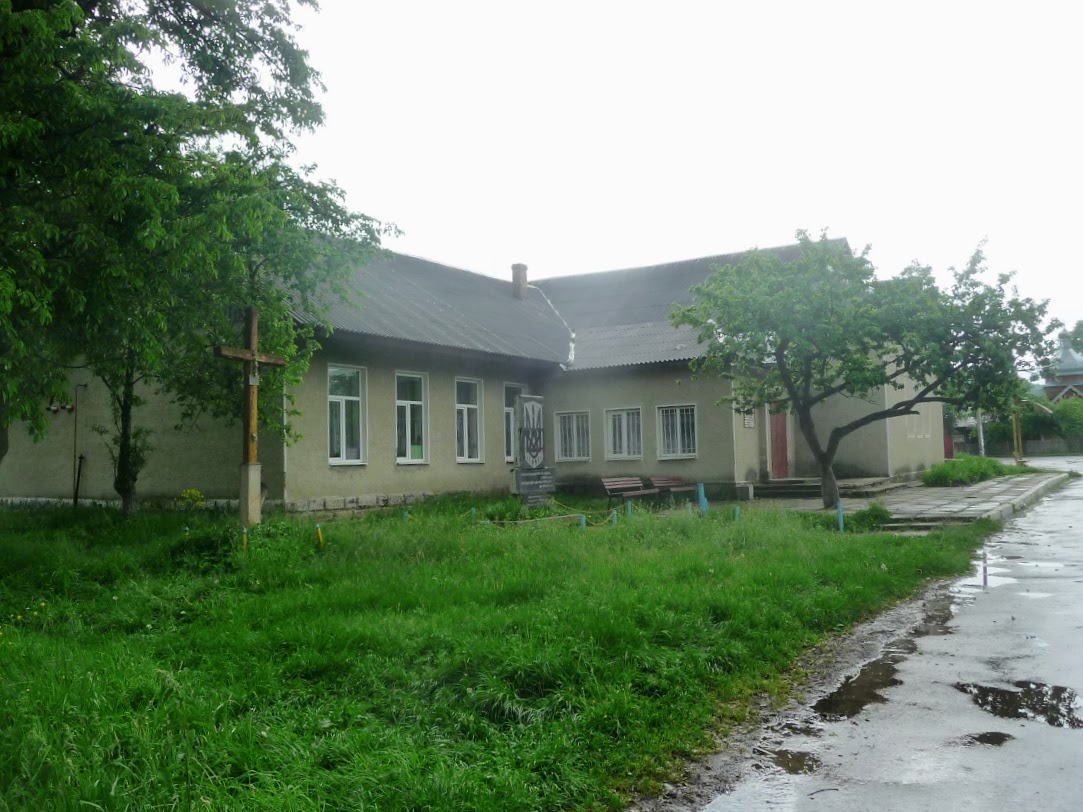
Vyhoda. The village council.
Despite the not-especially-favourable weather, my goal was achieved, and I saw the oldest church in the Dolyna area. I share my wonderful impressions of the trek.
















No comments:
Post a Comment
Leave your impression