 |
| Prosiana. The kaolin quarry |
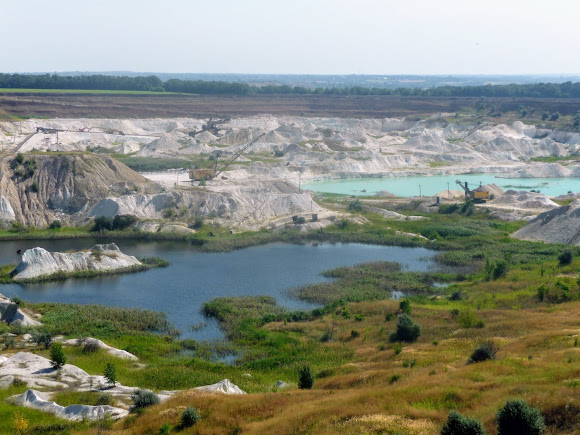
Were it not for the earth-moving machinery, one might think this was a resort town.
 |
| Prosiana. The kaolin quarry |
But this is a kaolin deposit and the industrial extraction of white clay at the Vershyna site in the Dnipropetrovsk region.
The worked-out sections of the quarry have been granted the status of the "Vershyna" landscape reserve, from which I began my walking tour of the Prosiana kaolin deposit.
 |
| The "Vershyna" landscape reserve. A worked-out kaolin quarry |
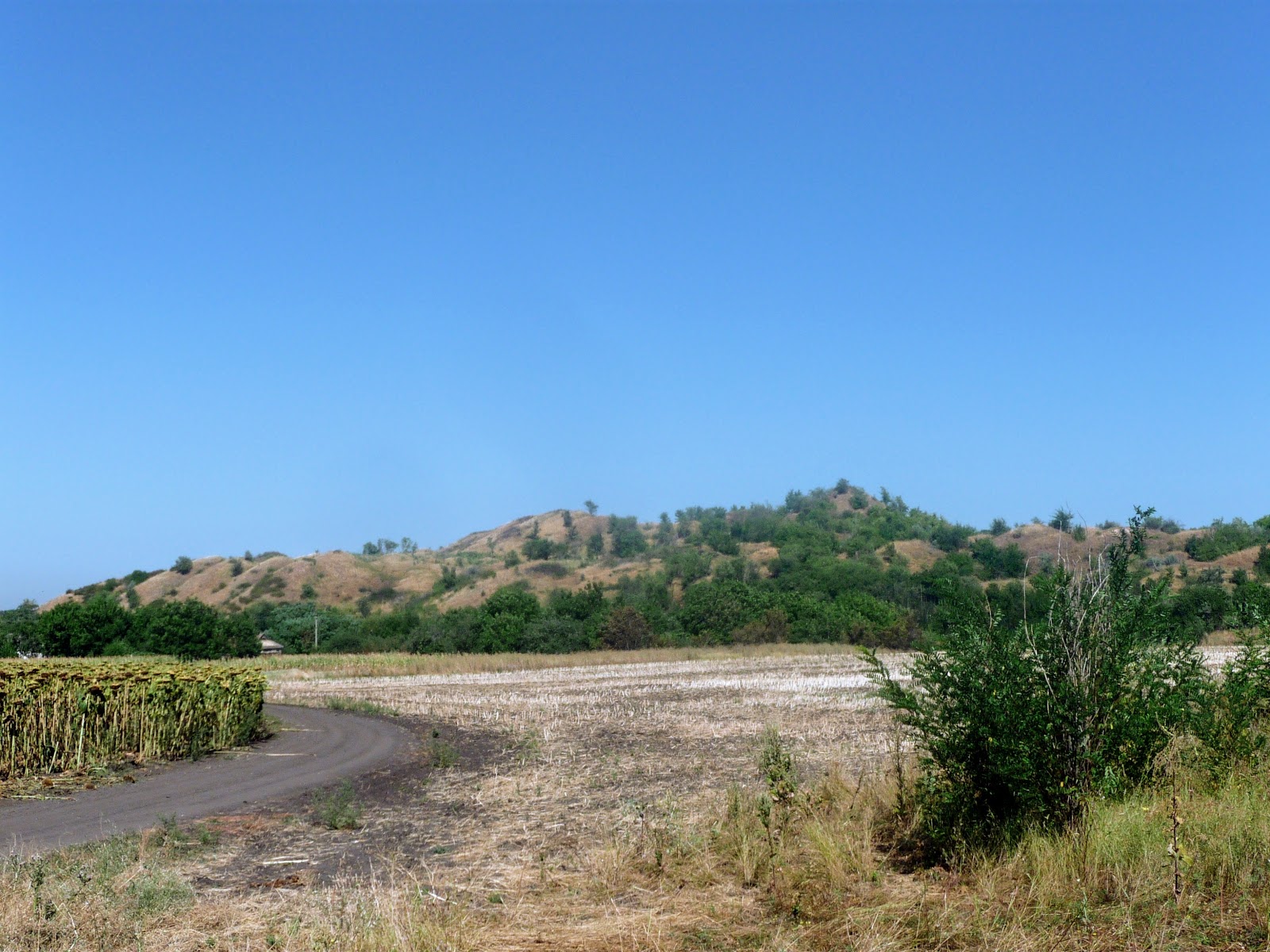
The brown crests of the ridge, overgrown with shrubs and trees — these are the quarry's spoil heaps.
The dirt road that leads from stop point No. 23 to the small village of Otrishky runs between hills of quite considerable height.
Formed as a result of man-made processes, the unusual relief looks incredibly exotic amid the flat steppe zone.
In 1998 the territory of 48.4 hectares was declared a reserve for the preservation of rare, useful and endangered species of plants and animals.
In this way the protection of the steppe's biological resources is carried out.
Of course, even such mountains beckon you to the heavens and call on you to be distracted from the problems of earthly existence.
At the foot of the mountain the peak seems not so unattainable, but the conquest of any summit demands the expenditure of strength.
There turned out to be no paths here at all, and I combed through the dense, prickly vegetation as tall as a person.
Not yet having climbed the first mountain, I spotted a second one and was seized with the wish to visit it as well.
It was a little frightening to walk, because my feet sometimes sank into such little holes.
Perhaps this is the dwelling of jerboas, gophers or other rodents, hidden away from the scorching rays of the sun in the heat. I tried not to think about snakes. The little hill grew ever closer, and the panorama of views ever more alluring.
On the summit a wild pear had grown, with an enormous quantity of fruit.
In the distance the surrounding villages, the quarry, the shelter-belts and the fields could be seen.
Descending is always harder, and the thickets of thistles with their sharp spines at times crossed my progress like a wall.
The prickly guardians of the kaolin mounds tore my hands and legs until they bled.
Looking back one last time at the conquered "Everests", I came out onto the road, on the verge of which, quite recently, lovers of the "swift bonfire" had set light to the dead wood.
In dry and windy weather the fire-hazard situation exceeds the norm, and fire ever more often destroys our green oases, even in this already not very wooded locality.
Here the flames had reached the walnut trees, behind which stands a village homestead.
To cut the corner, I went across a field from which, if I am not mistaken, rapeseed had been harvested.
If there is a little bridge for anglers on a small pond, a former quarry, then it means fish are to be found there too.
Pheasants and other feathered inhabitants of the reed thickets scattered in different directions on seeing a lone traveller amid the half-wild terrain.
And these are the consequences of the subversive activity of the mole rats.
The sunflower has become the main agricultural crop in many regions of Ukraine, drawing all the useful substances out of the fertile black earth.
The seeds will keep filling out for another month.
Getting to the second intended
summit was no easier.
My feet sank into the huge cracks of the dried-out and fissured ground.
Under some silver oleaster tree — an olive, as we call it — I left my bag with spare shoes and a bottle of water, so as not to drag an extra burden on myself.
I had to climb a slope of 45 degrees.
The loose surface would not let me get any grip.
Grabbing hold of anything did not work either. The root system and stems of the plants on the hill are very weak, and no sooner did I take hold of them than they at once tore out by the root or broke.
I recalled the experience of traversing hard-to-reach spots in the Carpathians on the
Dovbush Rocks and at Lake Zhuravlyne, as well as the journey across the barkhans of the
Oleshky Sands.
A final push, and I am on the summit, from which, as a reward for my labours, a wonderful view opened up over the reserve and the working kaolin quarry.
From here the picturesque pond with its angler's bridge and my first "Chomolungma" could be seen as clearly as on the palm of a hand.
A strong wind snatched off my sun hat and carried it in the opposite direction to the one by which I had begun the ascent.
I had to descend by another slope, no less steep.
I caught the hat, but the tree under which I had left the bag with the bottle of water and spare shoes, try as I might, I could not find. The tall grass had hidden the traces of my steps.
And the thickets of thistles blocked my way entirely.
I came out again to the field with the sunflowers.
This is the last unharvested field with a crop; the other lands have already been cultivated.
About 15 minutes later I came up to the open quarry.
This is the only section of the Prosiana deposit being worked at present.
The main characteristic features of kaolin are its refractoriness, plasticity and binding properties. Enriched kaolin clays are used in the production of electrotechnical ceramics, porcelain, faience and ultramarine.
Thanks to its unique qualities, kaolin — an indispensable component in the production of paper, rubber, roofing materials and white cement. White clay is used in cosmetology and medicine as an absorbent and is considered beneficial to the human body.
The mineral was discovered in 1882 by the mine foreman Medvedev. Now extraction is carried out by the open-pit method from a depth of 14 to 23 metres.
The output of the Prosiana kaolin plant is supplied to the countries of the near and far abroad. It is kaolin that gives the water its striking turquoise colour, but the bottom of the quarry is clayey and viscous, so bathing in such places is strictly forbidden. In the rays of the bright sun the place looks fairy-tale-like and romantic.
I would have had to walk no less than 7 kilometres to Prosiana station under the scorching sun and without a drop of water. To my good fortune, a car was passing — something not very often met on a dirt track in the back of beyond. A young family was returning from Chaplyne, and the kind people offered to give me a lift right to the station.
 |
| Prosiana. The railway station. Wagons with kaolin |
 |
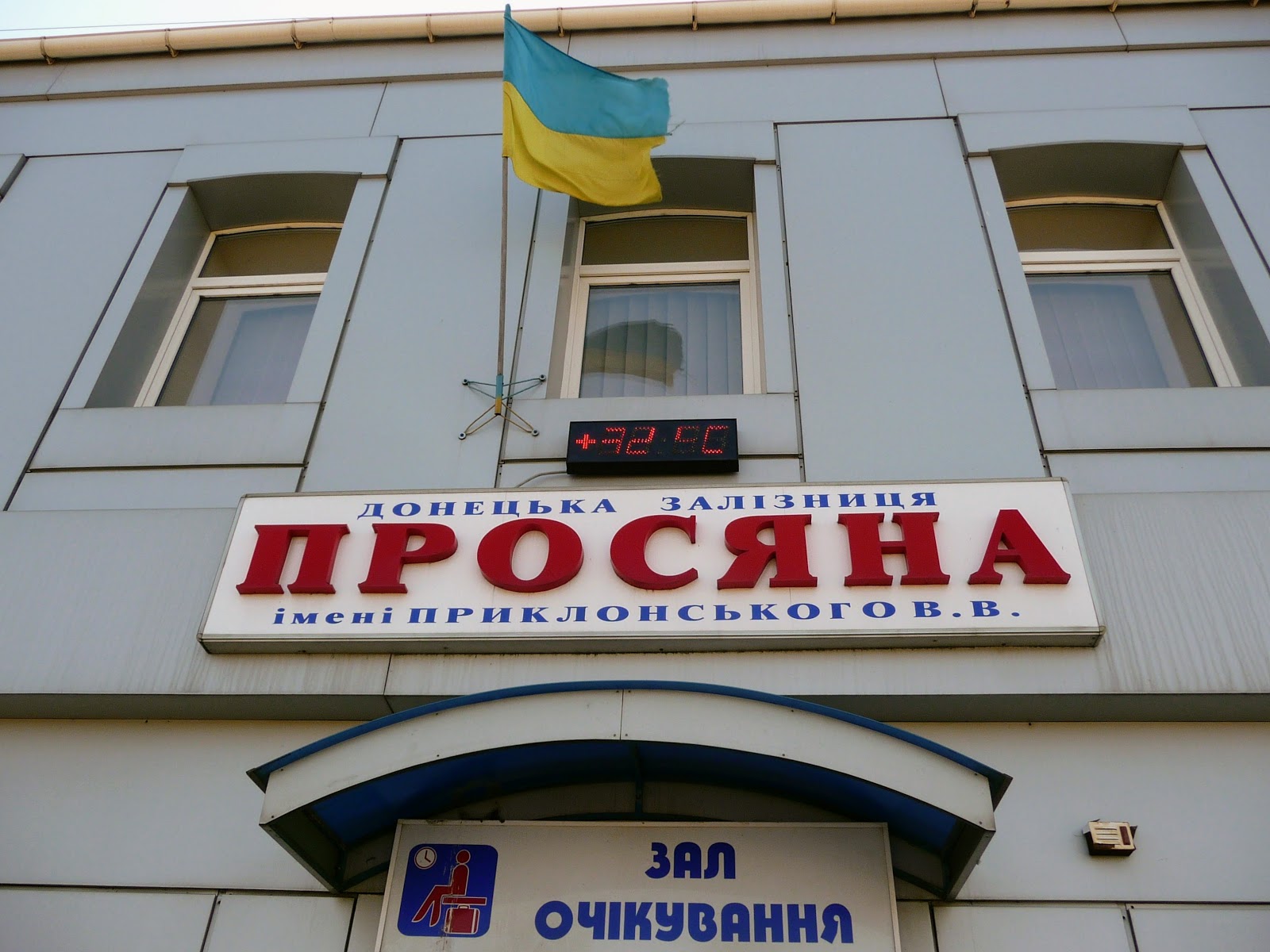
| Prosiana. The railway station. On the display, +32 degrees |
I still had a little time before the electric train, and I made a small circuit of the settlement, to get an idea of where the workers of the largest kaolin plant in Europe live.
 |
| The railway building. Stone masonry |
 |
| The railway building. Stone masonry |
 |
| The railway station named after Pryklonsky, a former head of the Donetsk Railway. A memorial sign |
 |
| Prosiana. The grain elevator |
The tour turned out to be interesting and instructive, and I share my impressions with you.
 |
| Prosiana. The railway station |






No comments:
Post a Comment
Leave your impression