I went to Verkhni Hai, in the Drohobych district of the Lviv region, to see the wooden Church of the Holy Trinity.
 |
| Verkhni Hai. The Church of the Holy Trinity. 1910. |
Archaeological finds attest that people settled here as far back as the times of the primitive communal system. Later the locality belonged to the Principality of Galicia and the Principality of Galicia-Volhynia. The written mention of the village dates from 1409, when the Polish king Wladyslaw II Jagiello granted the lands to Stanislav Korytko.
 |
| Verkhni Hai. Drohobych district. Lviv region |
There is no Catholic community in the village now, and the former Roman Catholic church, consecrated in honour of the greatly revered Mother of God of Perpetual Help, belongs to the Greek Catholics.
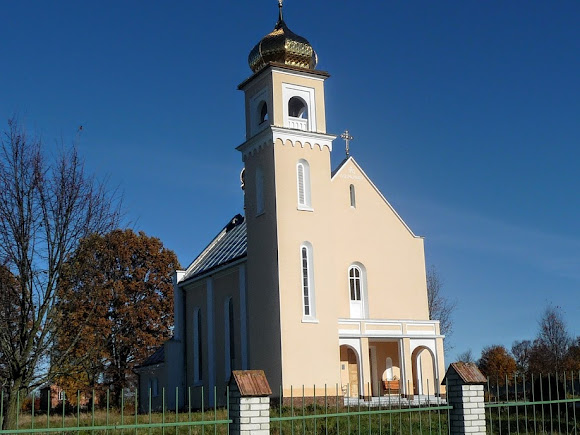 |
| The Church of the Mother of God of Perpetual Help. The former Roman Catholic church |
 |
| The Church of the Mother of God of Perpetual Help. The former Roman Catholic church |
The village turned out to be utterly deserted; there was no one to ask how best to go. You can take the long street, or you can go by the shorter path, cutting the corner, which I always do. This district of the village is called Potik. Evidently not by chance, since I had to cross the Liutychyna river — or perhaps this little stream is called the Liutychynka. In autumn it is a small brook, over which boards and stones have been thrown. And the banks are slippery and steep, overgrown with tall grass. Probably few people walk here, for afterwards I made my way without a path through the thickets.
Soon I came out onto a road, and after about 600 metres I saw the church. From here a wonderful view opened up; you could admire the surroundings and the line of the horizon, which passed smoothly into a dark blue-green strip, and the Carpathian mountains seemed close by.
 |
| Verkhni Hai. Shkilna Street |
The gaze takes in the forest tracts of Prykarpattia, already touched by the October frost. Not for nothing is this village named Verkhni Hai (Upper Groves); there is also Nyzhni Hai (Lower Groves), because it lies lower down the course of the Liutychyna. Not every town has its own coat of arms and flag. On the coat of arms and flag of the village — a stylised depiction of oaks, firs and ears of wheat.
 |
| Verkhni Hai. The coat of arms of the village |
 |
| Verkhni Hai. The flag of the village |
By the entrance to the church stood a bicycle, and a man came out to meet me, of whom I asked whether one might go in.
 |
| The Church of the Most Holy Mother of God. 1990. |
"Of course you may! Come in, madam!" — the villager opened the door before me. He told me about the church, consecrated in 1990 in honour of the Nativity of the Most Holy Mother of God.
 |
| The Church of the Most Holy Mother of God. 1990. |
There are few Orthodox parishioners in the village, and in general the number of inhabitants is not growing; everyone is moving to the town.
 |
| The Church of the Most Holy Mother of God. 1990. |
The population is about a thousand people. In a big city — that is three buildings, while in Verkhni Hai — 320.
 |
| The Church of the Most Holy Mother of God. 1990. |
The next stop was by the village school, surrounded by a fruit orchard. On the trees the last little apples were still reddening. In the town they would long since have been picked, but the village children have branches breaking under the weight at home too.
 |
| The school. The orchard |
On the roof of the old school, which houses the workshops for labour lessons and the canteen, workmen were repairing the roofing, getting ready for winter. On the facade the figures "1935" have survived.
 |
| The old pre-war school. 1935. |
Before the beginning of the Second World War the village was part of the Neudorf gmina, with its centre in the village of Neudorf, which is now
Nove Selo. A typical village centre — a village council, a People's House, an outpatient clinic, little shops. In Verkhni Hai amateur arts activity has not died down; the circles are active.
 |
| Verkhni Hai. The village council |
And in the village council building there is a library with free internet, as stated in a notice. Beside the administration building, in 2009, the villagers set up a modest memorial sign for the village's 600th anniversary.
 |
| The memorial sign for the village's 600th anniversary |
Having walked another 300 metres along Sadova Street, I at last saw the wooden Church of the Holy Trinity.
 |
| The Church of the Holy Trinity. 1910. |
The church is first mentioned in 1589; it was probably more than a few hundred years old when the present one was built in its place in 1910. In Soviet times the shrine was closed for about 30 years, and a village museum was housed in it.
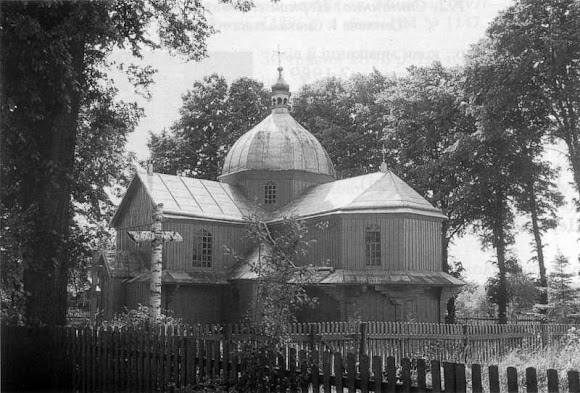 |
| The Church of the Holy Trinity before the repair. 1910. |
For the church's centenary the parishioners prepared thoroughly, covering it and the bell tower with clapboard and metal domes.
 |
| The Church of the Holy Trinity. The bell tower. 1910. |
They cleared the grounds and cut down the trees. The Euro-fashionably spruced-up church marked its hundred-year anniversary.
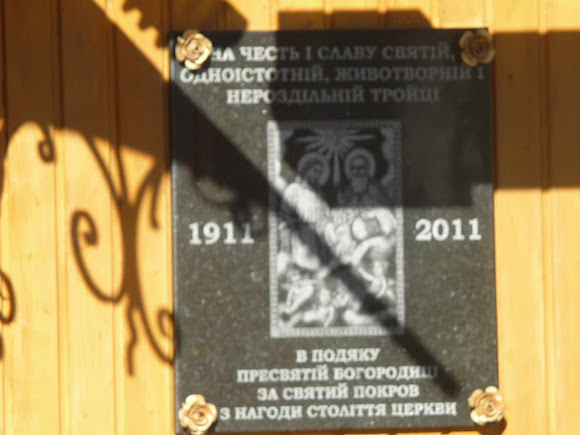 |
| The Church of the Holy Trinity. The memorial plaque |
To my regret, I could not get into the churchyard; the wicket in the new wrought-iron fence was firmly shut, which very rarely happens. It is also impossible to walk around the church grounds, since the village homesteads are very close on all sides. Through the fence I photographed the church and the symbolic grave of the Fighters for the Freedom of Ukraine with its cross.
 |
| The symbolic grave of the Fighters for the Freedom of Ukraine. A birch cross |
A little disappointed, I set off for the centre to look for the bus stop. Along the southern edge of the village runs the railway; there is a station, and suburban trains stop here, heading to
Stryi,
Lviv,
Drohobych,
Sambir.
 |
| The railway station. The station building |
The bus did not keep me waiting long. I saw one more Subcarpathian village, became acquainted with its history, and I share my impressions with you.


No comments:
Post a Comment
Leave your impression