The Church of the Intercession of the Most Holy Mother of God is a working church on the grounds of the
museum of folk architecture and life in Pyrohiv. In 1974 the shrine was brought to
Kyiv from Zakarpattia to the newly created skansen, and the almost two-hundred-year-old church became an exhibit that drew both believers and tourists, who came to admire the flawless beauty of this masterpiece of wooden architecture and to touch the history of prayer and service.
 |
Pyrohiv. Museum of Folk Architecture and Life. The Church of the Intercession of the Most Holy Mother of God. 1792
|
The three-domed structure is one of the finest examples of the Lemko school of folk monumental architecture of the 18th century, and one of only two preserved on the territory of Ukraine. Since 1999, with the formation of a community, services have been held in the ancient church on Sundays and feast days.
 |
| The iconostasis and church furnishings. The Church of the Intercession of the Most Holy Mother of God. 1792 |
Researchers have written many articles about the church, and its photographs can often be seen on various media outlets and social networks.

And once, the wooden church became unneeded by its own community. It was built in 1792 amid the Carpathian mountains, beech forests and crystal-clear streams in the village of Ploske, the largest settlement in the district, with 76 inhabitants. The length of the building is 11.3 metres, the width 5.85 m. On the log frame the inscription "Year of the Lord 1792" has survived. The monumental structure of three rectangular log frames in the shape of an octagon is crowned by a tower and Baroque cupolas. The church is clad with small boards and covered with shingle — a roofing material in the form of wooden plates. History has not left us the names of the builders, but the high standard of the work tells us that they were connoisseurs of proportion and material, and jacks of all trades. The folk craftsmen passed on the subtleties of their craft as an inheritance, and these are still used by first-class builders of wooden sacred structures from Western Ukraine. A school was opened at the church, and religious life increased the number of villagers. After 135 years, in 1927, the church faced the fate of a migrant, like other Lemko kin. The parish decided to sell the old church and, with the proceeds, build a stone replacement. Having dismantled the creation made of logs 55-65 centimetres wide, they carried it by sledge to Svalyava, and from there by rail to the village of Kanora near Volovets.
 |
| Pyrohiv. Museum of Folk Architecture and Life. The Church of the Intercession of the Most Holy Mother of God. 1792 |
At the new site, next to the house of prayer, a wooden bell tower was erected. During the campaign against religion, in 1953, the church was struck off the register and removed from the lists of working churches. The building declined and fell into ruin through neglect and mismanagement. What saved this architectural pearl of the Zakarpattia region was the opening in Kyiv of an open-air museum, home to the largest collection of wooden churches in Ukraine. The wooden beauty, taken apart into its component pieces, was transported to the capital and carefully reassembled like a construction set. Today it is the architectural dominant of the "Zakarpattia" sector.
 |
| The wooden Lemko church of 1792 |
And what of the ancestral home of this wooden celebrity — is there a church in Ploske now? The village lies in the valley of the Velyka Pynia River, into which hundreds of streams pour from the mountain peaks.
 |
| The villages of Ploske and Pavlove, Svalyava district, Zakarpattia region |
 |
| The village of Ploske. A bridge over the Velyka Pynia River |
The settlement has its own coat of arms and flag depicting a fish and the sun. These symbols of a sunny, fish-rich land appeared on Ploske's seal in 1844.
 |
| The village of Ploske. Coat of arms and flag |
An asphalt road runs through the village, linking it with the district centre,
Perechyn and
Uzhhorod. The village administration occupies a two-storey building, which also houses the post office. For a population of 1,000, it is a very respectable village-council building.
 |
| The village of Ploske. The village council |
The expanses of Ukraine's green wealth around the village are the holdings of the Svalyava forestry enterprise. The administrative building of the Ploske forestry unit is done in the Hutsul style.
 |
| The administration of the Ploske forestry unit |
In the traditions of Zakarpattia architecture, a three-storey school was built in the 1990s, where children from all the surrounding mountain villages study. The building's facade is adorned with touching lines addressed to Mother Ukraine.
 |
| The village of Ploske. The school |
In the schoolyard stands a gilded sculpture of the Kobzar. Monuments to T. H. Shevchenko in Zakarpattia are not found in every village, nor even in every town — unlike in Prykarpattia.
 |
| The village of Ploske. The school. Monument to T. H. Shevchenko |
In the small village club, the windows have been framed in plastic and the roof repaired.
 |
| The village of Ploske. The House of Culture |
This cultural hub was presented to the villagers in 1967 for the 50th anniversary of the October Revolution. The notable event was recorded on a memorial plaque.
 |
| The House of Culture. A memorial plaque |
The fellow villagers who died in the Second World War, and the liberation of the village from the Nazis in 1944, have likewise not been forgotten by their descendants.
 |
| A memorial sign to the fellow-villager soldiers |
 |
| A memorial plaque about the liberation of the village |
In the centre of the village there are three shops, a hairdresser's and a bus stop.
 |
| The village of Ploske. A shop |
And at the very core, where the village streets converge like mountain streams, rises the main landmark — a stone successor to its progenitor, famous throughout the country.
 |
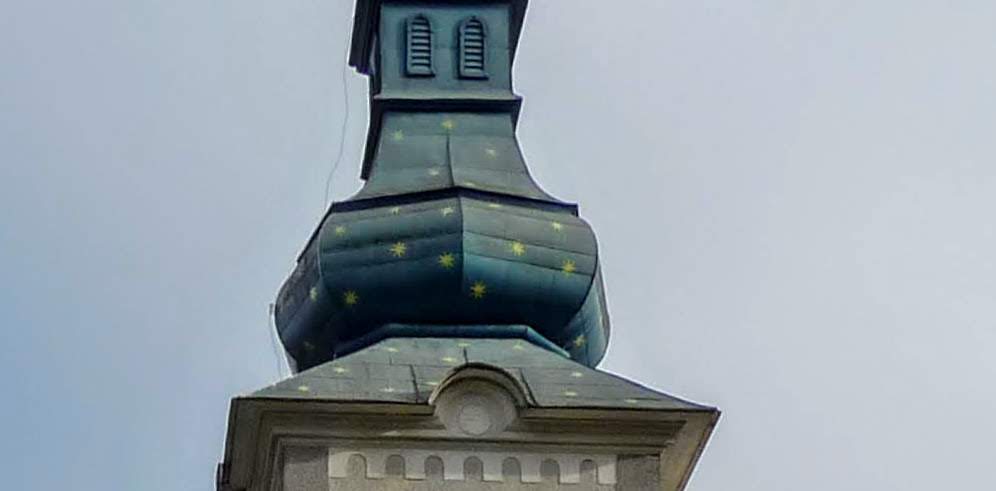
| The village of Ploske. The Church of the Intercession of the Most Holy Mother of God. 1928 |
The Holy Intercession Church was built during 1925-1928 to the design of the well-known architect Mykhailo Bilak.
 |
| The Church of the Intercession of the Most Holy Mother of God. 1928 |
The service is announced by three bells — two cast in 1923 and one in 1930. In the churchyard stand memorial crosses and a figure of the Mother of God.
Besides the Orthodox church, the village has a Greek Catholic church, but no past achievement in wooden folk building has been found in Ploske. The nearest monument of wooden architecture, the
St Michael's Church of 1588, can be seen in
Svalyava in the suburb of Bystryi, twenty kilometres from Ploske.
Coordinates of the Holy Intercession Church in Ploske: 48°39’29"N 22°53’55"E
Coordinates of the Church of the Intercession of the Most Holy Mother of God at the Museum of Folk Architecture and Life in Pyrohiv: 50°21’38"N 30°31’3"E




No comments:
Post a Comment
Leave your impression