The Museum of Folk Architecture and Life in Pyrohiv is the largest in Eastern Europe. This open-air museum occupies an area of over 300 hectares in a picturesque spot in the southern part of
Kyiv.
 |
| Kyiv. Pyrohiv. The Museum of Folk Architecture and Life. The "Podillia" exposition |
Its grounds hold over 300 genuine structures, brought from various regions of Ukraine.
 |
| Pyrohiv. The museum. A house of the 18th c. Luhy village, Chechelnyk district, Vinnytsia region. |
 |
| Pyrohiv. The museum. The "Middle Naddniprianshchyna" exposition |
In the course of a single walk you can visit the country's main historical and geographical regions and get acquainted with expositions of homesteads,
wooden churches, of craft and musical instruments, household objects and clothing.
 |
| The Museum of Folk Architecture and Life. The "Bukovyna" exposition |
 |
| Pyrohiv. The museum. The "Slobozhanshchyna" exposition |
 |
| Pyrohiv. The museum. The "Polissia" exposition |
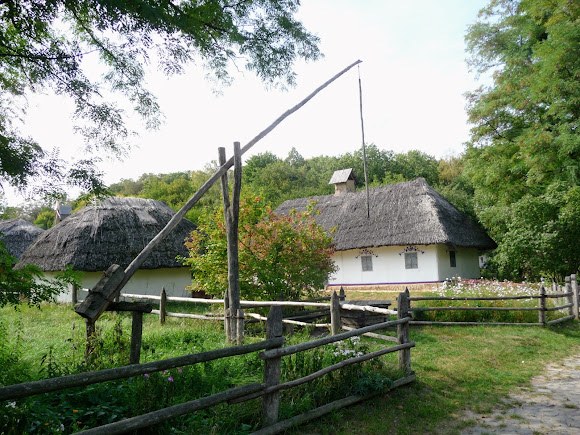 |
| Pyrohiv. The museum. The "Podillia" exposition |
 |
| Kyiv. Pyrohiv. The Museum of Folk Architecture and Life |
On a separate glade of
windmills stand the largest artefacts, huge giant-labourers that cleave the sky with their wings.
 |
| Pyrohiv. The Museum of Folk Architecture and Life. Wooden windmills |
In the northern part of the open-air museum, our picturesque Carpathians are represented in three expositions: Prykarpattia, Zakarpattia and Bukovyna.
 |
| The "Prykarpattia" exposition |
 |
| Pyrohiv. The Museum of Folk Architecture and Life. The "Prykarpattia" exposition |
Amid cliffs, gorges, waterfalls and mountain rivers, the houses of the Ivano-Frankivsk area were built on a stone foundation of wooden logs and covered with shingles, small wooden boards.
 |
| The "Prykarpattia" exposition |
The grazhda, a multifunctional log building of two yards with a cellar, a shed and a storehouse, belonged to the headman of the village of Verkhovyna in the Ivano-Frankivsk region.
 |
| A grazhda, Verkhovyna village, Ivano-Frankivsk region. |
 |
| A grazhda, Verkhovyna village, Ivano-Frankivsk region. |
The bukhnia house is a small dwelling with a roof left unfinished on one side. The owner of this typical Hutsul structure from the village of Shepit in the Kosiv district was a hunter. Weapons, animal skins and other trophies are gathered in the house of the daring huntsman.
 |
| Pyrohiv. The museum. A bukhnia house, Shepit village, Kosiv district, Ivano-Frankivsk region. |
 |
| A bukhnia house, Shepit village, Kosiv district, Ivano-Frankivsk region. |
At the village homesteads the museum staff introduce visitors to folk crafts and applied artistic work. There is much to learn here, to take part in the creative process and to buy souvenirs like those our ancestors knew how to make from materials close at hand.
 |
| A bukhnia house, Shepit village, Kosiv district, Ivano-Frankivsk region. |
Three houses at once moved here from the Mizhhiria district of the Zakarpattia region.
 |
| A house, Roztoky village, Mizhhiria district, Zakarpattia region. |
The oldest dates from 1807, yet it looks like a sturdy structure.
 |
| A house, 1807. Synevyrska Poliana village, Mizhhiria district, Zakarpattia region. |
The entrance to the house built in 1841, from the village of Rekity in the Zakarpattia region, is decorated with wood carving. Above the door, as talismans, are carved crosses, a sun and other Christian symbols.
 |
| A house, 1841. Rekity village, Mizhhiria district, Zakarpattia region. |
 |
| A house, 1841. Rekity village, Mizhhiria district, Zakarpattia region. |
A water mill served people in this same district, in the village of Pylypets.
 |
| A water mill, Pylypets village, Mizhhiria district, Zakarpattia region. |
 |
| A water mill, Pylypets village, Mizhhiria district, Zakarpattia region. |
The owners tried to adorn their dwellings, and some houses are whitewashed or picked out with paint.
 |
| The Museum of Folk Architecture and Life. The "Zakarpattia" exposition |
A house from the village of Tereblia in the Khust district marked its 300th anniversary. Its last owner was a molfar, who knew how to disperse clouds, control the weather and heal with spells.
 |
| The molfar's house, 1718. Tereblia village, Khust district, Zakarpattia region. |
 |
| The interior of the molfar's house |
The homestead is completed by outbuildings and a crane well, the upper part of which is hewn from oak. Water was drawn with the help of a lever mechanism, with a bucket hung on the longer arm.
 |
| A storehouse, Tereblia village, Khust district, Zakarpattia region. |
 |
| A homestead, Tereblia village, Khust district, Zakarpattia region. |
 |
| A homestead, Tereblia village, Khust district, Zakarpattia region. |
 |
| A crane well, Zakarpattia region. |
The land of the red rue — Bukovyna — is represented by buildings from the Vyzhnytsia and Storozhynets districts.
 |
| A house, Korytne village, Vyzhnytsia district, Chernivtsi region. |
 |
| A storehouse, Vyzhnytsia district, Chernivtsi region. |
 |
| A house, Velykyi Kuchuriv village, Storozhynets district, Chernivtsi region. |
 |
| A house covered with shingles |
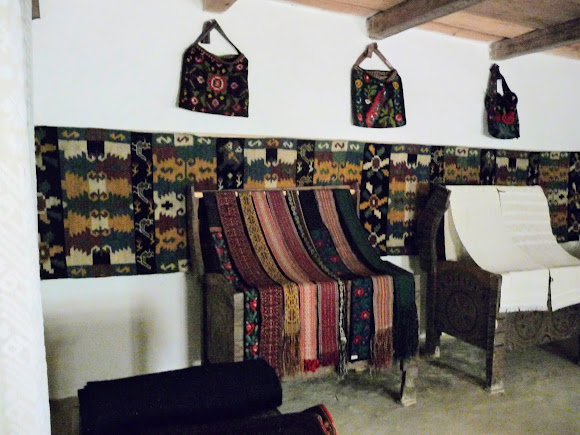 |
| A house, Velykyi Kuchuriv village, Storozhynets district, Chernivtsi region. The interior |
In the house from the village of Lomachyntsi in the Sokyriany district, people knew how to grow grain, thresh corn and weave cloth from sheep's wool. In this house-mill, mechanisms for threshing grain and producing cloth are set up in the entrance hall. The wheel was set in motion by the energy of a mountain river, whose water came down along chutes.
 |
| A house-mill, Lomachyntsi village, Sokyriany district, Chernivtsi region. |
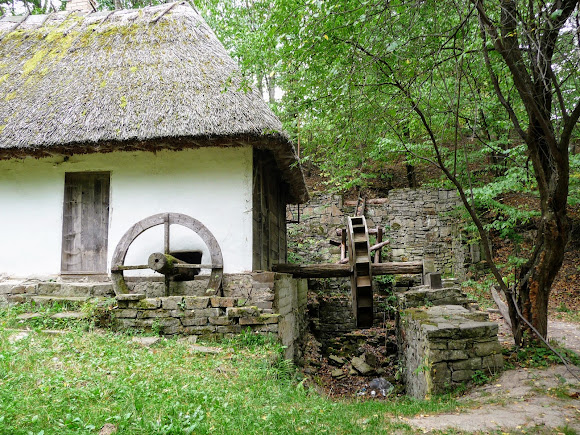 |
| A house-mill, Lomachyntsi village, Sokyriany district, Chernivtsi region. |
What colourful houses are on show in the ethnographic zone "Podillia"!
 |
| The Museum of Folk Architecture and Life. The "Podillia" exposition |
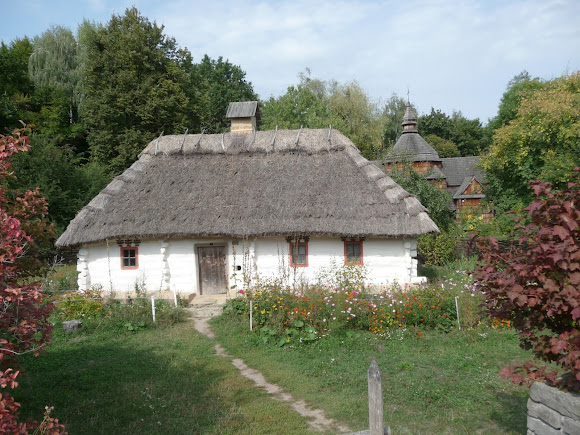 |
| A house of the 18th c. Luhy village, Chechelnyk district, Vinnytsia region. |
 |
| A house of the 18th c. Luhy village, Chechelnyk district, Vinnytsia region. |
 |
| A house, Puzhaikove village, Balta district, Odesa region. |
 |
| A house, Puzhaikove village, Balta district, Odesa region. |
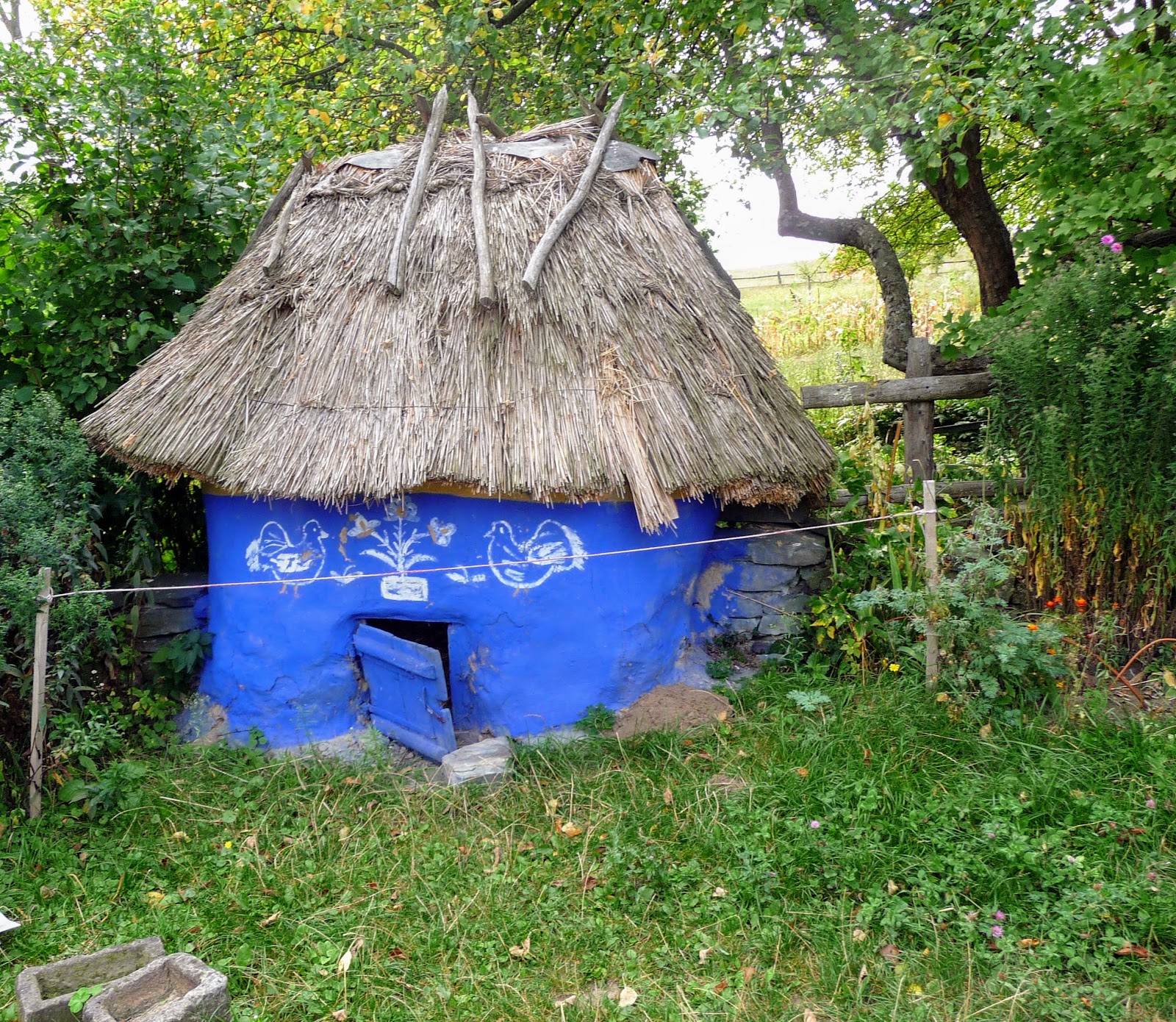
In Kadyivtsi in the Kamianets-Podilskyi district of the Khmelnytskyi region, people loved to paint the walls, doors, stove, dishes and furniture. From the designs, in which a flower is always present — a symbol of love, spring, perfection and beauty — one can judge that happy and beautiful people lived in these houses.
 |
| A house, 1892. Kadyivtsi village, Kamianets-Podilskyi district, Khmelnytskyi region. |
 |
| A chicken coop, Kadyivtsi village, Kamianets-Podilskyi district, Khmelnytskyi region. |
 |
| A house, 1892. Kadyivtsi village, Kamianets-Podilskyi district, Khmelnytskyi region. |
In different regions the walls and roof coverings differ in material and technique. In the village of Borsuky in the Nova Ushytsia district of the Khmelnytskyi region, the roof was covered from the eaves upwards with sheaves of ears of corn. The walls are put together from oak boards between dug-in posts and plastered with yellow clay, while the frame stands out with its white colouring.
 |
| A house, 1900, Borsuky village, Nova Ushytsia district, Khmelnytskyi region. |
The oldest structure of the open-air museum is in the ethnographic region of Polissia.
 |
| The "Polissia" exposition. A cross |
 |
| The "Polissia" exposition |
 |
| The "Polissia" exposition |
The house in the village of Samary in the Ratne district of the Volyn region was built at the end of the 16th century.
 |
| A house, 1587, Samary village, Ratne district, Volyn region. |
 |
| The oldest building of the open-air museum |
In Volyn the European tradition of building enclosed yards took root, where residential and farm premises stand around the perimeter of a square structure, and in the middle is a yard with a cart.
 |
| An enclosed yard, Solovi village, Stara Vyzhivka district, Volyn region. |
By the house from the village of Bekhy in the Korosten district of the Zhytomyr region, an improvised apiary has been created, in which the log hives are made from a wooden log with a hollowed-out core. Beekeeping is one of the most widespread crafts of the Polissia land.
 |
| A house of the 18th-19th c., Bekhy village, Korosten district, Zhytomyr region. |
 |
| Pyrohiv. The Museum of Folk Architecture and Life. An apiary |
The bread-growing land gave the museum a storehouse, one part of which is a warehouse and the other a horse-driven threshing machine.
 |
| The "Polissia" exposition. A warehouse and a threshing machine |
Slobozhanshchyna presents a house from the village of Popivka in the Kreminna district of the Luhansk region. The yards in this area were divided into a "clean" one and a "farm" one.
 |
| A house, Popivka village, Kreminna district, Luhansk region. |
 |
| A storehouse, Bilokurakyne district, Luhansk region. |
As if out of a Gogol tale, six homesteads at once formed their own little khutir.
 |
| A house of the 19th c., Revazivka village, Novi Sanzhary district, Poltava region. |
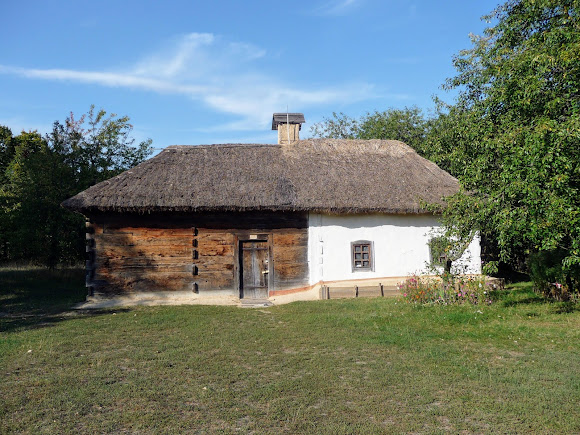 |
| A house of the 19th c., Bobrovnyk village, Zinkiv district, Poltava region. |
The mistress of the house from the village of Popivka in the Zinkiv district wove white linen and embroidered rushnyky (towels) with red threads, which symbolise love, the continuity of the family line and passion.
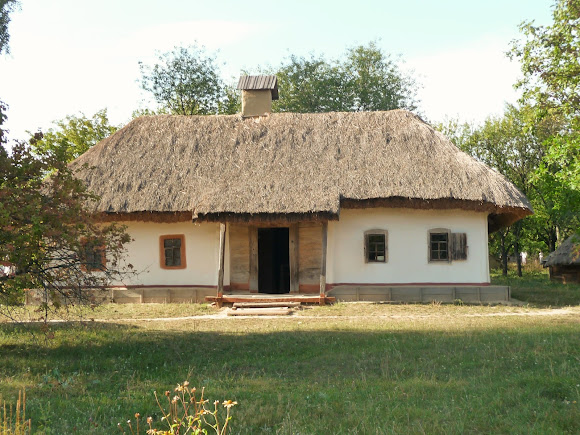 |
| A house of the 19th c., Popivka village, Zinkiv district, Poltava region. |
 |
| The interior of the house |
 |
| A house of the 19th c., Popivka village, Zinkiv district, Poltava region. |
In every house in Ukraine, holy images always hung in the icon corner (pokut), decorated with rushnyky embroidered especially for this purpose. On entering the house one had to cross oneself and bow to the icons.
 |
| A house of the 19th c., Popivka village, Zinkiv district, Poltava region. |
In the village of Kuntseve in the Novi Sanzhary district at the end of the 19th century, houses were built in two halves and whitewashed with lime, so that the dwelling would look neat.
 |
| A peasant grain-grower's house, 19th c., Kuntseve village, Novi Sanzhary district, Poltava region. |
The lands in the valley of Ukraine's main river, the Dnipro, were called Podniprovia. This historical region shows off a rarity — a parish school from the village of Liutasheve in the Talne district of the Cherkasy region. In this 19th-century school you can sit at a desk, see teaching aids and even the birch rods whose use against negligent schoolchildren was permitted by the board of trustees.
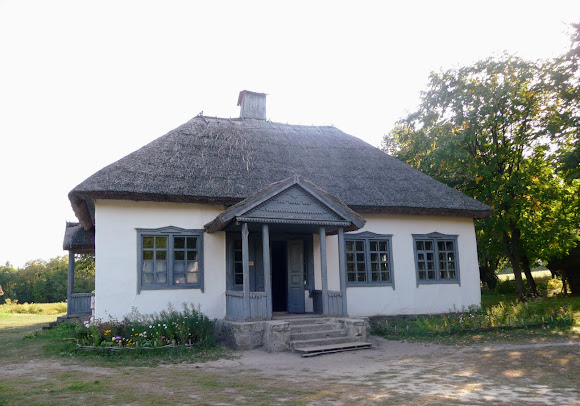 |
| A school of the 19th c., Liutasheve village, Talne district, Cherkasy region. |
 |
| A classroom |
A unique exhibit is the house from the Cherkasy region, the homeland of T. H. Shevchenko, which belonged to his relatives.
 |
| The house of T. H. Shevchenko's relatives, 19th c., Cherkasy region. |
Festive events, folk ethnographic performances, student initiations, wedding ceremonies and other memorable occasions are held regularly on the museum grounds.
 |
| Kyiv. Pyrohiv. The Museum of Folk Architecture and Life. Festive events |
To see the living fairy tale in Pyrohiv, you can travel by:
• from the "Lybidska" metro station — Trolleybus No. 11
• from Besarabka Market — Minibus No. 156
• from Leninhradska Square, the "Druzhby Narodiv" metro station — Minibus No. 172
• from the "Akademmistechko" metro station — Minibus No. 576
• from the "Lukianivska" metro station — Minibus No. 496
 |
| The Museum of Folk Architecture and Life. The "Podillia" exposition |
The museum is open from 10:00 to 18:00. The day off is Wednesday.
 |
| Kyiv. Pyrohiv. The Museum of Folk Architecture and Life |
Coordinates:
50°21’12"N 30°30’36"E




No comments:
Post a Comment
Leave your impression