Zolotonosha is a city founded in the middle of the 16th century and located 30 kilometres from Cherkasy. This district centre of Cherkasy region cannot be called popular among tourists, but for lovers of strolls along the old streets of a county town there is plenty here to feed on.
A fascinating journey from the regional centre begins with the crossing of the Dnipro and the Kremenchuk Reservoir over a metal bridge and the longest concrete-and-earth dam in Ukraine, 13 km long.
The architectural dominant and main church of the city — the Holy Dormition Cathedral — has three altars: the main one, the Dormition; the right one, in honour of the Holy Trinity; the left one, in the name of St. Nicholas.
Built at the beginning of the 20th century on the site of a burned-down wooden church of the 17th century, the cathedral became one of the largest religious buildings of Central Ukraine.
The central street is named in honour of the national poet Taras Shevchenko, who visited Zolotonosha in 1845.
The pre-revolutionary buildings were supplemented by post-war ones. The two-storey buildings erected at the beginning of the 20th century belonged to merchants and entrepreneurs.
Shevchenko Street. Commercial buildings
The merchants of the last century, who left their initials and the dates of construction on the facades, opened shops, pharmacies and banks on the ground floors, while the upper floors held residential premises.
Initials and dates of construction on the facades of the buildings
Not every city can boast its own talented architect, to whose designs beautiful buildings were built within a few years. The town planner A. F. Balavensky created a whole complex of zemstvo institutions that can be called the architectural pearls of Zolotonosha.
Sadovyi Avenue, 3. Education department of the district administration
The boys' gymnasium on Sadovyi Avenue was completed by many famous people, including the Ukrainian writer Semen Skliarenko.
Sadovyi Avenue, 10. Former boys' gymnasium. 1910. Centre for Children's and Youth Creativity
During the years of the Hitlerite occupation, the Germans burned down the building built in 1910. After its restoration, the centre for children's and youth creativity was housed in it.
Sadovyi Avenue, 10. Former boys' gymnasium. 1910. Centre for Children's and Youth Creativity
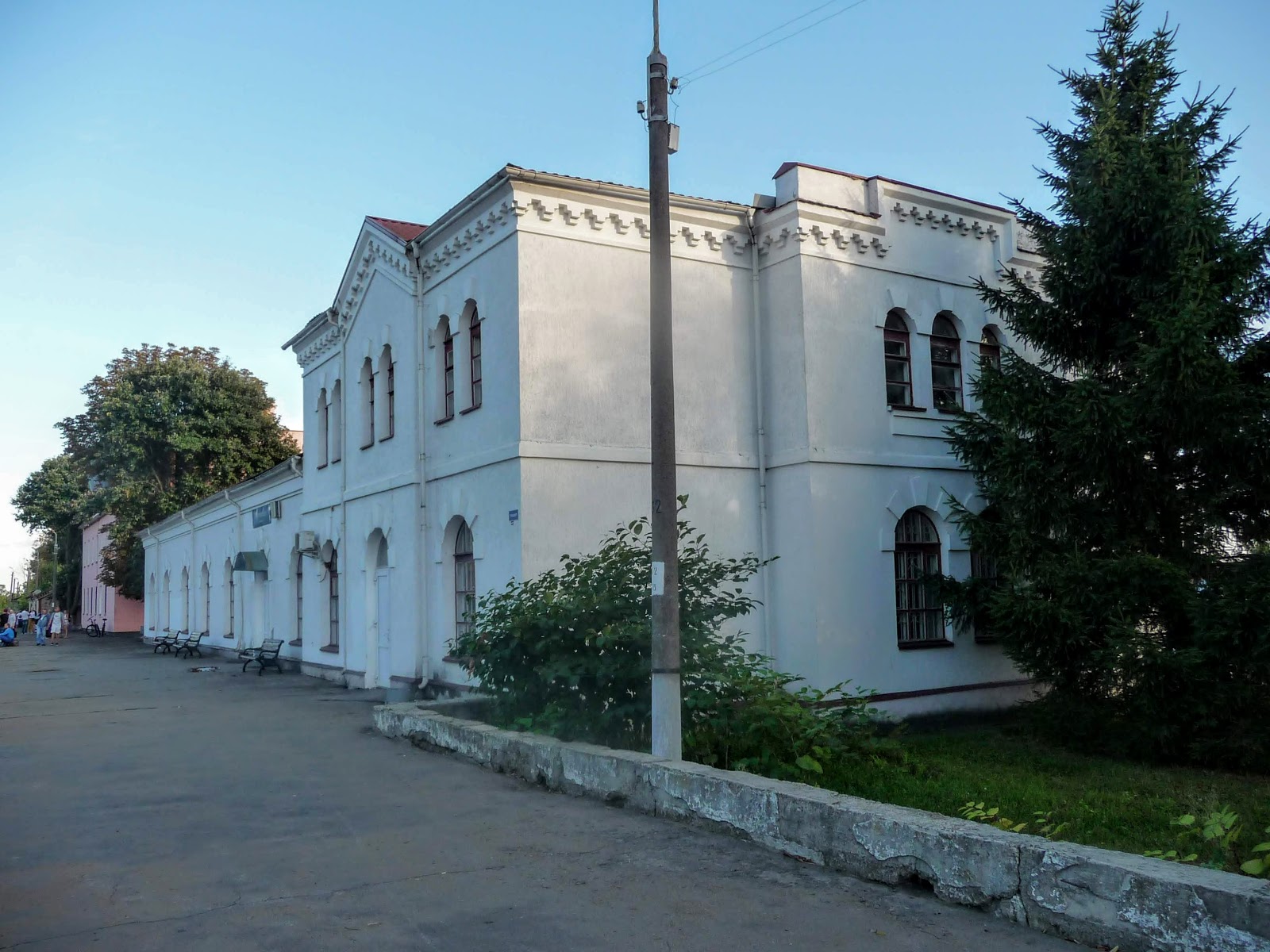
The girls' gymnasium appeared in Zolotonosha eight years earlier than the boys' one, but in size it yields a little to its successor. During the war the occupiers chose the building to set up a gendarmerie. Now the educational purpose of the building has not been lost, and it houses the technical school of Ukrzaliznytsia.
Cherkaska Street, 14. Former girls' gymnasium. 1902. Technical school of Ukrzaliznytsia
Another teaching building for the training of railway workers was built in the 1950s, but it too is not without traditional decorations — semicircular windows.
Shevchenko Street. Technical school of Ukrzaliznytsia. Teaching and amenity building
Since 1911, local administrative institutions have been located at 5 Sadovyi Avenue.
Sadovyi Avenue, 5. Former zemstvo council. Architect Balavensky. District administration
On the facade of the district council and city council buildings are the coats of arms of Zolotonosha in the form of a Cossack cross, symbolising Cossack glory.
Sadovyi Avenue, 8. City administration
Sadovyi Avenue, 5. Former zemstvo council. District administration
In the historic centre, which can be walked round in an hour or an hour and a half, you will come across one- and two-storey pre-revolutionary mansions.
Sichova Street. Residential building
Cherkaska Street. Residential buildings
On some, figures indicating the date of construction have been preserved.
Sadovyi Avenue, 9. Printing house
Institutions are located in the brick buildings.
Nezalezhnosti Street, 15. Centre for Administrative Services and the Bureau of Technical Inventory
On Cherkaska Street, at 20, in a building with brick trim, a local history museum has been opened.
Cherkaska Street, 20. Local history museum
Unfortunately, the arch-gateway was not preserved by time and people.
Sichova Street. The arch-gateway of a former water-therapy clinic
An economically developed city with cultural traditions cannot do without a theatre, and the temple of Melpomene appeared in Zolotonosha in 1910. On its stage, the People's Artist of the USSR Natalia Uzhvii began her creative path. The staff of the present district house of culture help to expand and enrich the cultural space of the Zolotonosha district.
Teatralnyi Passage. Former county theatre. District house of culture
In this building with arched windows and a brick cornice, spiritual and enlightening activity could also have been in full swing.
Sadovyi Avenue, 7. Editorial office of the 'Zlatokrai' newspaper
The high quality of education has been preserved in Zolotonosha to this day, and its graduates become students of prestigious domestic and foreign universities. Each school has its specialised subjects. School No. 2 specialises in the study of information technology.
School No. 2
The Zolotonosha Technical College of Veterinary Medicine, founded in 1898, is one of the oldest specialised educational institutions in Ukraine.
Sadovyi Avenue, 1. Technical College of Veterinary Medicine
Among the veterans of the alcoholic-beverage industry is the 'Zlatohor' distillery, which for more than 120 years has used the natural resources of this bountiful land.
The 'Zlatohor' distillery. 1896
Legends about the origin of the area's name tell of natural deposits of gold in the depths of the Zolotonosha earth and of treasures hidden in the backwaters of the Zolotonoshka River. The waters of this blue artery were used for agricultural needs, and now the ecological state of this left tributary of the Dnipro is considered extremely unsatisfactory because of the discharge of untreated effluent from the city's enterprises.
The Zolotonoshka River
Several green zones have been created in the city, where quite a lot of memorial signs and memorials have been erected.
The T-34-85 tank
Since 1993, a sculpture of Taras Shevchenko has risen in the park named after the poet-prophet.
The Shevchenko Park and the sculpture of the Kobzar
In the public garden by the Holy Dormition Cathedral, a native of Zolotonosha, General Dmytro Petrovych Nevirovsky, a participant in battles against the Turks, the szlachta and Napoleon's army, is immortalised in stone.
Public garden. Bust of General D. P. Nevirovsky
On the site of the 1920 battle of the Black Zaporozhians of the UNR Army against the Bolsheviks, a memorial sign with a bas-relief of the battle scene has been erected.
Public garden. Memorial sign to the Black Zaporozhians
Memorial Park is the largest green oasis in Zolotonosha by area. Among the firs and birches, the memory is kept of all the historical events and heroes who brought glory to their native city. Here have been set up a war memorial to the liberators of Zolotonosha in 1943, to the 12,030 residents of the city tortured by the Hitlerites, and to 392 fellow countrymen from Helmiaziv. Not forgotten are the internationalist soldiers, the liquidators of the Chornobyl NPP accident, the border-guard soldiers and the Heroes of the Heavenly Hundred.
Memorial Park. War memorial
Memorial Park. Monument to the Heavenly Hundred
Zolotonosha is called the city of marigolds. Bright flower beds with the flowers of the traditional Ukrainian wreath give the streets a festive look. How can one not recall the touching words of the song: 'Mother sowed marigolds in her land of the dawn'.
Flower bed on Shevchenko Street
Flower bed on Sadovyi Avenue
In September the city holds a traditional festival of marigolds, which have enriched Ukrainian culture with their floral colour, with master classes, exhibitions and competitions.
Ukrainians associate these flowers with the image of the mother, the home, faithfulness and maternal love.
A flower bas-relief on the facade of the veterinary college
Flowers in planters by the veterinary college
Flowers by the Holy Dormition Cathedral
The fountain is not distinguished by elaborate forms, but it is in working order, without floating debris or rubbish in its bowl.
The fountain
The central square, on which mass events are held, and the avenue leading to it have undergone reconstruction and are laid with new paving tiles.
The central square
The avenue to the central square
The square is framed by buildings of the Soviet period. In the 'Zoria' hotel in 1966 stayed the poet Mykola Nehoda and the composer Anatolii Pashkevych, where they also wrote the requiem-song 'Across the Steppe, Across the Steppe ...'.
The 'Zoria' hotel. Memorial plaque to M. Nehoda and A. Pashkevych
In the former 'Myr' cinema, which has lost its sign and its original decoration, the Zolotonosha League of Laughter gathers comedians from all regions of Ukraine.
Former 'Myr' cinema, the city house of culture
The former restaurant 'Vesna' now bears the name 'The First Zolotonosha Restauration'.
In the centre of Zolotonosha, a signpost of cities informs of the distances to the regional centre and neighbouring Poltava, as well as to Tel Aviv, Paris, Berlin and, for some reason, Tyumen.




No comments:
Post a Comment
Leave your impression