Modern cities are losing their historical appearance. Intensive construction activity changes the styles of urban development, and in the process that very atmosphere disappears — the one that helps you feel the wellsprings of a city's birth. In Donetsk only a handful of buildings from the pre-revolutionary era have survived, from the time when the industrial centre was called Yuzivka and the economic development of the region was just beginning.
 |
| Donetsk. Postysheva St. 2017. |
Let us walk the streets of Donetsk in search of the architectural and cultural heritage that is vanishing with time.
 |
| Donetsk. Postysheva St. 2017. |
On Postysheva Street, the former 7th Line, the greatest number of historical buildings has survived.
 |
| Postysheva St, 23 |
In the northern part of the city they were built in the English style for foreign specialists, and it is no wonder that the first and only hotel received the name "Great Britain".
 |
| The "Great Britain" Hotel. 1883. |
An old-timer of the city, since 1883 it has not lost its purpose. At first the hotel had two storeys; later a third floor was added on. Next to it stood a cinema. A. I. Kuprin, V. V. Mayakovsky, Theodore Dreiser, K. H. Paustovsky and other well-known figures stayed at the "Great Britain". In the 1920s its bourgeois name was changed to the workers' and collective farmers' house "Zhovten" (October), but over time the historical name returned.
 |
| Postysheva St. The "Great Britain" Hotel. 1883. |
Building No. 55 was erected in 1903 in the Art Nouveau style, of which Donetsk has very few examples, and it holds the status of an architectural monument.
 |
| Postysheva St, 55. 1903. |
It belonged to David Krol, a dealer in facing tiles, whose tiles make up the building's facade. The structure survived the Second World War, was damaged by fire in the 1980s, and stood in ruins for several years until skilled hands took it in hand.
 |
| Postysheva St, 55. 1903. |
Opposite (Postysheva St, 44) stood a merchant's house from the end of the 19th century. The construction of an enormous shopping centre swallowed up this monument of architecture and history, and now we see an imitation of the facade, a displaced mock-up.
 |
| Postysheva St, 44. Shopping centre, imitation of the merchant's house facade |
 |
| Postysheva St, 44. Shopping centre, imitation of the merchant's house facade |
Without any particular external alterations, the house of the fire chief and police officer Ekk (Postysheva St, 48) managed to survive.
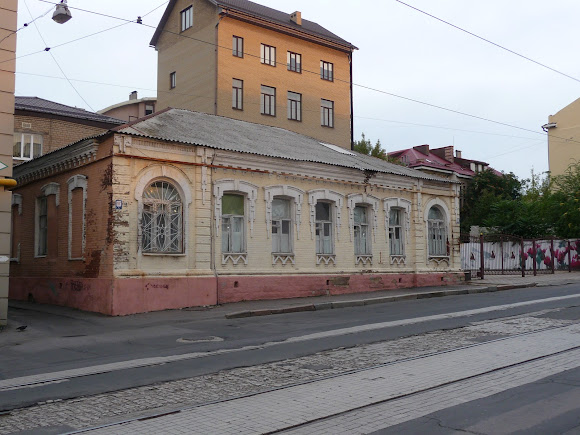 |
| Postysheva St, 48. The Ekk house |
Its openwork decoration is made of trapezoidal and rounded brick, probably produced at the factory of his neighbour, David Krol.
 |
| Postysheva St, 48. The Ekk house |
In 1903 the brotherhood school (Cheliuskintsiv St, 49) was built of red brick.
 |
| Cheliuskintsiv St, 49. The brotherhood school |
It was founded by the church brotherhood of the Church of the Transfiguration of the Saviour, which the Bolsheviks blew up in 1931. The Orthodox brotherhood was engaged in providing aid to the population, in enlightenment work, and in the building of shelters, day nurseries and hospitals. When a third floor was added on, the school, together with the "Great Britain", were the tallest buildings in Yuzivka.
 |
| Cheliuskintsiv St, 49. The brotherhood school |
Before the revolution of 1917 the brotherhood school numbered a thousand pupils; these were children from various layers of the population. Over a century the building has not changed its educational purpose. At different times it housed various educational institutions, a local history museum, a teacher-training institute, and an evening school.
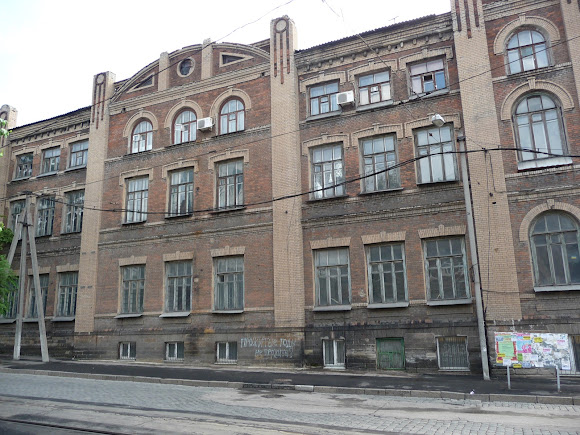 |
| Cheliuskintsiv St, 49. The brotherhood school. 1903. |
Perhaps the schoolchildren and students of the brotherhood school lived in the house opposite (Cheliuskintsiv St, 54). The neighbours are very much alike in their brickwork.
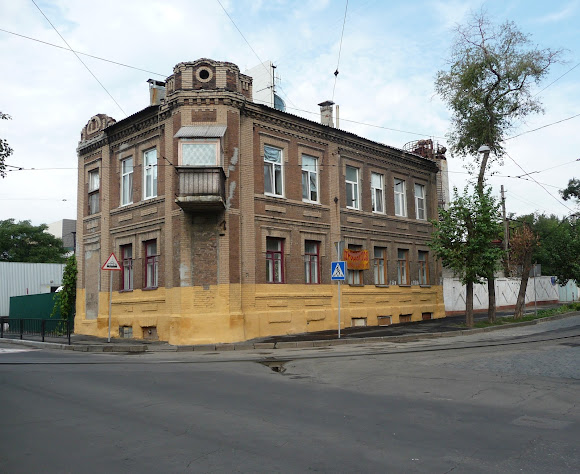 |
| Cheliuskintsiv St, 54. Residential building |
In 1879 an unknown architect built a school for the children of English specialists at Tkachenko St, 113.
 |
| Ivana Tkachenka St, 113. The English school. 1879. |
Local historians doubt that the building was intended for the education of a small group of children from the United Kingdom. In Soviet times the civil registry office was located here, and many Donetsk residents who tied the knot in this building recall the steep oak staircase up which the
groom climbed, carrying his chosen one in his arms. In 2002 an attic floor was added and a plastering imitating brick was applied.
 |
| Ivana Tkachenka St, 113. The English school. 1879. |
In Hryhorivka, at Pukhova St, 23, the building of a parish school has survived, founded in 1873 at the St. Nicholas church, which was destroyed in the atheist years. The school's second building was rebuilt, and now the "Harmonia" gymnasium is located there.
 |
| Pukhova St. The parish school |
Returning to the houses whose owners were industrialists and merchants, with particular bitterness over its destruction I would like to tell of the Hughes house. John Hughes was an engineer, an industrialist, the founder of Donetsk. In 1869 he began building a metallurgical works, and in 1873 — his own house.
 |
| Klinichna St. The house of John Hughes. 1891. |
The single-storey mansion did not please his wife and daughter, who had arrived from Albion. The designs of the Russian architects proved unsuccessful, and the house was rebuilt to the design of an English architect. The master did not live to see the housewarming of 1891; Hughes died in 1889. Beside the palazzo of red brick roofed with iron, a garden was laid out. Electricity and running water were brought in from the works. In 1903 the large family left Yuzivka.
 |
| The house of John Hughes. 1891. |
For several years it was inhabited by the works manager Anderson, who also returned to England. Until its nationalisation by the Bolsheviks in 1918 the house belonged to the manager Svitsyn. Until the Second World War the house served as lodging for the works directors. Later various organisations occupied the premises, and then they began to dismantle it and sell off the brick.
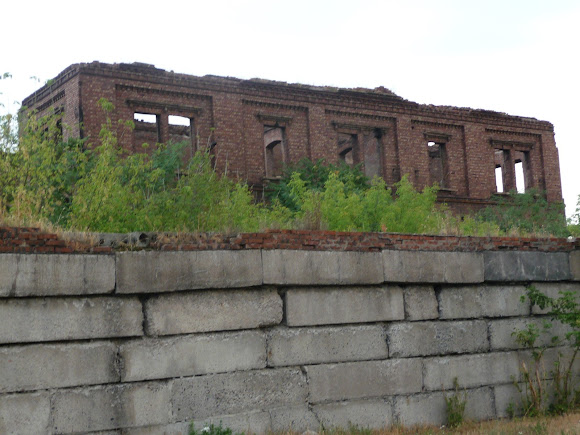 |
| The ruins of the house of John Hughes. 1891. |
Now only ruins remain of this beautiful building, fenced off by a barrier you cannot get past.
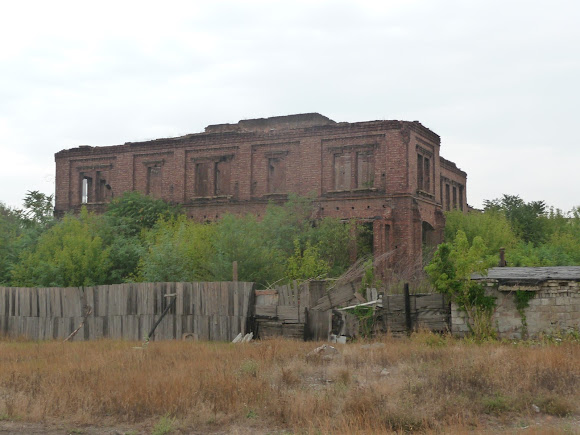 |
| Klinichna St. The ruins of the house of John Hughes. 1891. |
The same sad fate befell the house of Nesterov, or, as it is also called, of Archibald Balfour, co-owner of the DMZ. The "Swallow's Nest" is dated 1889.
 |
| Pontiiska St. The ruins of the Nesterov house. 1889. |
One of the towers, which no longer exists, recalled the church of St. George in London. Stairs led up to the second one — three-storeyed, hexagonal, crenellated, with vaulted windows.
 |
| The ruins of the Nesterov house. 1889. |
The walls, 70 cm thick, were faced with tile. Now it is one continuous ruin, its entrance open from every side.
 |
| Pontiiska St. The ruins of the Nesterov house. 1889. |
The house of the merchant Horelyk (Zhovtneva St, 82) was luckier. Built in the Art Nouveau style in 1905, the building with its pointed dome has been granted the status of a monument of architecture and town planning.
 |
| Zhovtneva St, 82. The house of the merchant Horelyk. 1905. |
Thanks to the "Olimpik" sports club, the Rutchenko landowners' house has been restored. At the end of the 19th century, in this workers' settlement, the structure seemed a veritable palace.
 |
| Ivana Tkachenka St. The Rutchenko house. Administration of FC "Olimpik" |
The buildings of the former Bosse and Hennenfeld works, situated across the road, have remained industrial buildings to this day.
 |
| Buildings of the former Bosse and Hennenfeld works |
 |
| Buildings of the former Bosse and Hennenfeld works |
Such barrack-type houses with several separate entrances I came across in the Maslivka district.
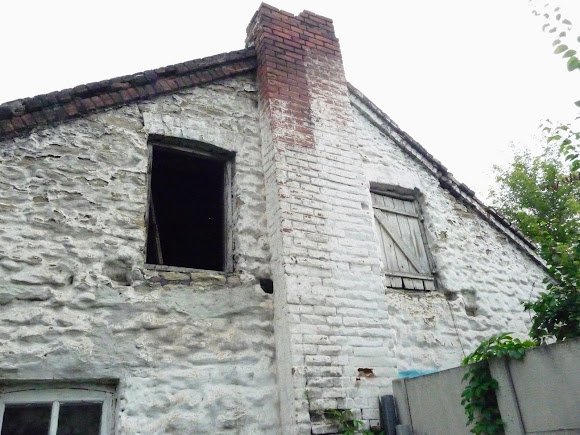 |
| Tushynska St. Residential buildings |
A resident of one of the flats believes that the buildings are about 150 years old, making them contemporaries of Yuzivka.
 |
| Tushynska St. Residential buildings |
For the management and the British specialists, houses were built mostly of brick,
 |
| Chervonoarmiiska St, 76. Residential building |
 |
| Zhovtneva St, 83. Residential building |
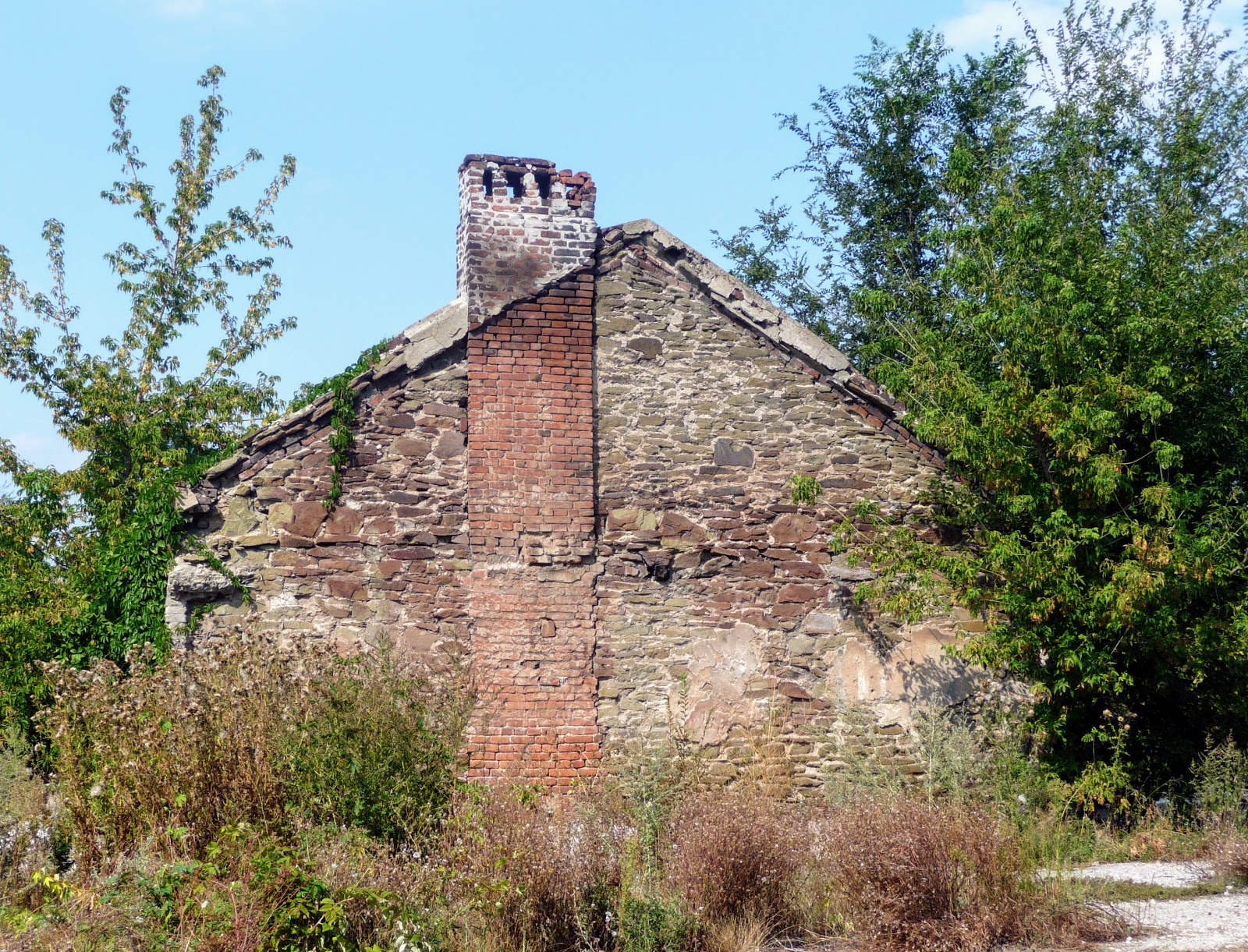
but the stone that came out of the mine together with the waste rock was used very often.
 |
| Donetsk. Ivana Tkachenka St, 131. Residential building |
 |
| Ivana Tkachenka St, 94 |
 |
| Livoberezhna St, 25 |
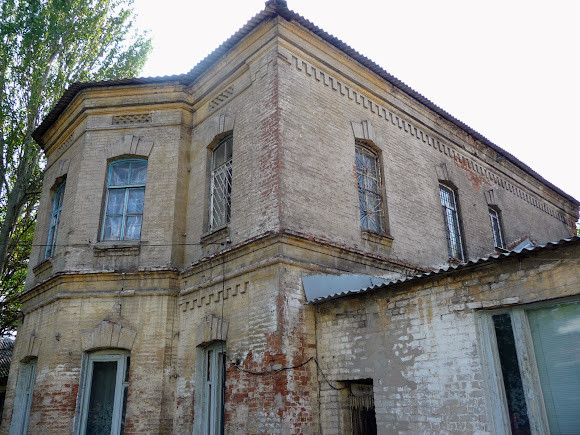
The treatment block of the psycho-neurological hospital (Livoberezhna St, 76) has preserved over 125 years not only its external appearance but also the date on the facade indicating the year of construction.
 |
| Livoberezhna St, 76. The Rykiv hospital. 1892. |
This is the former Rykiv hospital of 40 beds, so named after the mine owner Rykovsky. At those mines, in 1908, 150 people died in a methane explosion, and it was in this very hospital that another 120 people died of gas poisoning. The medical institution was long ago reinforced with buttresses, and, like every state-funded establishment, it is in need of repair.
 |
| Livoberezhna St, 76. The Rykiv hospital. 1892. |
Despite their historical and cultural value, old houses are disappearing and being demolished in large numbers in the big cities. It is very important to preserve for our descendants those meagre remnants, the architectural heritage and the atmosphere of the bygone eras.




No comments:
Post a Comment
Leave your impression