Sukha Balka. A Natural Monument and a 2006 Crash Memorial
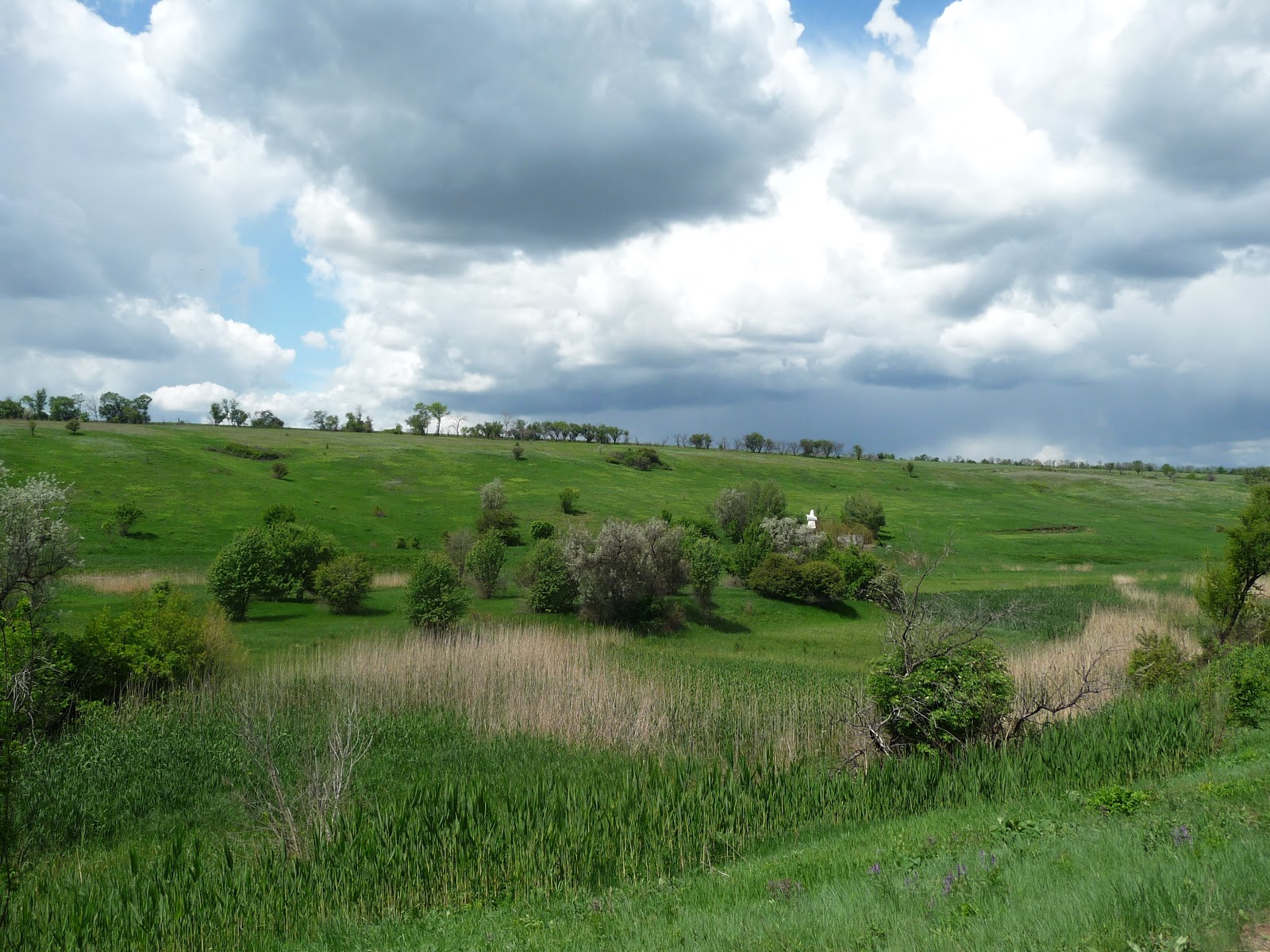
The Sukha Balka botanical natural monument is located in the Yasynuvata district of the Donetsk region, on the north-western side of the settlement of the same name and a kilometre from the H-20 road to the east.
The gully, with an area of 150 hectares, is stretched from north to south over 4.5 kilometres, cut through with ravines and covered with ravine woodland.
The slopes of the rather deep gully have an incline of up to 60 degrees.
The land belongs to the Donetsk Research Station of the National Scientific Centre "O. N. Sokolovskyi Institute of Soil Science and Agrochemistry".
At the bottom of the picturesque hollow a stream flows, and in its bed an earthen dam has been built, reinforced-concrete slabs have been laid, and a pond has been created.
Since 1991 the territory has been listed among the natural monuments of local significance and is protected by the state in order to preserve rare plant species.
The gully features the varied grassland vegetation of feather-grass steppes, including 38 species of medicinal plants and 6 species listed in the Red Book of Ukraine.
Feather grass alone grows here in 3 species — Ukrainian feather grass, Lessing feather grass and hairy feather grass. This grass, so characteristic of the Ukrainian steppes, lends the hollow a special colour and relief.
In early June the hillsides are strewn with wild strawberries.
Despite the gully's protected status, signs have been put up on the approaches to the artificial pond declaring the water body to be private property. Fishing and rest by the pond are chargeable.
In 2006 a tragic event took place in the gully. A Tu-154 airliner of the "Pulkovo Airlines" company was flying from Anapa to Saint Petersburg.
Sukha Balka. Donetsk region. Memorial to those killed in the 2006 air crash. The Anapa-Saint Petersburg flight
In a severe thunderstorm the crew tried to take the airliner over the storm clouds instead of going around them from the side, as the instructions require. As a result of intense air currents, the Tu-154 reached supercritical angles and, at an altitude of more than 11,000 metres, shot sharply upwards, after which it fell into a flat spin and about 3 minutes later crashed to the ground, slamming into the slope of a ravine. All who were on board, 160 passengers, of them 46 children, and 10 crew members, perished.
Soon a wooden cross with the inscription "Donbas mourns" was set up at the site of the air disaster.
On the anniversary of the tragedy, in 2007, a monument was unveiled at the spot where the fuselage fell, made in Saint Petersburg and assembled by the Ukrainian side.
The monument is a fragment of the aircraft's wing and four marble stelae bearing the names of the dead and views of the city on the Neva.
On both sides of the memorial the victims' relatives have set up individual memorial plates.
Birch trees, planted as living green obelisks for each perished passenger, have grown into a grove.
Despite the closeness of military operations over 6 years, the monument itself has survived in good condition. Weather and the settling of the soil on the gully slope have damaged the integrity of the facing tiles on the steps; in some places they have come away. Someone had come to the monument to commemorate the souls of the dead, leaving flowers and votive lamps.
A road and an alley were laid to the memorial, and chestnuts, lilac and perennial flowers were planted.
For the fortieth-day commemoration a well was dug; the water came close to the surface, and the spring needs clearing.
Video from 2021.
The asphalted car park, in a spot far from any settlements, is not in use.




No comments:
Post a Comment
Leave your impression