Farm labour and rural idyll do not appeal to every Ukrainian. To the rural backwoods a city dweller comes to the dacha or for fishing with barbecues. There are no supermarkets, no entertainment, a limited circle of communication. Today I shall see how the Ukrainian villages live in Mezhova district of Dnipropetrovsk region, having ridden the electric train for 2 halt points and walked about 14 kilometres on foot.
 |
| Antonivske. Halt point No. 18. The Avdiivka-Chaplyne suburban train |
The village of Antonivske stretches along the railway near halt point No. 18 on the line Chaplyne-
Pokrovsk , 5 kilometres from
Mezhova.
 |
| Antonivske. Halt point No. 18 |
3 parallel streets — Shkilna, Stepova, and the longest, Tsentralna, formerly Lenin Street.
 |
| Antonivske. Tsentralna Street |
Neat houses surrounded by marigolds and asters. You walk along the village street, everyone greets you, exchanges good wishes, and to an unfamiliar passer-by they try to give directions and even to treat you to autumn fruits.
 |
| Antonivske. Tsentralna Street |
The population is shrinking in settlements remote from the town, and the schools, in the course of optimisation, have closed. Along the way I got acquainted with the third-grader Nastia, who told me that the pupils from Antonivske are taken to neighbouring Vesele by a yellow bus. Nastia finds studying easy and interesting.
 |
| A sports ground in the school yard |
In the building of the former school a library and a doctor's office are housed.
 |
| Antonivske. The closed school |
In the school yard, sports and play equipment has been installed for the village children.
 |
| Antonivske. The sports and play grounds |
A well on the street is always a joy for a traveller and a sign that good people live here.
 |
| Antonivske. A well |
Not every city has functioning houses of culture, yet in a small village the doors of the village club are open from the morning; it now belongs to the agricultural enterprise 'Mriia'.
 |
| Antonivske. The 'Mriia' House of Culture |
The agrarian enterprise specialises in growing cereals and industrial crops, and in producing oil and flour. The administration and warehouses of 'Mriia' are located in Antonivske.
 |
Antonivske. The 'Mriia' agricultural enterprise
|
To see a hearth of culture in a village is no less interesting than in a city.
 |
Antonivske. The 'Mriia' House of Culture
|
For the villagers' leisure, tennis and billiard tables and sound equipment have been bought, and a reading room with a selection of newspapers and magazines has been created.
In a large album, photo-documents and the recollections of the village residents have been gathered — about the Holodomor, the liberation from the Hitlerite occupation, the restoration of the collective farm, everyday labour and holidays in Antonivske. A notice invited young readers to Book Day, and for the veterans of labour a greeting was being prepared for the Day of the Elderly. On weekends, beadwork classes are held, to which my acquaintance Nastia came with a friend and demonstrated bright examples of applied creativity.
On the territory of the club, a ground for mass events has been created and a monument to the fellow-villager soldiers erected.
 |
| Antonivske. The ground for mass events |
The names of 160 natives of Antonivske who died on the fronts of the Second World War are commemorated on memorial boards.
 |
| Antonivske. A memorial sign to the fellow-villager soldiers |
From the club to the boundary of the village of Vesele the distance is 2.5 kilometres. The road with its worn-out gravel does not favour quick progress.
 |
| The Antonivske-Vesele road |
On the southern side spread fields of ripened sunflower, above which rises a group of Scythian burial mounds. The highest, the Buhaieva Mohyla mound, serves as the 'Oleksandrivka' geodesic point, but the metal tower on it has been cut off.
 |
| The Buhaieva Mohyla mound. The 'Oleksandrivka' geodesic point |
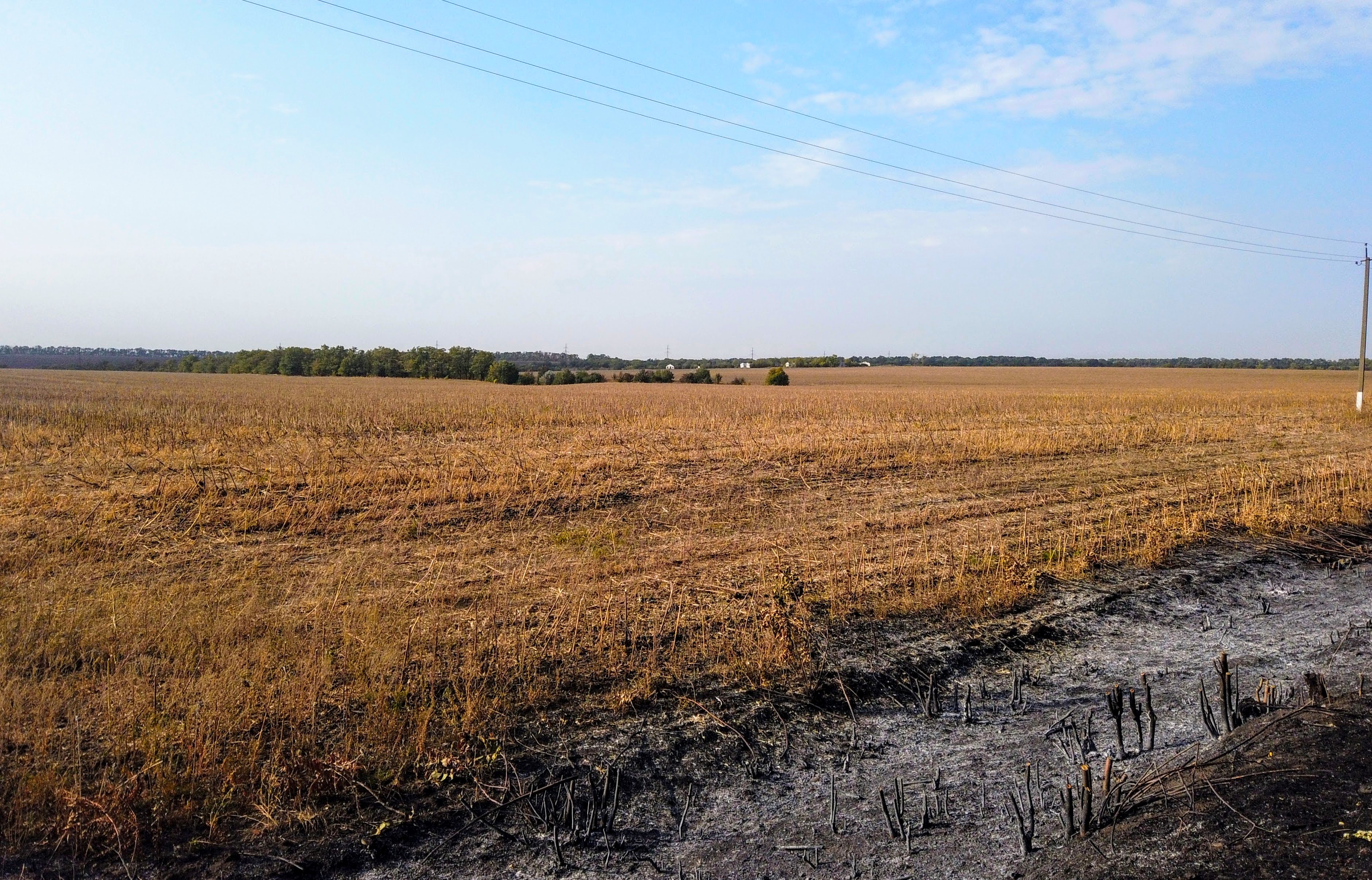
On the roadside remain traces of the activity of mad pyromaniacs who staged a fire-show in dry weather. By the fires, the shelterbelts in the area of
Raipole and
Pidhorodnie.
 |
| Dubova Ravine. An agricultural field |
In the distance the Dubova ravine can be seen, and the southern part of Vesele is called Dubove.
 |
| Vesele (Dubove). Kyivska Street |
The private sector on Kyivska Street is decorated creatively and in the national spirit.
 |
| Vesele (Dubove). Kyivska Street |
The village arose in 1878, and the construction of the railway prompted the peasants from the ancient Zaporizhian settlement of Ivanivka to move closer to the main line.
 |
| Vesele. Ukrainska Street. Dwelling houses |
 |
| Vesele (Dubove). Kyivska Street |
The halt point at kilometre 347 opened in 1967 through the efforts of the war veteran I. F. Oryshchenko. This front-line soldier returned to his native village a blind invalid and secured the creation of a platform in Vesele, since the neighbouring stops of the suburban train were not close. In 2019, grateful fellow villagers, in honour of Ivan Fylymonovych, on the pavili
on of the halt point installed a memorial board.
 |
| Halt point kilometre 347. A memorial board to I. F. Oryshchenko |
The street leading to the centre of the village bears the name of Lieutenant Kapustin, who died at the age of 23 during the liberation of the village in 1943.
 |
| A memorial sign to Lieutenant Kapustin on Kapustin Street |
I managed to see an original plaque with the street name on a little house with wooden shutters.
 |
| Vesele. Kapustin Street. A dwelling house |
And unconventional posts with a little star on an emptied homestead.
 |
| Vesele. Kapustin Street. A post |
On this street are located a feldsher station, a kindergarten, a house of culture, and the starosta district of the Mezhova settlement council.
 |
| Vesele. The school yard and the sports ground |
Nor are the names forgotten of the liberator soldiers and of the 218 fellow-villager soldiers who did not return home from the front.
 |
| Vesele. The war memorial |
Terrible grief burst into the homes of the toiling grain-growers in 1932-1933 after the decrees of the Kremlin elite.
 |
| Vesele. A memorial sign to the victims of the Holodomor |
In the centre of the village a mini-market 'Veselka' has been set up, and a grocery shop operates under the same name.
 |
| The 'Veselka' grocery shop |
 |
| Vesele. The 'Veselka' market |
If the library has survived, it means that people who love reading live in the village. The book collection of Vesele is housed in a building with a little cockerel on the tiled roof.
 |
| Vesele. The library |
The Church of the Ascension of the Lord occupies the premises of a rebuilt dwelling house.
 |
| Vesele. The Church of the Ascension of the Lord |
Not all institutions managed to survive, and a surviving letter on the signboard reminds one that the building held a bathhouse.
 |
| Vesele. The former bathhouse |
The next point of the journey will be neighbouring Bohdanivka, which I shall reach first by electric train and then on foot. The suburban train
Avdiivka-Chaplyne arrived at the railway platform at 10.55, and within 3-5 minutes it whisked me to the halt point Kyrpycheve. I shall have more time to examine the halt on the way back, but for now I needed to work out how to get to Bohdanivka quickly.
 |
| The Kyrpycheve halt point. The Avdiivka-Chaplyne suburban train |
On the advice of a passenger who got off at the Kyrpycheve halt, it is not necessary to go by the long road, making a circle; one can walk along the railway, turn onto a path in the shelterbelt, and come out straight onto the street.
 |
| The Kyrpycheve railway platform |
This fellow, no doubt, had long since seen the path and did not use such a way of entering the village. I did not want to return to my starting position and lose time, but in the dense thicket of the shelterbelt not a single gap could be seen, and walking along the gravel of the railway embankment was not easy. After about 900 metres it became clear that the railway track was veering off to the north, while I needed to turn south, and I would have to make my way through the thickets of the endless plantation, otherwise I might pass Bohdanivka and come out only at the next halt point. This hundred-metre obstacle of green plantings seemed like a dense forest with fallen trees and thorny branches.
 |
| Bohdanivka. The shelterbelt |
At last the hard-to-pass thickets ended, but beyond them there was no road; instead, a field began at once. I had to gauge the depth of the ploughland and move to the south-west towards the village.
 |
| Bohdanivka. An agricultural field |
Bohdanivka was founded by settlers from Ivanivka at the beginning of the XX century, and now it is the centre of a village council that includes Antonivske and 6 other small villages.
 |
| Bohdanivka. Street signs |
 |
| Bohdanivka. The centre of the village |
In the building of the village council are housed a feldsher station and a post office.
 |
| Bohdanivka. The village council, feldsher station, post office |
The house of culture with columns at the entrance was closed, despite the weekend day.
 |
| Bohdanivka. The house of culture and the play ground |
The first school in Bohdanivka was opened in 1932. A new school building opened its doors in 1994, and now, together with the school, it houses a kindergarten.
 |
| Bohdanivka. The school |
In September 1943, enemy tanks entered Bohdanivka; the German command tried to seize Bohdanivka, Dubove (Vesele), Antonivske, and the Mezhova station. Within a few hours, as a result of the fighting, the villages were liberated by the Red Army. The common grave of the fallen liberator soldiers is in the public garden; in 1956 a monument with the figure of a soldier was erected on it. On the memorial boards are commemorated the names of the Red Army soldiers and of 170 fellow-villager soldiers who died on the fronts of the war.
 |
| Bohdanivka. The war memorial |
In the public garden a memorial sign has been placed to the victims of the Holodomor in this grain-growing land.
 |
| Bohdanivka. A memorial sign to the victims of the Holodomor |
Along the pot-holed road to the halt point, over a route a little more than 2 kilometres long, the landmark was the sign of the agricultural enterprise 'Bohdanivske', the former collective farm 'Druzhba', which from afar resembles a roadside cross.
 |
| The road from Bohdanivka to the halt point and Mezhova |
 |
| The sign of the agricultural enterprise 'Bohdanivske' |
At the end of September the harvest has been gathered from the fields, and a large area of the land is ploughed for winter crops, autumn tillage, and the spring sowing.
 |
| Bohdanivka. An agricultural field |
At last I saw the railway crossing and a well beside it; the water borehole, however, turned out to be dried up and without a bucket.
 |
| The railway crossing and the dried-up well |
The arrival of the Chaplyne-Avdiivka suburban train was expected at 13.05, and I still had 25 minutes in reserve. Keepers of railway history know that in the designing of the Hryshyne (Pokrovsk) — Rivne railway it was planned to build the line not from Hryshyne but from Kyrpycheve. But a delegation of local elders, merchants, and village starostas was against the construction, giving as their reason the small population and the waterless locality.
 |
| The Kyrpycheve halt point |
At the halt point there is a two-storey dwelling house for the railwaymen. In the two entrances only 2 flats are occupied, the rest are empty.
 |
| A dwelling house for railwaymen at the Kyrpycheve halt |
Very strange looks the inscription on the sign — an unsuccessful transliteration from the Russian language. How could a respectable department allow such illiteracy?
 |
| The sign at the Kyrpycheve railway platform |
And here is the Chaplyne-Avdiivka electric train; today it arrives without delays, exactly on schedule.
 |
| The Kyrpycheve halt. The Chaplyne-Avdiivka suburban train |




No comments:
Post a Comment
Leave your impression