 |
| Vasylivka, Mezhova district, Dnipropetrovsk region. |
To see such a masterpiece is a stroke of luck for a traveller, but I did not yet know this when I got off at halt point No. 19 of the Pokrovsk-Chaplyne line.
 |
| Halt No. 19. The Avdiivka-Chaplyne suburban train |
From the suburban train Avdiivka-Chaplyne, besides me, 2 more passengers got off: a man with boxes on a cart was crossing the railway track towards Mykolaivka, while a lady headed for Vasylivka. I asked the man whether life still smouldered in Mykolaivka and whether there was a common grave there. 'No, there is nothing there, everything is in ruins, a few dacha-dwellers come, it is a pity to abandon one's native places,' my fellow traveller replied. So there was nothing for me to do there, I decided, and headed north to Vasylivka, to which one must walk 2 kilometres along an asphalt road with holes and potholes.
 |
| The T-04-06 road. Mezhova district |
The lady walked about 100 metres ahead and smoked, poisoning the atmosphere of the shelterbelt's autumn attire. I did not overtake her, admiring the October medley of colours along the way. The weather from the morning was comfortable for a walk, +15-18 and cosy.

The village was deserted, only goats bleating at the sight of an unexpected passer-by.

 |
| Vasylivka. Central Street |
Hearing a conversation in one of the yards, I came up to the wicket gate and asked the mistress of the house where the common grave was. The woman gladly responded; I am always lucky with good people. Vira — the director of the club, the only communal village institution not yet closed — led me to the monument, telling me along the way about the village, the club, and the military burial. In the grave are buried 12 Red Army soldiers; one of them, a pilot, Senior Lieutenant A. D. Halushko, was shot down by the Hitlerites over Mykolaivka in 1943 and reburied in the 1950s in the common grave in Vasylivka. Relatives of Junior Sergeant I. H. Holovko came to the memorial; he was a native of Kirovohrad region who died in October 1941 during the defensive battles on the outskirts of Vasylivka. Before the war Ivan Hryhorovych had five children and worked in Khartsyzk district of Donetsk region as head of the Khartop mine. On the stele are set boards with the names of the buried, and the names of the fellow-villager soldiers are commemorated.


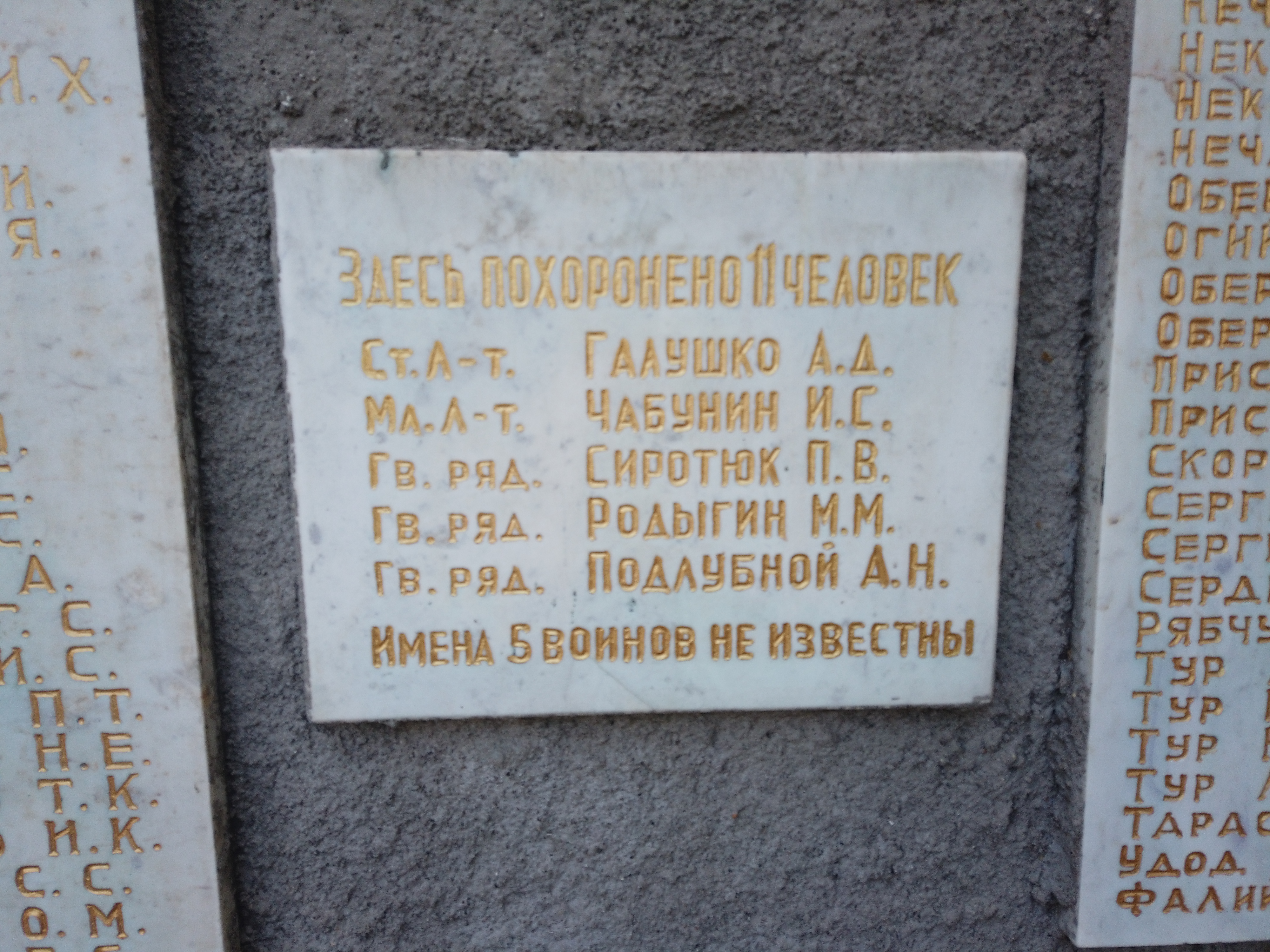 |
| Vasylivka. The war memorial |
Beside the memorial is a wasteland, on which until the 1930s a church rose.

The godless authorities demolished the shrine, and from its materials built, in 1937, a club, which thanks to the villagers' activity remains a centre of culture to this day.

 |
| Vasylivka. The village club |
In the village House of Culture festive events are held, and a library and a needlework circle operate. In the auditorium a local-history corner has been created, an exhibition of the applied-art works of fellow countrymen.


 |
| Vasylivka. The village club |
In Vasylivka there are also historical burials, though tracking them down proved no easy matter amid the blackthorn thickets. Part of the cemetery, where the first settlers are buried, was covered with a layer of ash after the mad antics of pyromaniacs who set fire to the dead wood.
 |
| Vasylivka. The cemetery. Burials of the first settlers |
A modest monument stands on the common grave of 10 residents of Vasylivka tortured to death by the Makhnovists. During the Civil War a band of Makhno operated in the village.
 |
| Vasylivka. Burial of 10 residents tortured to death by the Makhnovists |
In the village cemetery rests a resident of Vasylivka, a participant in the uprising on the battleship Potemkin in 1905. Serhii Yakovych Huz (1877-1924) served as senior galvaneer and was sentenced to ten years of hard labour.
 |
| Vasylivka. The grave of S. Ya. Huz, a participant in the uprising on the battleship Potemkin |
In 1932-1933, during the artificial famine, about 90 residents of the village perished. In memory of the victims of the Holodomor a cross has been erected.

In 1914 a zemstvo school was built in Vasylivka, a brick building with large windows. The educational establishment was closed long ago, the premises stood empty and were on the verge of collapse. Now the classrooms hold an incredible fruity smell and store a harvest of apples, and the building survived thanks to the gardener Mykola Petrovych.


 |
| Vasylivka. The zemstvo school of 1914 |
On Central Street the feldsher station and the post office did not manage to survive. Nor is there a shop in Vasylivka, whose population is about 50 people.

 |
| Vasylivka. The closed feldsher station. The former house for the zemstvo school teacher |
 |
| Vasylivka. The closed post office |
Once a week bread is brought to the village and once a month groceries.
 |
| Vasylivka. Here the villagers wait for the shop-van |
Not a single bus passes through the village, though a bus shelter of the new format has been installed on the eastern outskirts. The former one — in the centre of the village, faced with tiles like the others in Mezhova district — is unneeded and abandoned.
 |
| Vasylivka. The abandoned bus stop |
The people of Vasylivka need at least one service a month, so as to travel toMezhova to the bank, pharmacy, hospital, and pension fund.
 |
| Vasylivka. Central Street. A dwelling house |
There are fewer and fewer residents, and abandoned houses in the village are no rarity. It is very bitter to see ruined family hearths, where for long years the people of Vasylivka lived, worked, and raised their children.


 |
| Vasylivka. Abandoned houses |
In contrast to the vanishing ancestral nests, a unique hata drowns in flowers, in which the family of Anatolii Yakovych Bereza lives.
 |
| Vasylivka. The village hata of 1888 |
A few years ago the owners restored the roof, observing all the old technologies. The reed roof is set away from the walls, which gives the structure a special character. Our ancestors believed that a dwelling is like the tree of life and carries within it similar features. The roof is the crown, the walls the sturdy trunk, the foundation the root that binds it to the earth. Perhaps this is why the tradition of painting the base of a dwelling black and the walls white has survived, to emphasise the boundary between the white world and the underworld. The house has living and household rooms. A low threshold leads into the entrance hall. The heating is by stove. In the yard is a well. The homestead has a neat, well-tended look, and it only remains to thank the owners for the joy they gave and to wish them and the house well-being and prosperity.

.JPG "Vasylivka. The village hata of 1888. The reed roof")
| Vasylivka. The village hata of 1888 |
Through the village flows a dried-up stream. The road over the culvert is laid with stones.


On the north-western outskirts, in the bed of the reed-choked watercourse, a dam and a pond were created, which has also grown shallow.


Mezhova district is a land of grain-growers, with fertile soil and industrious people. All the fields around Vasylivka are ploughed and sown.


On the eastern side lies the village of Vesele, on the south-eastern — Bohdanivka, where I visited on my previous journey through the Mezhova area. On the south-western side is Volodymyrivka, where I am now heading. I have 1 hour 50 minutes in reserve and almost 9 kilometres of path across rough terrain and along Central Street of Volodymyrivka to stopping point 337, so I need to hurry and pick up the pace.
This story is also available in Ukrainian: Василівка. Порятунок зруйнованих. Сільські хати, пам'ятки, земська школа, клуб і інше

No comments:
Post a Comment
Leave your impression