The water tower was invented in order to hold a reservoir of water up high and to create pressure in the water-supply system. With the growth of towns and the increase in consumers, the main function of this important element of the water supply has been lost. The most interesting examples can be seen at railway stations or in industrial zones. Most of them are not used for their intended purpose, since there is no need to fill steam locomotives with water. The water tower at the junction station of Koziatyn can be considered a masterpiece of hydraulic engineering architecture. Exquisite in its beauty, with lacy brick decoration, the tower was built at the end of the 19th century by the famous architect O. V. Kobeliev.
 |
| Koziatyn, Vinnytsia region. The water tower at the railway station |
The water tower in
Rivne was built in the brick style; it served to fill steam locomotives and to supply the administrative buildings of the railway station. A metal plate with the number "1903" above the entrance testifies to the date the monument was put into operation.
 |
| Rivne. The water tower of 1903 at the railway station |
Many of the oldest water-supply structures have the status of architectural monuments and are the calling cards of their towns. The water tower in
Vinnytsia is one of the symbols of the town on the Southern Buh. Built in 1912, the seven-tiered structure was, before the war, one of the tallest buildings in the town and additionally served as a fire watchtower. In the premises, preserved in their original form, a museum of internationalist soldiers and a tourist centre are housed, while the chimes remind one of the fleeting nature of time.
 |
| Vinnytsia. The water tower of 1912 |
Non-listed towers can also boast of beauty and have their own history.
 |
| Stryi, Lviv region. The water tower at the railway station |
During the Second World War the Wehrmacht built new towers at stations to fill their steam locomotives. In 1943 at the station of
Nizhyn a successor was built on the site of the one blown up by the partisans.
 |
| Nizhyn, Chernihiv region. The water tower of 1943 |
An original design is that of the tower at the railway station of
Pokrovsk. Prisoners of war of the Red Army began to raise the monumental structure of red brick in 1942. The tower was in use in 1946-2013, after which no worthy use could be found for the sturdy building, which resembles a defensive fortification.
 |
| Pokrovsk, Donetsk region. The water tower at the railway station |
A similar tower rises at the station of
Mezhova. During the years of the Nazi occupation the fascists set up an observation post on it. Traces of shelling remain on its walls.
 |
| Mezhova, Dnipropetrovsk region. The water tower at the railway station |
A contemporary of the Catherine railway line, this brick water tower served to fill steam locomotives. It is a pity that no use has been found for one of the oldest buildings of
Avdiivka, and the industrial monument is falling into ruin.
 |
| Avdiivka. The water tower on the grounds of the vocational school |
In
Velyki Sorochyntsi the first rural water main in Ukraine was put into operation in 1928. During the war the tank came under fire and received 7 holes. After repair, the 140-thousand-litre reservoir was protected from the effects of the natural elements with plastic, which disrupted the authenticity of the structure.
 |
| Velyki Sorochyntsi, Poltava region. The water tower of 1928 |
The water towers of the engineer Shukhov are valuable objects of cultural heritage, whose features make it possible, with a minimal quantity of building materials, to create an effective system of water delivery. In Ukraine only a few hyperboloid structures have passed the 100-year mark, and all of them need reconstruction. In
Mykolaiv in 1907 the world's first steel structure for a water main was erected. At the beginning of the 20th century the town authorities appreciated the advantages of the design, and the tower served for more than 50 years.
 |
| Mykolaiv. The Shukhov water tower of 1907 |
In
Cherkasy the lacy lady worked from 1914 to 1975. The historical monument is kept under supervision on the grounds of the water utility.
 |
| Cherkasy. The Shukhov water tower of 1914 |
In 2019 enterprising citizens managed to save one of the 11 "Shukhov" wonders raised in Ukraine. In the town of
Chasiv Yar the water tower was built in the 1920s on the grounds of a refractory plant. It, together with the production workshop, was to have been dismantled. Thanks to the public, this monument of industrial architecture has been entered in the list of newly discovered objects of cultural heritage.
 |
| Chasiv Yar, Donetsk region. The Shukhov water tower |
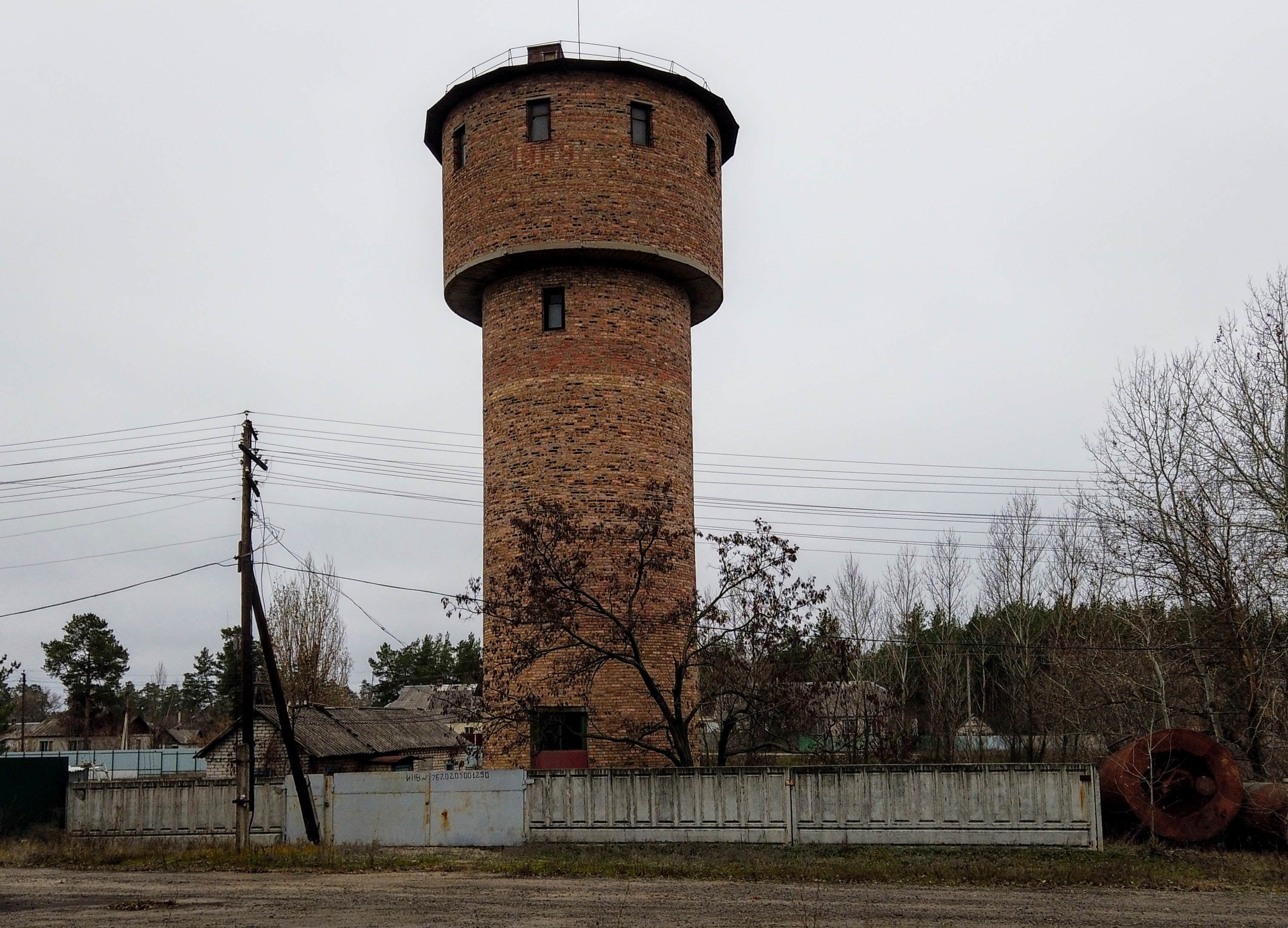
A large number of towers are made of red brick.
 |
| Myronivka, Kyiv region. The water tower of 1957 |
 |
| Bila Tserkva, Kyiv region. The water tower of 1946 |
Reinforced-concrete and brick towers built at the end of the 1950s and the beginning of the 1960s are found in residential neighbourhoods and on industrial sites.
 |
| Myrnohrad, Donetsk region. Water towers |
Towers that have dropped out of the water-supply chain are sometimes destined to be turned into a mast for satellite dishes.
 |
| Novooleksiivka, Kherson region. A water tower |
 |
| Uhersko, Lviv region. A water tower |
In recent decades many enterprises have been repurposed, and the towers have turned into warehouses or stand empty and fall into ruin.
 |
| Sambir, Lviv region. A water tower on the railway |
 |
| Water towers in Novolozuvativka, Raipole and Novopidhorodnie of Dnipropetrovsk region |
But all the same one cannot always do without these labourers, and they are used at less than full capacity.
 |
| Myrhorod, Poltava region. A water tower on the railway |
 |
| Opishnia, Poltava region. A water tower |
In some places the towers are set up in pairs.
 |
| Olesko, Lviv region. Water towers |
 |
| Vasylkivka, Dnipropetrovsk region. Water towers on the grounds of the hospital |
Very often one can see Rozhnovsky towers, which consist of a tank, a hatch and a support with stairs. The capacity of these structures varies within the range of 10 m3-150 m3.
 |
| Komyshuvakha, Donetsk region. A water tower |
 |
| Dibrivka, Poltava region. A water tower |
Sometimes these metal water-bearers with their gleaming onion domes resemble futuristic contraptions.
 |
| The Arabat Spit, Kherson region. Water towers |
Storks like to make themselves at home on the wide surface of the "Rozhnovkas", and it happens that a nest falls through a rotten hatch.
 |
| Myropillia, Sumy region. A water tower |
 |
| Dachne, Dnipropetrovsk region. A water tower |
It is pleasing to the eye and the soul when a useful application is found for these sturdy structures.
 |
| Myrhorod, Poltava region. A water tower turned into a mill |
 |
| Lviv, Stryiskyi Park. The water tower of 1894. A restaurant |
Abroad such structures serve as a conference hall, a shopping centre, a restaurant, a hotel and even a student dormitory. The design of water towers makes it possible to turn the building into a stylish cafe or an unusual cinema, an art gallery or an exhibition centre. The towers are simply made to become a popular tourist attraction, with the most creative ideas brought to life.




No comments:
Post a Comment
Leave your impression