The image of the Hutsuls in literature and films appears as a freedom-loving people in elegant embroidered clothing, with ancient traditions. The Hutsuls know the nature of the mountains and forests and have a distinctive dialect. To see a modern Hutsul village, I set out from Yablunytsia in the Ivano-Frankivsk region to the neighbouring village of Stebnyi in the Zakarpattia region along a mountain ridge, admiring the views in the land of the Mountains and stopping many times to fix in my memory and on film the incredible pictures of the nature and daily life of the villagers.
 |
| Stebnyi, Rakhiv district, Zakarpattia region |
Moving along the hilly road after the night's downpour, slipping on the wet stone and sinking into the clay slush, was difficult.

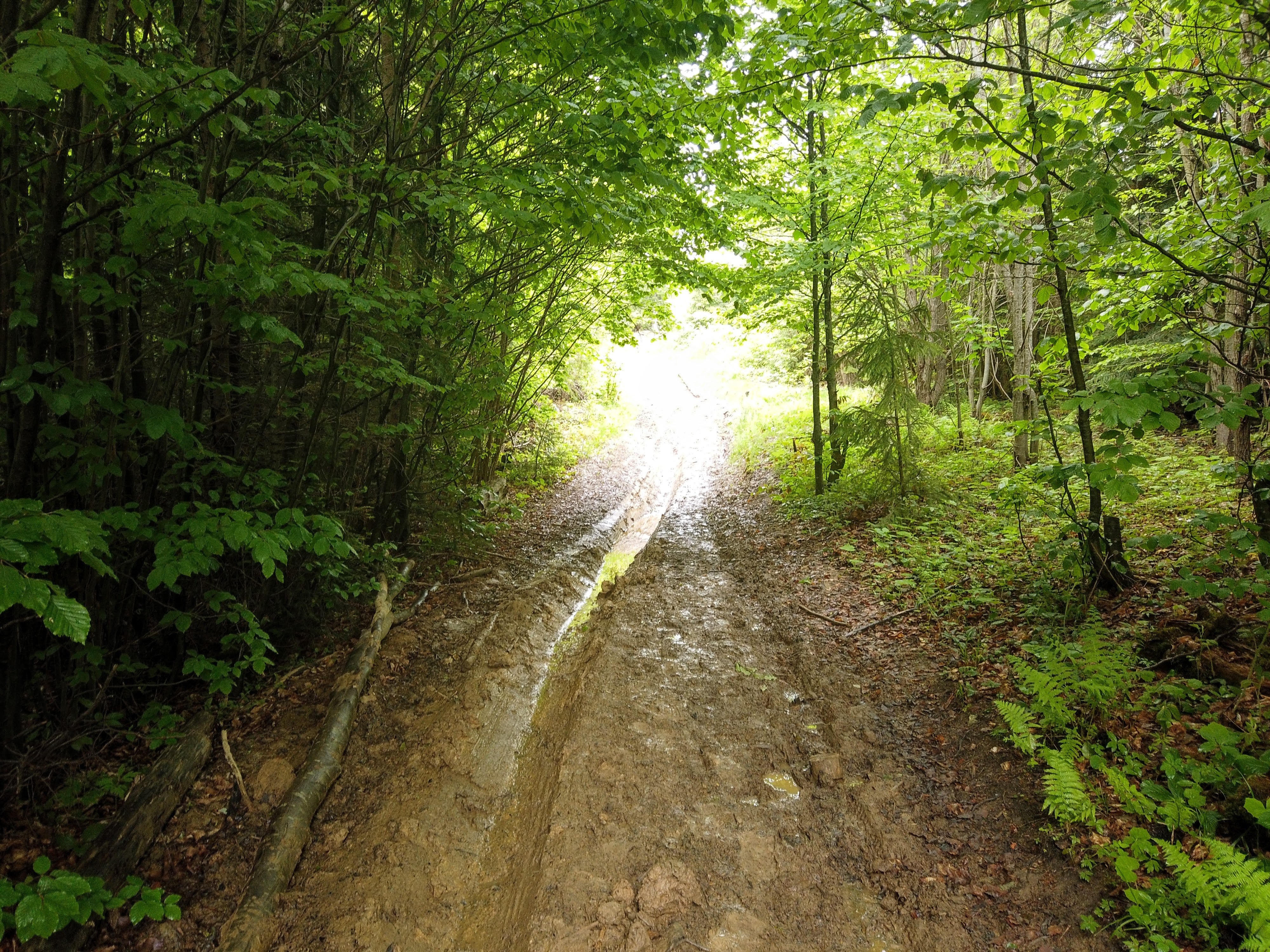 |
| Stebnyi. The road in the forest |
Somewhere nearby the chiming of sheep could be heard. I know that at the foot of the mountain there is a cheese dairy, and I would very much have liked to see the process of making budz and vurda - products from sheep's milk - but in the dense coniferous-beech thicket I could not make out by which clearing to descend to the flock's stopping place.
 |
| Stebnyi. Forest and mountains |
Having covered more than 5 kilometres over the mountainous, forested peaks in less than 2 hours, I saw the houses of Stebnyi scattered across the mountain slopes. In Uzhhorod, in the museum of folk architecture, a grazhda homestead from Stebnyi is on display. In the enclosed courtyard there is a three-room dwelling, household premises, a cattle shed and storerooms for keeping firewood and the harvest.
 |
| Uzhhorod. The skansen. A grazhda homestead from the village of Stebnyi |
I came out onto the northern part of the village, which stretches for 7 kilometres along the river of the same name from north to south. In mountain villages the hydronyms often coincide with the names of the settlements.

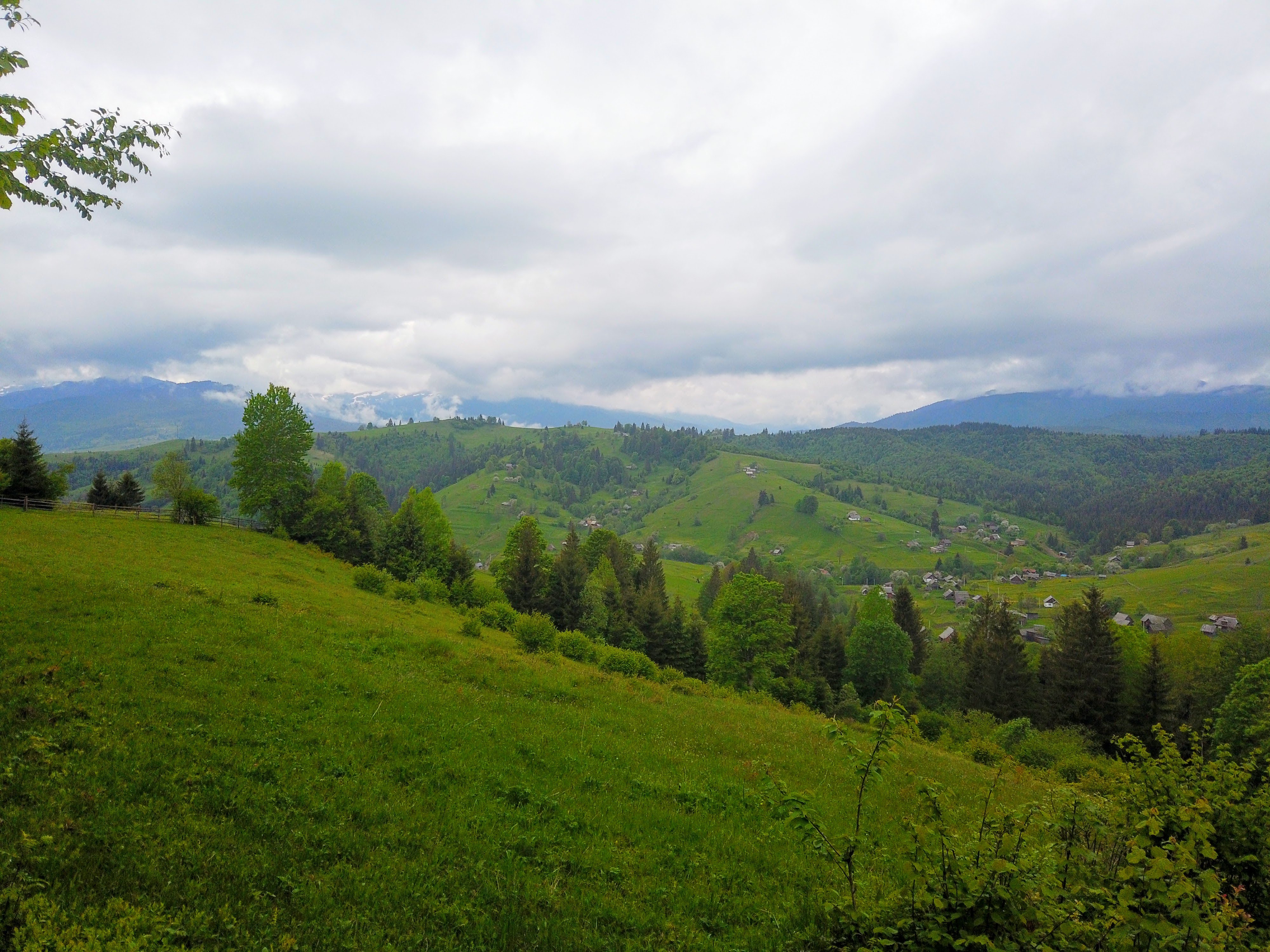 |
| Stebnyi. View of the northern part of the village |
The farthest homestead turned out to be abandoned, but with the number 223 preserved on the facade of the wooden house.

 |
| Stebnyi. An abandoned homestead |
Down below by the river my way was blocked by cows strolling about freely. I have no experience of dealing with domestic animals. In Carpathian villages the cows graze untethered; their movement around the pasture is limited by a wooden fence, and their location is determined by the chiming of the little bells fastened around the necks of these breadwinners.
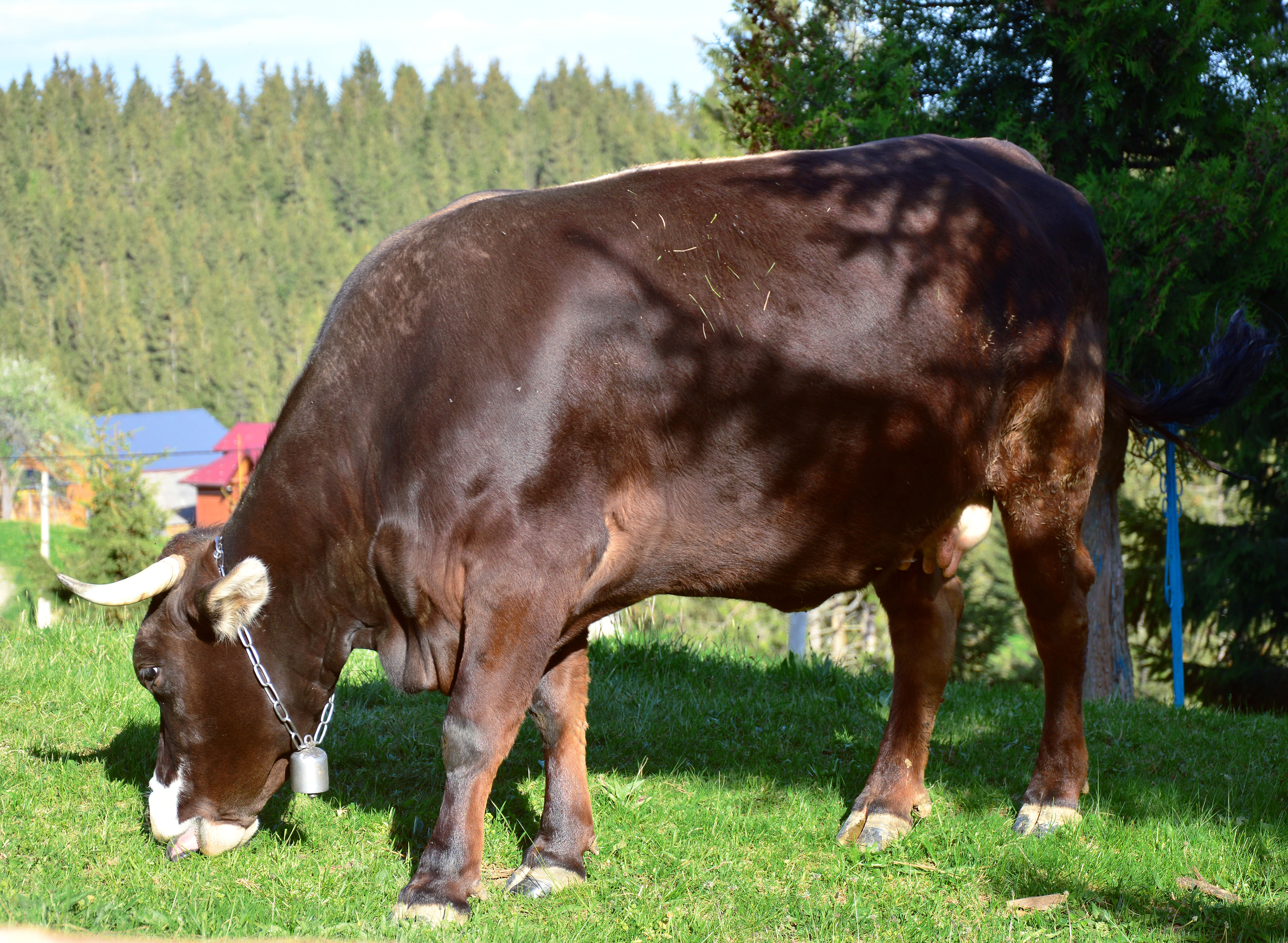

The little cows had no intention of freeing up space for a traveller, and I had to make a forced halt on a fallen tree, waiting for some help, while the horned fatties went on cropping the grass and watching me. My attempt to go around the company was not crowned with success, because the meanest of them came at me with her horns, and all I could do was either jump into the river or call for help. Fortunately, the mistress of the unruly gang came up, advising me from afar to treat the hooligan to a bit of bread. From now on I will take treats with me for unforeseen encounters with cloven-hoofed creatures.

My rescuers, Olena and her 8-year-old son Yaroslav, smiled warmly. Olena told me that I still had 2 kilometres to walk to the church, and then to the bus station in Yasinia another 4 kilometres or so.

 |
| Stebnyi. The village road |
The church is closed today, but you can ask the sexton Stepan, who lives 2 houses before the church, to open it. Olena's speech differed from the usual language in its use of unfamiliar words. Some phrases could be understood from the context. For example, instead of "tak" (yes) the Hutsuls say "yo", and "tutka" means "here". They call the mountains "gruni", with a voiced "g". The whole further route ran along the mountain river Stebna, a tributary of the Lazeshchyna, in the Danube basin.

 |
| Stebnyi. The Stebna river |
Several times a young motorcyclist overtook me on the road, soaked and sticky with mud.

 |
| Stebnyi. The central street |
Little bridges are thrown across the water artery to the homesteads. The chronology of the village's history begins 300 years ago, when timber harvesters floated valuable raw material down the mountain stream, built dams and formed a settlement. Before the revolution, a narrow-gauge railway, 5 kilometres long, operated in Stebnyi, which the Russians dismantled in 1916. Now the river has grown shallow, but it can be capricious during floods and downpours.


 |
| Stebnyi. The Stebna river |
The villagers are engaged in farming; the tourist business is not developed here, tutka, as the locals say.

 |
| Stebnyi. Residential buildings |
In the village I counted 4 shops with the usual set of bread, dairy, confectionery and sausage products.

 |
| Stebnyi. The grocery shops |
The dwelling houses are predominantly wooden, but stone ones are also encountered.


.JPG "Stebnyi. Wooden and stone dwelling houses")
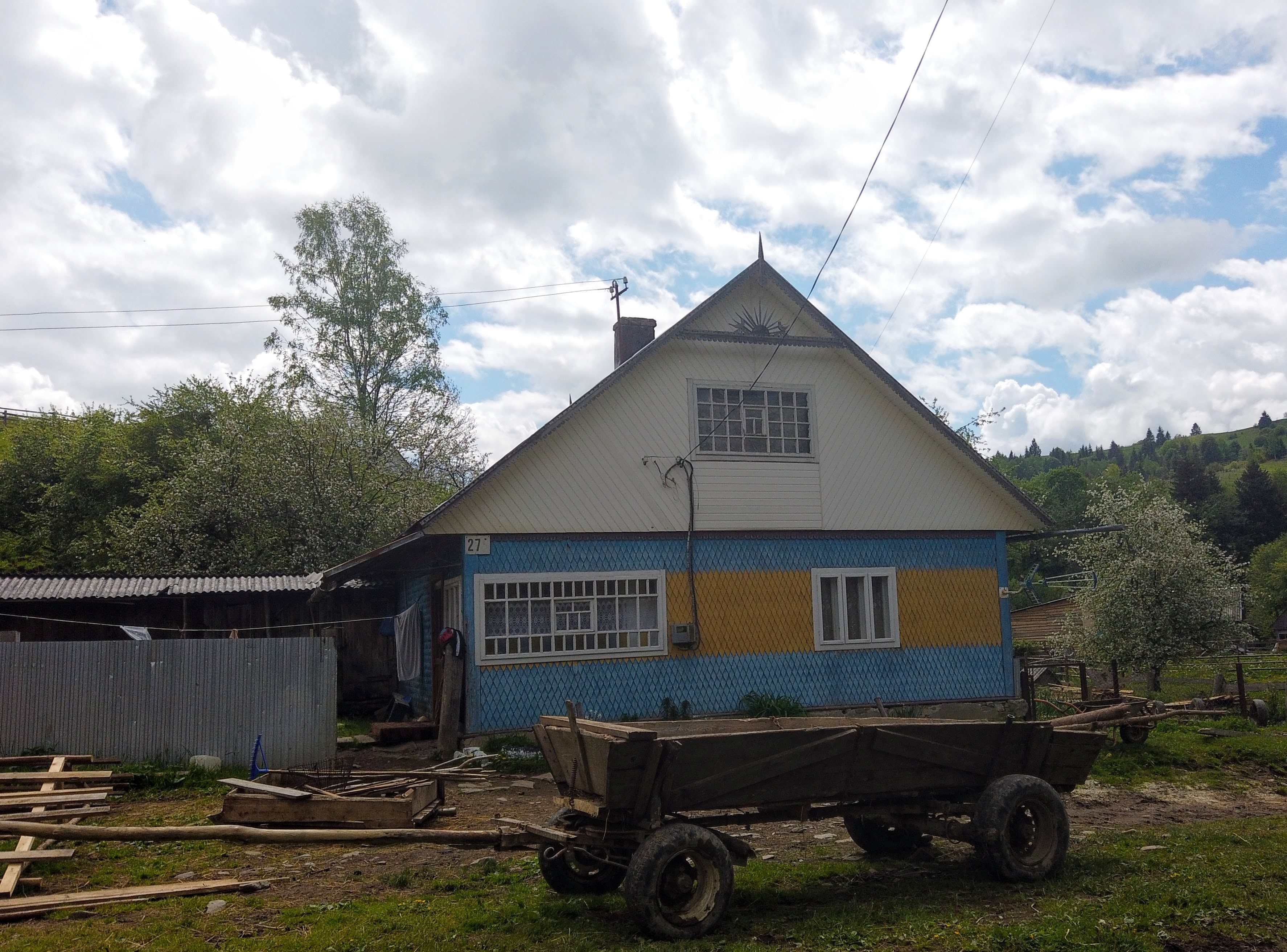 |
| Stebnyi. Residential buildings |
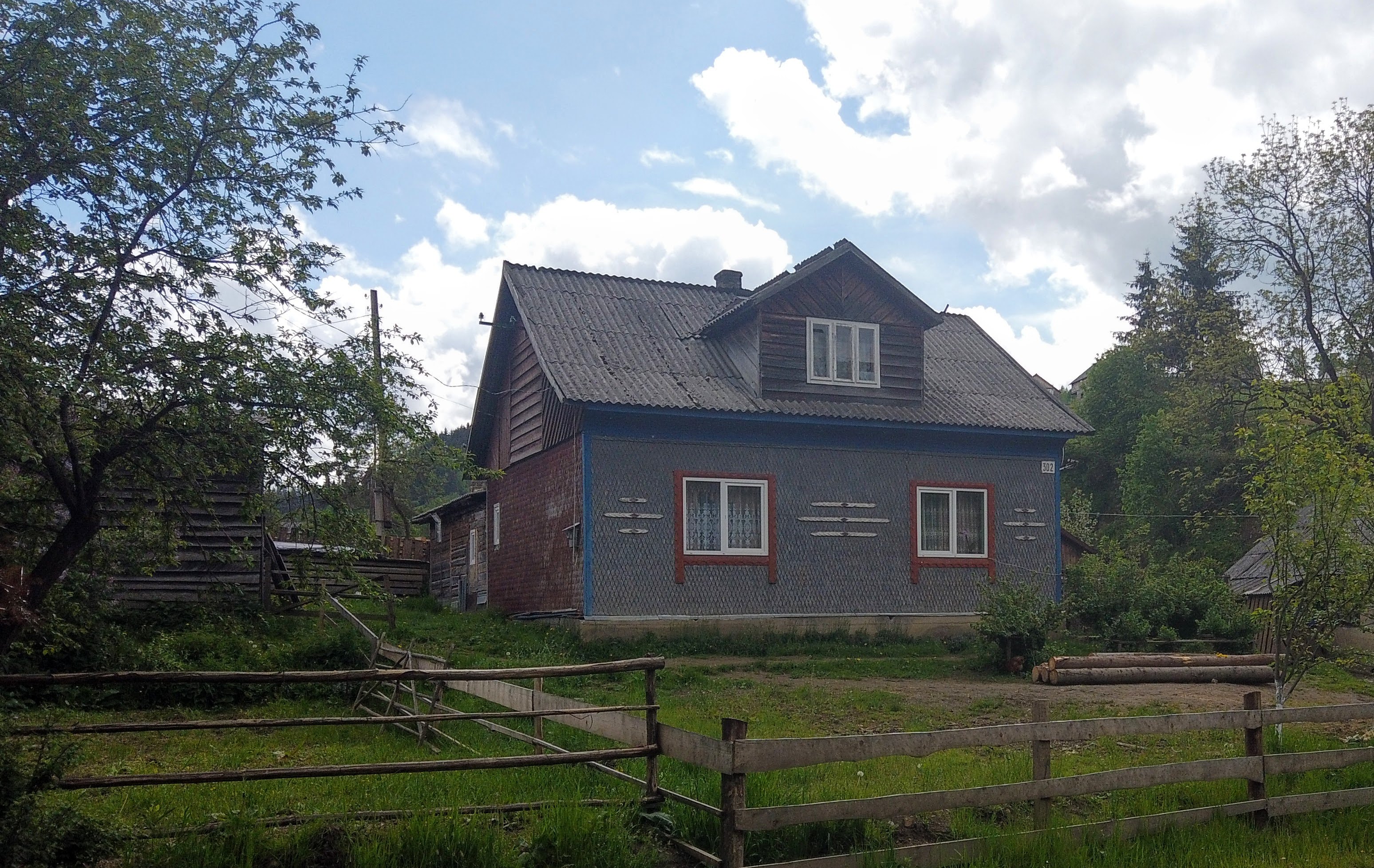
The people of Zakarpattia decorate their homes with wood carving, artistic ornamentation of the facades and figured framing of the windows.


 |
| Stebnyi. Village houses |
Almost all the houses have plaques with numbers. The villagers do not cultivate the stony-clay soil, which is unsuitable for gardening. But fruit trees, mostly apple trees, are found in the yards.


 |
| Stebnyi. Blossoming orchards |
According to 2002 statistics, 807 people lived in the village. Given the situation in the country and the general demographic decline, one may assume a reduction of the population in this Hutsul village.


 |
| Stebnyi. A village street |
An old little house of spruce logs resembles an exhibit in museums of folk architecture and daily life. Its owner Volodymyr, a builder by profession, worked in many cities, like many other skilled people of Zakarpattia. Volodymyr recalls Mariupol, where he took part in the construction of a church. What is there now in that long-suffering city?
 |
| Stebnyi. An old house |
The devout Hutsuls build chapels not only by the road but also in their own yards, glorifying the Lord. The doors of the chapels stand open; anyone who wishes may enter and pray before the holy images.


 |
| Stebnyi. A chapel |
The main shrine of Stebnyi was built in 1856. When I saw the Church of the Holy Myrrh-Bearing Women, I remembered Olena's advice at the start of my journey - two houses before the church lives the sexton Stepan, who can open the house of prayer. But the distances between houses in mountainous terrain can be hundreds of metres, and I did not have time to go back half a kilometre. The church stands on a rise on the grounds of the village cemetery.

 |
| Stebnyi. The Church of the Holy Myrrh-Bearing Women, 1856 |
In the years of Soviet rule it was closed, but it survived thanks to a museum being housed there. The opening and restoration of the shrine began in the years of Ukraine's Independence. Despite its status as an architectural monument of local significance, the church did not escape drastic renovations, and the place of worship lost the architectural features of the Hutsul style.
 |
| Stebnyi. The Church of the Holy Myrrh-Bearing Women before the 2016 reconstruction. Photo from www.risu.org.ua. |


 |
| Stebnyi. The Church of the Holy Myrrh-Bearing Women after the 2016 reconstruction |
It is a great pity that the jack-of-all-trades masters of Zakarpattia, who have built hundreds of churches across all of Ukraine, are not always able to fully preserve the authenticity of the monuments of sacred architecture in their own villages. Already on my way out of the church yard I met a man walking towards me. It was that same Stepan, who performed the duties of sexton and administrator of the Myrrh-Bearers' Church.
 |
| Stebnyi. The grounds of the Church of the Holy Myrrh-Bearing Women, 1856 |
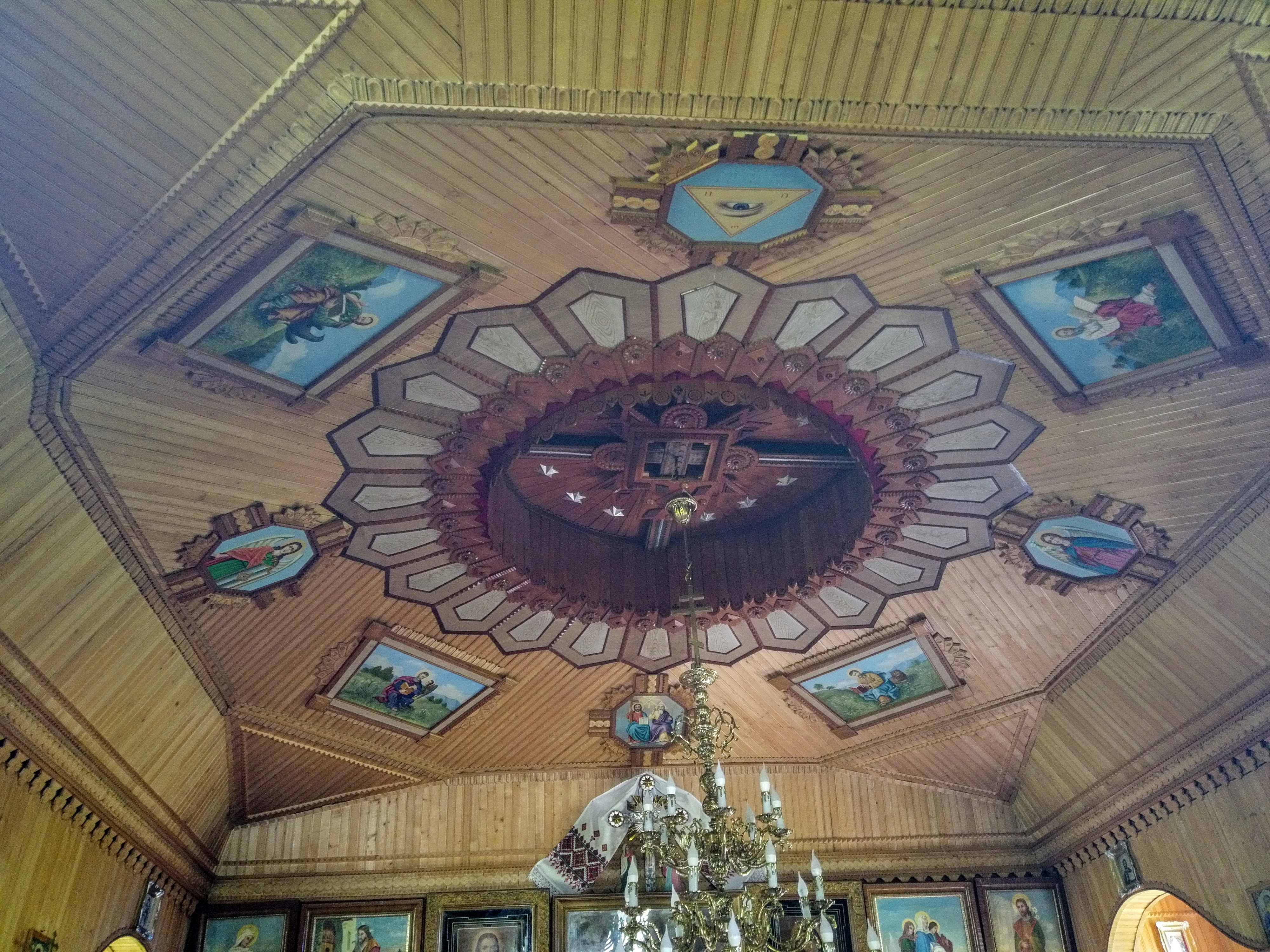
The long journey was crowned with luck: Stepan hospitably opened the church so that I could see the interior. The internal decoration of the church has been preserved in the traditions of Orthodox wooden Hutsul churches, with a renewal of the wall panelling and the replacement of the carved iconostasis. Rushnyky embroidered by the craftswomen of Zakarpattia adorn the holy images and fill the religious space with light and purity.


 |
| Stebnyi. The Church of the Holy Myrrh-Bearing Women. 1856 |
The bell tower, square in plan with an octagonal second tier, is a contemporary of the church.


 |
| The bell tower of the Church of the Holy Myrrh-Bearing Women |
A chapel built in recent years is open to parishioners at all times.


Next to the church stands the primary school. It is good that the educational institution has been kept for the younger pupils and that the building, erected by the Czechoslovak government in the 1930s, has been repaired.

 |
| Stebnyi. The primary school |
The club is not only the centre of culture of the Hutsul village. Part of the premises is occupied by a paramedic station. I do not know how the establishments operate, but the plaques on the facade attest to their location, and also that the club is overseen by the Ministry of Culture and Tourism.

 |
| Stebnyi. The club and the paramedic station |
Walking along the "wise" road, as Volodymyr called the winding street, I met local residents who greeted me warmly, and some were curious about whom the guest had come to visit. I thank all my new acquaintances for their hospitality and humanity, for the invitations to lunch and coffee, and for the interesting stories.
 |
| Stebnyi. The central street |
This story is also available in Ukrainian: Стебний. Нетуристичний маршрут до гуцульського села у туристичних Карпатах

No comments:
Post a Comment
Leave your impression