 |
| Yasinia, Rakhiv district, Transcarpathian region |
The settlement of Yasinia lies in the valley of the mountain river Chorna Tysa, at the point where it merges with its tributary the Lazeshchyna.
 |
| Yasinia. The confluence of the Chorna Tysa and the Lazeshchyna |
 |
| Yasinia. The Chorna Tysa |
Once the area was surrounded by dense forests dominated by ash trees (yaseny), and from this the toponym derives. These guardian trees rise in a green corridor along the settlement's streets.

 |
| Yasinia. The map and coat of arms of the Rakhiv district and a map of the Transcarpathian region on the colonnade |
One of the suspension bridges over the Tyschora, as the locals call the water artery, leads to Yasinia's main landmark — the wooden Church of the Ascension of the Lord.
This house of God was built in 1824 in the Hutsul style and has held the status of an architectural monument since Soviet times. Since 2013 the religious building has been a UNESCO heritage site.
 |
| Yasinia. The Church of the Ascension of the Lord (the Struk Church). 1824 |
The iconostasis has survived from the time the church was built. The bell tower is even older than the church — it was raised in 1813.
 |
| Yasinia. The Church of the Ascension of the Lord. 1824 |
The church stands on a hill, from which a panorama of the settlement opens up.

 |
| Yasinia. The Church of the Ascension of the Lord |
This house of prayer is known as the Struk Church, in honour of its founder and first settler, Ivan Struk.
According to legend, 400 years ago the shepherd Ivan Struk was driving sheep from the Dniester lands to Transcarpathia. Having crossed the Yablunytsia (Tatar) pass, Ivan made a halt on the bank of the Chorna Tysa so that his family and flock could rest. The long journey dragged on into autumn, and the travellers were overtaken by a snowstorm that did not abate for 3 days. Struk decided to head home, leaving the large flock of sheep in the valley. Returning in spring and not expecting to see the animals alive, the shepherd was astonished to find his charges — and even with offspring. Taking the survival of the flock as a fateful sign, Struk settled on a new place to live and, to mark these blessed events, built a church on the hill that was the predecessor of our shrine.
.JPG "Yasinia. The Church of the Ascension of the Lord. A UNESCO heritage site") |
| Yasinia. The Church of the Ascension of the Lord. A UNESCO heritage site |
The veteran ash tree, the legendary Ivan Struk and his epic sheep are depicted on the settlement's coat of arms.
 |
| Yasinia. The settlement's coat of arms |
In honour of the pioneer, a bas-relief of Ivan Struk is mounted on the façade of the museum.
 |
| Yasinia. The Museum of History and Local Lore. The bas-relief of Ivan Struk |
The Yasinia Museum of History and Local Lore is well worth a visit for anyone wishing to learn more about the life and traditions of the Hutsul region. This cultural and educational institution stands in the central part of the settlement, in a two-storey wooden building.
 |
| Yasinia. The Museum of History and Local Lore and the monument to Stepan Klocharuk |
On the ground floor is gathered a rich collection of national dress, embroidered towels, everyday objects, tools and photographs, among which are unique examples. There is an exhibition devoted to the forest riches of the Yasinia area. On the upper floor are collected paintings by local artists whose main themes are the landmark church, the nature of their native land, Hutsul beauties and flowers.

 |
| Yasinia. The Museum of History and Local Lore |
On the square in front of the museum stands a monument to Stepan Klocharuk, president of the Hutsul Republic, whose creation was one of the harbingers of Ukraine's independence. To another Yasinia native, Dmytro Klympush, an organiser of the Hutsul Republic, a monument was erected on Myru Street.
 |
| Yasinia. The monument to Dmytro Klympush |
On the House of Culture a memorial plaque has been unveiled about the naming of the square in honour of Stepan Klocharuk.
 |
| Yasinia. The memorial plaque in honour of Stepan Klocharuk |
Two other churches can be considered historical landmarks, although they have no official status. The Catholic Church of the Holy Apostles Peter and Paul has stood on the central street since 1814.
.JPG "Yasinia. The Church of the Holy Apostles Peter and Paul. 1814") |
| Yasinia. The Church of the Holy Apostles Peter and Paul. 1814 |
The Roman Catholic church bears an architectural resemblance to the Orthodox Church of the Protection of the Blessed Virgin Mary, built in 1903.
 |
| Yasinia. The Church of the Protection of the Blessed Virgin Mary. 1903 |
On the grounds of the Greek Catholic Church of the Holy Eucharist, a wooden chapel with a shingle roof is worthy of attention. Small wooden churches were built in remote highland settlements.

 |
| Yasinia. The Church of the Holy Eucharist |
Yasinia's cultural heritage includes the Jewish cemetery, situated on a high hill in the northern part of the settlement.
At the end of the 19th century, the Jews of the town were engaged in delivering provisions. The synagogue was housed in a building that now belongs to the fire station.
 |
| Yasinia. The fire station. The former synagogue |
During the years of the Second World War and the Holocaust the Jewish community was destroyed. On the kirkut, stone gravestones have survived on which, according to Jewish tradition, no portraits or sculptural compositions are placed. The portals depict animals, plant ornament and religious symbols.

 |
| Yasinia. The kirkut |
The central road runs along Myru and Hrushevskoho streets and is a section of the N 09 motorway, which links the Transcarpathian and Ivano-Frankivsk regions. Horse-drawn transport, popular and necessary in mountainous country, is often met on this road of national significance.
 |
| Yasinia. Myru Street. Horse-drawn transport |
Yasinia has quite a lot of shops, as well as cafés and pizzerias. Every Friday, trading stalls gather in the central part of the settlement with all manner of goods, representing every district of Transcarpathia.


 |
| Yasinia. Shops and trading stalls |
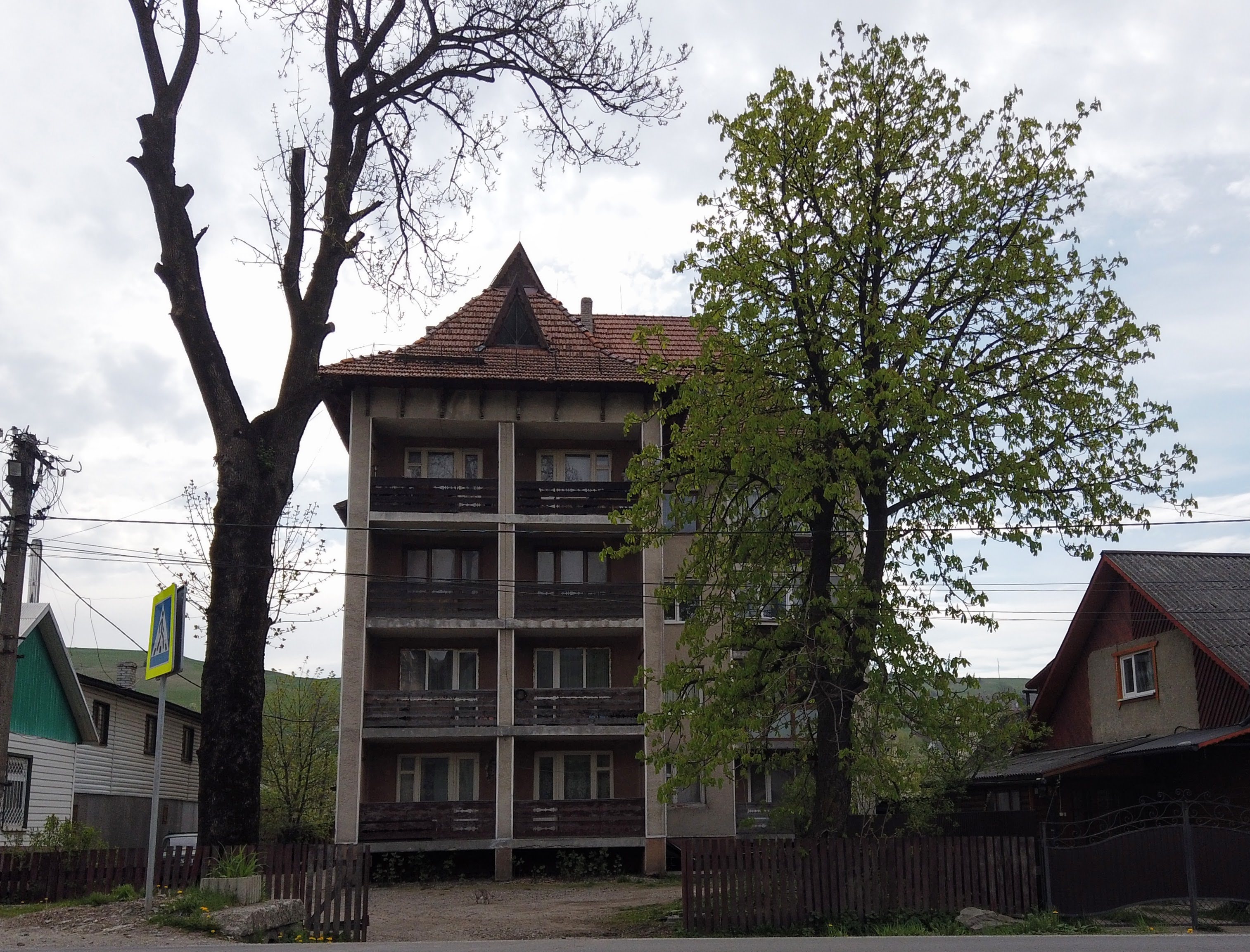
The residential development consists of the private sector and a few apartment blocks, which were built for the workers of the furniture factory and the timber mill.


 |
| Yasinia. Residential development |
Woodworking and wood carving remain one of the main crafts of the settlement's residents, despite the closure of the state enterprises.

 |
| Yasinia. The production buildings of a woodworking enterprise |
On the grounds of the Yasinia forestry administration, informational displays have been set up with specimens of native Carpathian trees, which serve as visual aids for those studying the forest and its inhabitants.

 |
| Yasinia. The grounds of the Yasinia forestry |
A souvenir shop is decorated with original sculptures, selling distinctive toys, crafts and tableware made by local craftsmen. Tourists and visitors to the settlement gladly buy souvenirs and useful household items.

 |
| Yasinia. The souvenir shop |
Such chairs are made in Yasinia, perhaps from the forefather ash trees themselves.
 |
| Yasinia. Wooden thrones |
The settlement has a bus station where interregional service buses stop: Mukachevo-Kolomyia, Ivano-Frankivsk-Rakhiv, Ivano-Frankivsk-Tiachiv and others. The suburban train Kolomyia-Rakhiv stops at the railway station.
 |
| Yasinia. Rakhiv district, Transcarpathian region |
This story is also available in Ukrainian: Ясіня. Історичний, туристичний, культурний центр Закарпаття. І не лише гори

No comments:
Post a Comment
Leave your impression