 |
| Yasinia, Zakarpattia region. The Strukivska Church |
So what is special about this religious building, and why has the church been granted protected status?
The Church of the Ascension of the Lord is located in a picturesque spot at the foot of the Carpathian peaks on the bank of the Chorna Tysa. The crossing over the babbling watercourse is a suspension bridge with a fairly large amplitude of sway, which creates a sense of an unearthly state from the very first steps on the way to the shrine.
 |
| Yasinia. The bridge over the Chorna Tysa river |
The house of prayer rises on a hill, from which at any time of year a charming panorama opens onto the undulating landscapes, mountain ridges and majestic forests.
 |
| Yasinia. The Church of the Ascension of the Lord. 1824 |
An information board announces that the place of worship is listed on the transboundary Carpathian route of wooden architecture, which includes 95 sacred structures on the Ukrainian side and 103 on the Polish side. The project was created for the purpose of preserving and popularising the monuments of wooden architecture.
 |
| Yasinia. The information board beside the Ascension (Strukivska) Church |
The board presents historical information about the appearance of the church in Yasinia. According to tradition, four hundred years ago the shepherd Ivan Struk was driving a herd from the Dniester region to Zakarpattia. Having crossed the Yablunytsia (Tatar) Pass, the Hutsul, with his family and his flock of sheep, made a halt in the valley of the Chorna Tysa river. The area was surrounded by dense forests in which mighty ash trees predominated. The journey dragged on, and the autumn weather with its endless snowfall overturned all the plans of the desperate traveller. It was impossible to move with the flock through the snowdrifts, and Ivan decided to return home without the herd. Not hoping to see the animals alive, in spring the shepherd found the sheep unharmed and with an increase in their numbers. Having multiplied his sheep wealth, Struk changed his place of residence, settled in this blessed land and built houses under the ash trees. Thanking God for the wonderful rescue, the Hutsul erected a chapel, which was the forebear of our beautiful church.
 |
| Yasinia. An ash tree and a cross on the memorable spot |
The present shrine dates from 1824.

 |
| Yasinia. The Church of the Ascension of the Lord. 1824 |
Cruciform in plan, single-domed and five-frame, the structure belongs to the Hutsul style of folk architecture. The tented octagonal dome is crowned by a decorative top. Smaller cupolas complete the four side frames adjoining the central frame. A wide, sloping canopy girdles the church.


 |
| Yasinia. The Church of the Ascension of the Lord. Wooden constructions and details |
The gable roof is covered with shingles, which were partly renewed during the reconstruction. An even larger batch of narrow boards is kept in the church yard for future repairs.

.JPG "Yasinia. The Church of the Ascension of the Lord. Shingles")
The graceful two-tiered bell tower was built in 1811-1813, but until 1895 its bells announced the service at another church, which was located in the northern part of the settlement. After a fire, the surviving bell tower was moved to the Ascension Church, forming a harmonious ensemble of religious buildings of Hutsul folk architecture.


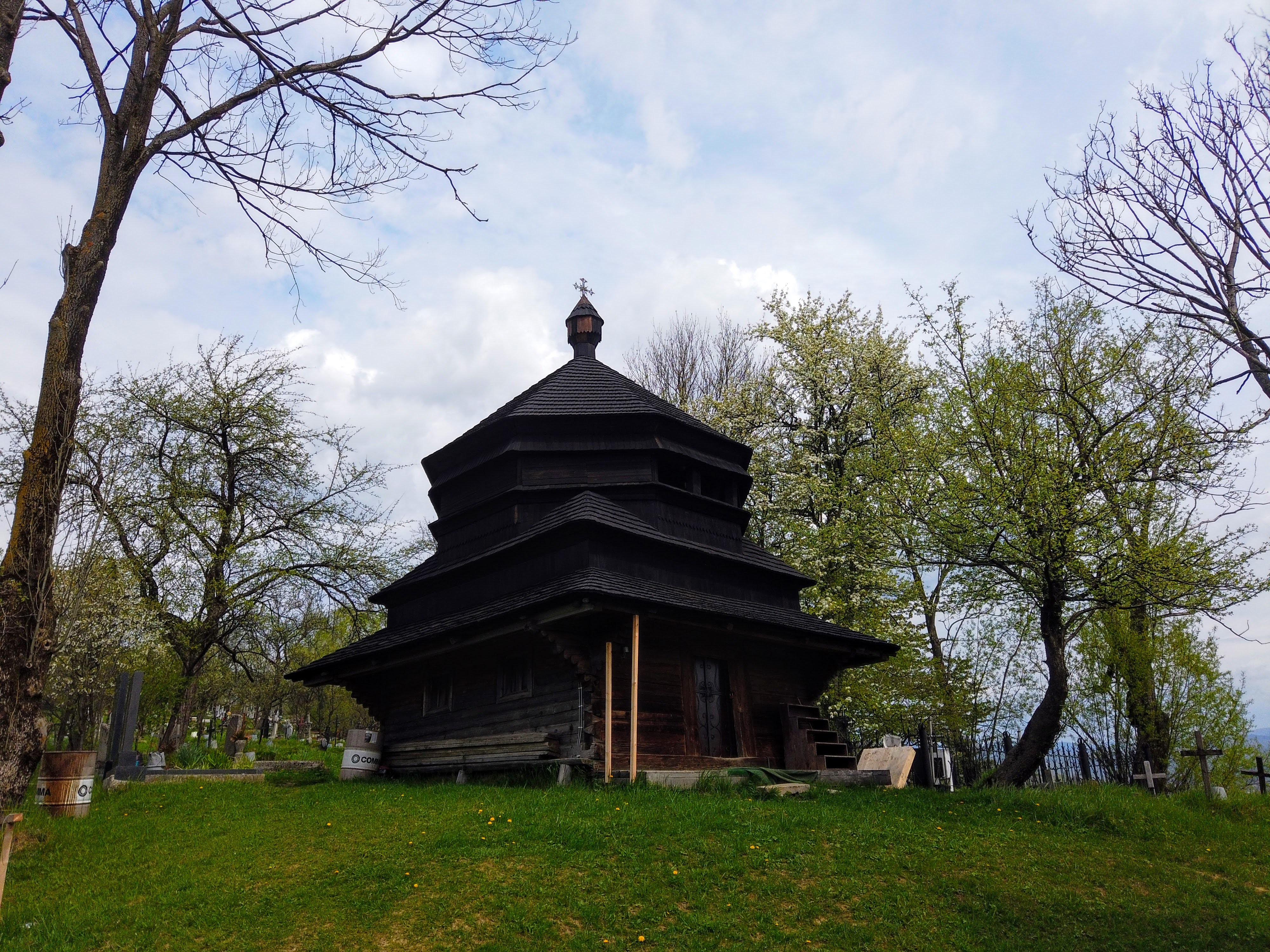 |
| Yasinia. The Church of the Ascension of the Lord. The bell tower |
Square in plan, the structure has an octagonal second tier and is crowned by a tented roof with a small cupola. The transverse multi-row canopies create an effect of striving upward, closer to the heavens.


 |
| Yasinia. The Church of the Ascension of the Lord. The bell tower |
The church has preserved a carved iconostasis, holy images and other relics that are already almost 200 years old. In the Strukivska Church, services are held by the Orthodox and the Greek Catholic communities.

 |
| Yasinia. The Church of the Ascension of the Lord |
In Soviet times the church acquired the status of an architectural monument; in 2018 it was recognised as an architectural monument of national significance. The church did not lose its grandeur during the years of wartime hardship, Soviet God-fighting, or in our own time, when many churches have lost their authenticity after drastic repair works using plastic and other modern building materials.
It is important that the communities, the local authorities and the master restorers continue to maintain the satisfactory condition of this object of the cultural heritage of Zakarpattia and of all Ukraine as fully as possible.
This story is also available in Ukrainian: Ясіня. Струківська церква Вознесіння Господнього зі статусом національної пам'ятки та спадщини ЮНЕСКО

No comments:
Post a Comment
Leave your impression