 |
| Lazeshchyna, Rakhiv district, Zakarpattia region |
Lazeshchyna is the easternmost settlement of Zakarpattia region and borders the Ivano-Frankivsk region. One version of the toponym's origin speaks for itself - a laz (a crossing) between Zakarpattia and Halychyna. The root "Laz" means a place on a border, a crossing, a checkpoint. In olden days there was a fortified outpost with a customs house here.
From the neighbouring Ivano-Frankivsk region, the national road H 09 runs to Lazeshchyna over the Yablunytsia Pass. For the locals, the woodcutters, the shepherds and the tourists there is a forest path along the mountain ridge, and it was along this path that I walked to Lazeshchyna from the village of Yablunytsia in the Nadvirna district of Ivano-Frankivsk region.

 |
| Lazeshchyna. The Carpathian mountains and polonynas |
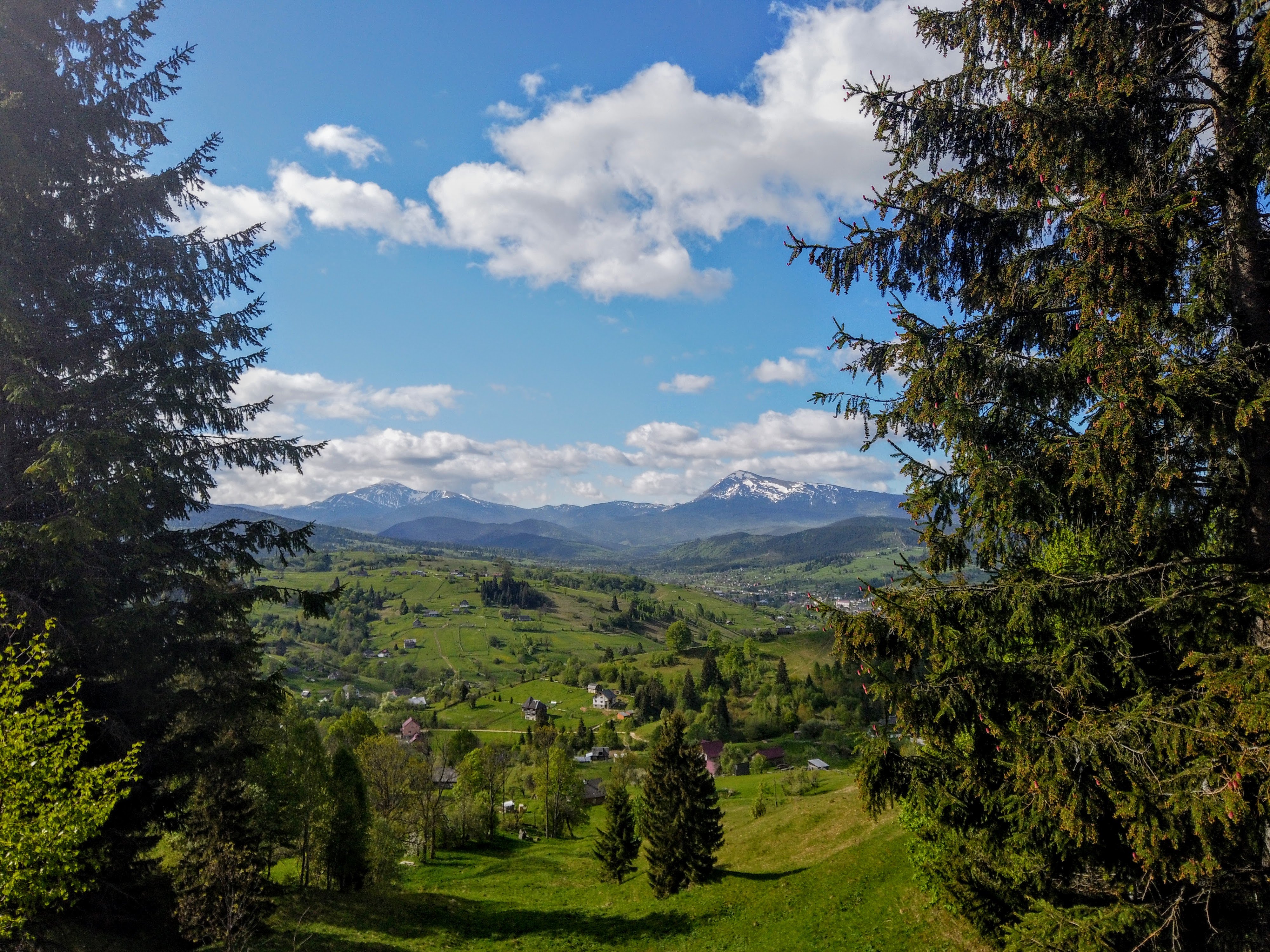
The stunning landscapes, the melody of the mountain river Lazeshchyna and the mountain air stir a genuine feeling of delight and strengthen the urge to hike along the picturesque ridge.


The green massif belongs to the Lazeshchyna forestry, and its guardian, the forester Mykhailo, makes daily rounds of his patch, checking the holding for fire safety and illegal logging. The forest has conservation, scientific, historical-cultural and recreational-health value. The queen of the Carpathian green riches is held to be the spruce, and her domain is filled out in splendour and picturesqueness by beech, ash, sycamore, fir and alder. You admire the forest and the mountain ridges and delight in the trills and whistles of the black grouse, the cuckoo, the capercaillie, the crossbills, the redstart, the eagle owl and other birds. Roe deer, bears, wild boars, foxes, wolves, badgers, lynx, otter and mink are inhabitants of the Carpathian land. Mykhailo warns that lately many snakes have been appearing in the thickets and damp places, and one must be careful in the green kingdom.


The forest gives way to meadows and clearings covered with grassy vegetation, good fodder for livestock. On the fenced pastures the villagers graze cows, horses and goats.


The traditional trade of the Hutsul region is sheep farming. Flocks, their little bells jingling, roam freely over the slopes, accompanied by their herdsmen.


Lazeshchyna is known for its historical events and dates. Not far from the pass, a rebel band operated under the leader Oleksa Dovbush. During the First World War the Russian army made a breakthrough in the Lazeshchyna area. A memorial sign has been placed on the spot where O. O. Borkaniuk, a native of Yasinia and a leader of the underground, was parachuted in during the Second World War.
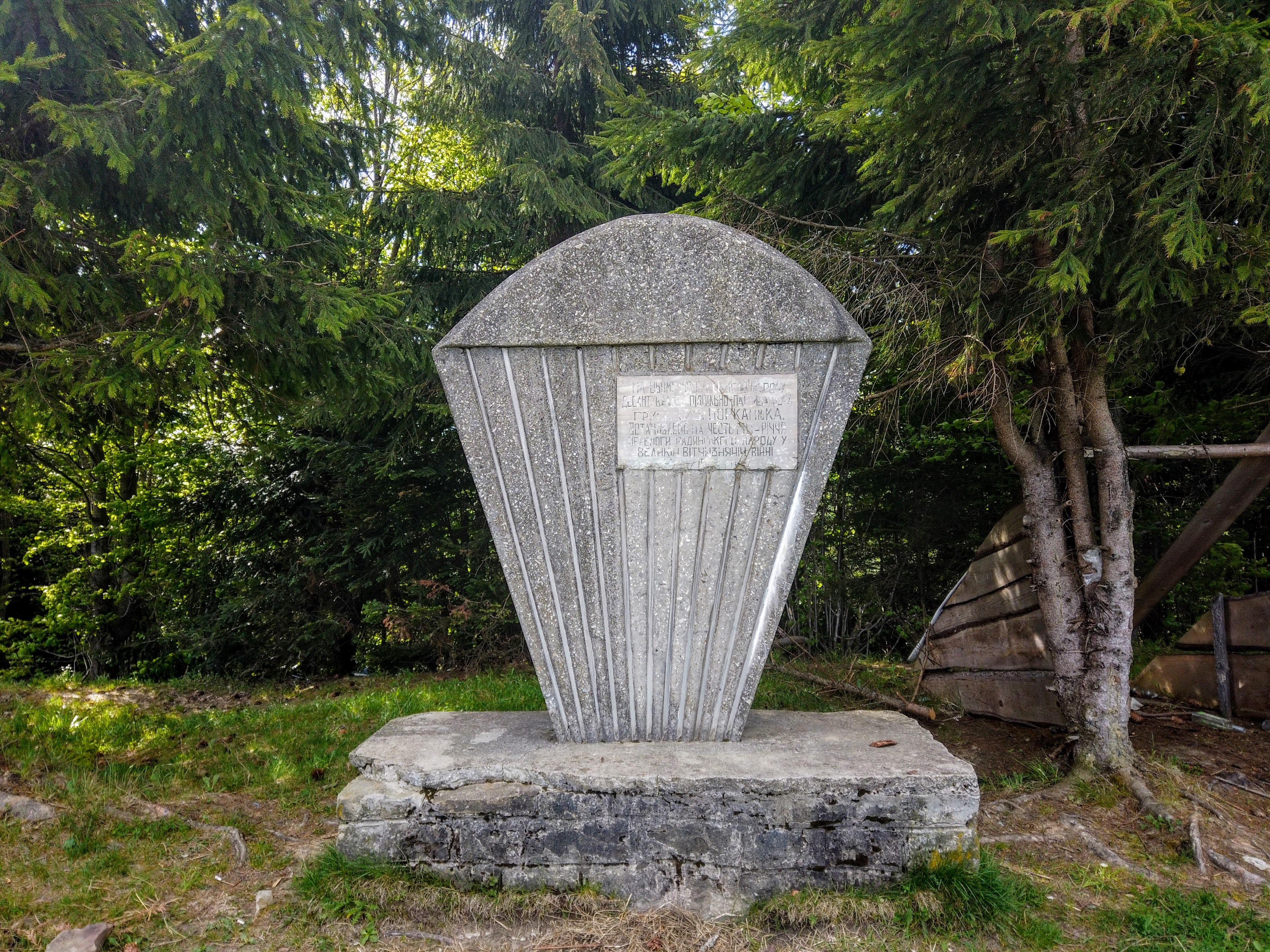 |
| Lazeshchyna. Memorial sign to the partisans and O. O. Borkaniuk |
A ruined wooden house right at the crest of the ridge is a witness of years gone by and of the life of a Hutsul family. The fruit trees left in the village yard go on blossoming and bearing, resisting the winds and the neglect.


The rain washes the clay from the road, exposing the stones and forming potholes. Not every car manages to get over the ridges and humpy rises. Motorcycles and horse-drawn transport move along the forest tracks without much trouble, and for a walker the promenade in good weather is a pleasure.


In the mountains you come across lonely graves of those who died in bad weather or in an accident.

To the huge spruce that towered like a stern sentinel on the highest hill I walked about 4 kilometres along a winding and hilly road.
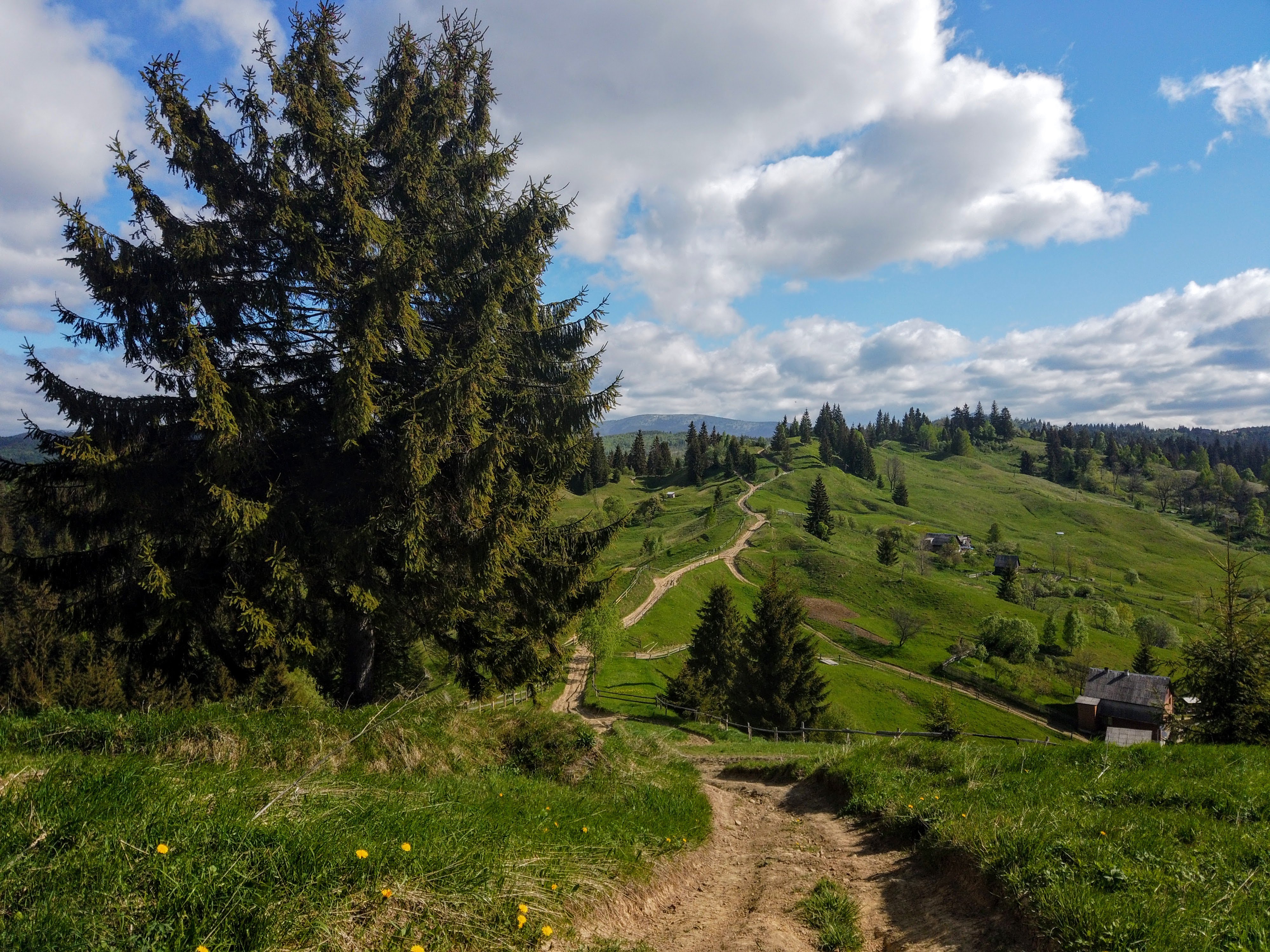

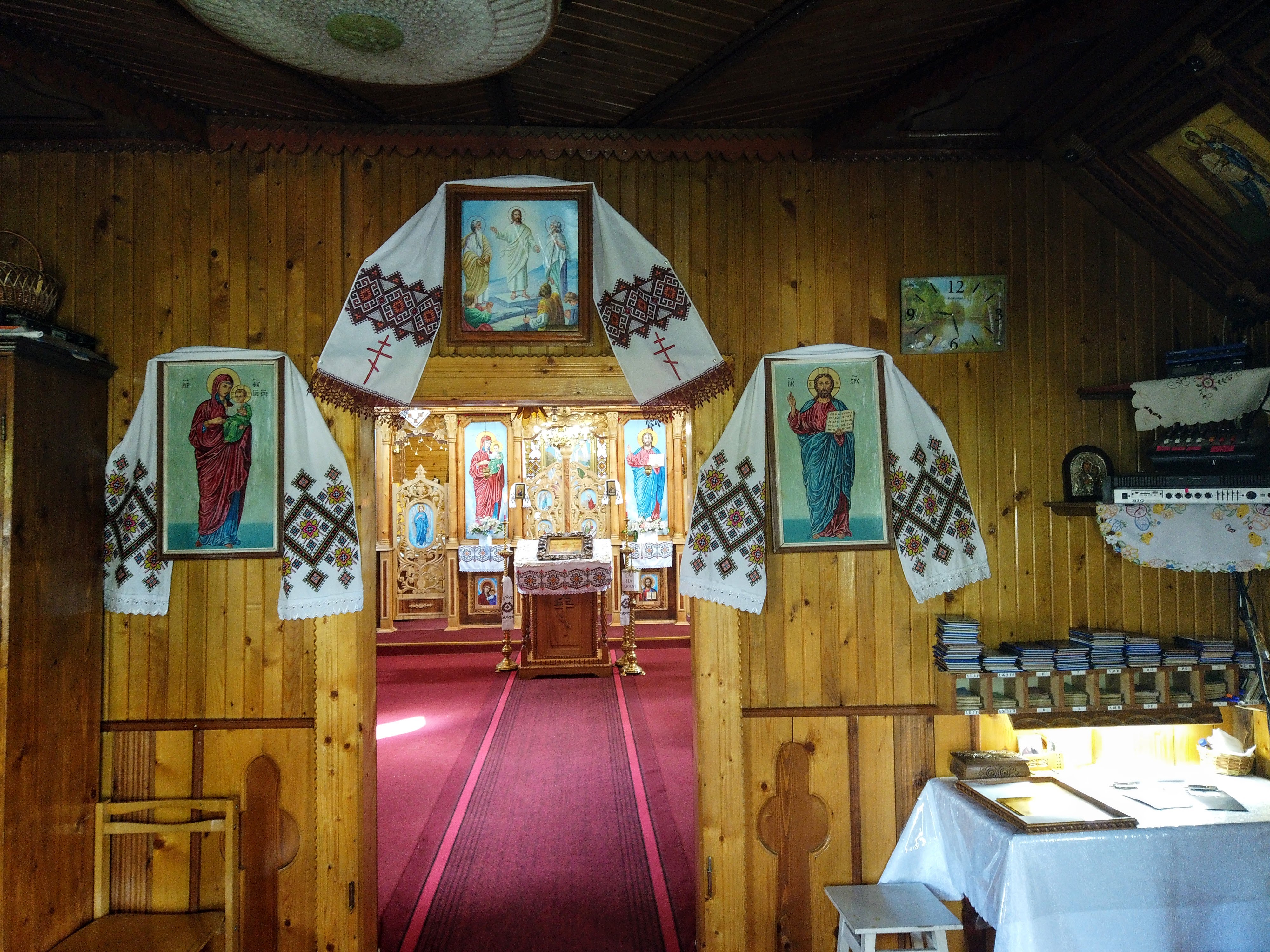
Paths stretched down the slope to the village homesteads, and one of them led me to the wooden church of the holy prophet Elijah, which belongs to a Greek Catholic community. The faithful come to services from the surrounding villages where there are no UGCC churches. Until 1944 the Greek Catholics owned the Church of Sts. Peter and Paul, built in 1827. Registered anew in 1991, the UGCC community later erected a new church. This church, with its built-in bell tower, was consecrated in 2013. As in all wooden churches, a carved iconostasis has been made here, and the holy icons are adorned with ritual towels.
 |
| Lazeshchyna. Church of the Holy Apostles Peter and Paul. UGCC |
The shrine stands beside the H 09 highway, along which I continued my acquaintance with Lazeshchyna, heading towards the centre of the village in a south-westerly direction.

A signpost recalls the distances: to the district centre - 36 kilometres, and to the regional centre - 245 kilometres. The Rakhiv district is the most remote from Uzhhorod and lies in the south-east of the region.
 |
| Lazeshchyna. The H 09 highway |
Roadside chapels and crosses are put up by the people of the western regions at the roadsides, at crossroads and at the boundaries of settlements.

 |
| Lazeshchyna. Chapels |
The bus stop, too, is built of wood. Buses on inter-regional routes stop here: Rakhiv-Ivano-Frankivsk, Kolomyia-Mukachevo, Tiachiv-Ivano-Frankivsk and other services.
 |
| Lazeshchyna. The bus stop |
The centre of the village - the village council, the outpatient clinic and pharmacy, the kindergarten, the school, the unfinished house of culture, the shops and cafes.
 |
| Lazeshchyna. A kolyba cafe |
 |
| Lazeshchyna. The stage for public events |
 |
| Lazeshchyna. The unfinished house of culture |
 |
| Lazeshchyna. The outpatient clinic and pharmacy |
 |
| Lazeshchyna. The village council |
 |
| Lazeshchyna. The kindergarten |
 |
| Lazeshchyna. The school |
 |
| Lazeshchyna. Monument to the Fighters for the Freedom of Ukraine |
 |
| Lazeshchyna. A shop |
 |
| Lazeshchyna. A panel on the shop facade |
 |
| Lazeshchyna. A chapel and a flagpole |
The people of Lazeshchyna cherish their shrine - the wooden Church of the Holy Apostles Peter and Paul - and in a few years they will mark its 200th anniversary. The church would have kept its authenticity had its gabled shingle roof not been covered with sheet metal more than a hundred years ago.


 |
| Lazeshchyna. Church of the Holy Apostles Peter and Paul. 1827 |
The church and its built-in bell tower with a two-tiered roof have little windows. In the church yard the parishioners light candles for health and for the repose of the dead in two chapels.


 |
| Lazeshchyna. Chapels |
An old cemetery with figured metal crosses surrounds the church on all sides.

There are benches in the church, and people of venerable age can sit during the service. On great feast days the little old church cannot hold all the faithful. A new brick church with gilded domes was consecrated in 2022; its construction lasted 20 years. According to the parishioners, only three churches in Ukraine have a similar design.
 |
| Lazeshchyna. The church under construction |
There is yet another Orthodox church in Lazeshchyna, but to reach it I had to walk a further 4 kilometres. A locality with a similar name has been known since the end of the 18th century. The village stretches for 10 kilometres along the bed of the river of the same name, whose sources rise on the Chornohora massif.
The mountain water stream Lazeshchyna shaped the main street along which the highway runs. Over the blue artery are thrown road bridges and pedestrian suspension crossings.

 |
| Lazeshchyna. The Lazeshchyna river |
In Soviet times Lazeshchyna underwent an administrative reorganisation, and several neighbouring villages were merged into a single settlement. The residential sector is made up of wooden houses in the Hutsul style and of modern homesteads that keep the national traditions. The main street is called Tsentralna (Central). On most facades there are little plaques with numbers, and the numbering exceeds 1500.


 |
| Lazeshchyna. Residential buildings |
The Church of the Transfiguration stands in the Plytuvatyi tract near the village of Yasinia. The church was built of spruce beams in 1780 in neighbouring Yablunytsia beyond the pass and, almost a hundred years later, was moved to its permanent place at Plytuvatyi.

 |
| Lazeshchyna. Church of the Transfiguration of the Lord. 1780, 1871 |
The Hutsul church consists of five log frames that intersect into a rectangle and form a cross. Four of the frames are covered with a gabled roof, and the central frame with an octagonal tent roof. The building has three doors, and the central entrance is supported by posts. In Soviet times the shrine was turned into a museum, which saved it from destruction.

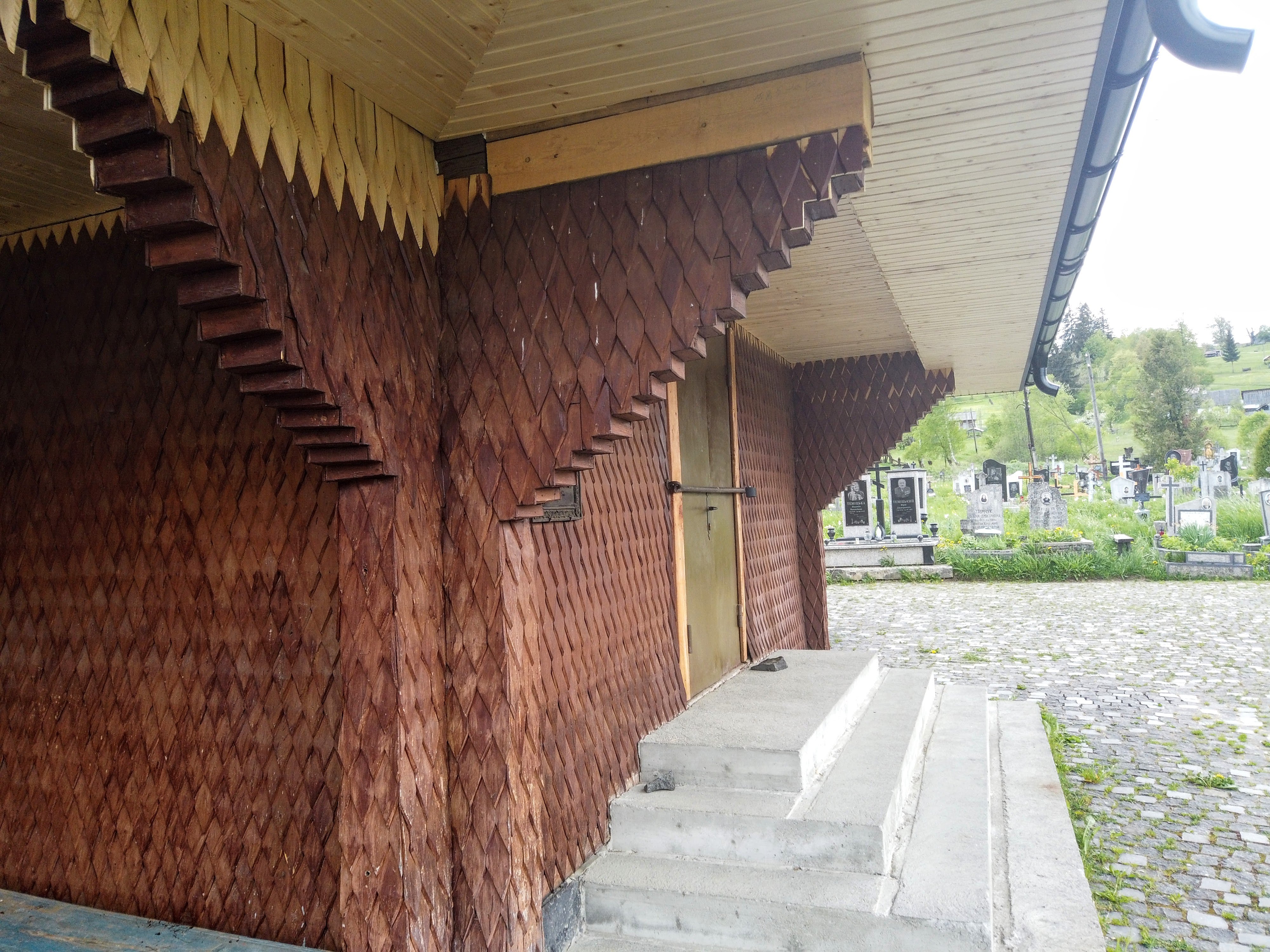

Judging by the protection plaque, the church was granted landmark status during the years of Soviet rule. The latest repair, using modern materials, replaced the metal covering with a bitumen roof.


The multi-tiered carved iconostasis was made by local masters.
The two-tiered bell tower is also built of spruce beams, but the sheet metal from an earlier restoration remains on it. The lower tier is surrounded by a canopy, and the upper tier is covered with a hip roof. On all four sides the rectangular sound openings are closed with shutters.


 |
| Lazeshchyna. The bell tower of the church at Plytuvatyi |
Getting to know the natural and man-made landmarks of the Hutsul village of Lazeshchyna, I reached the neighbouring village of Yasinia. The total distance came to about 14 kilometres, part of it over hilly terrain.

 |
| Lazeshchyna. The H 09 highway and the "Yasinia" signpost |
My thanks to all the residents of Lazeshchyna I met along the way, for their hospitality and their stories about their village.
 |
| Lazeshchyna, Rakhiv district, Zakarpattia region |
This story is also available in Ukrainian: Лазещина. Заповідна та туристична зона у Закарпатті. Три дерев'яні церкви в селі на Гуцульщині

No comments:
Post a Comment
Leave your impression