Rakhiv. A Staging Point for Tourists. To Go or Not?
Rakhiv is the highest-lying town in Ukraine and a town situated near one of the geographic centres of Europe. Lovers of mountain ascents come here to conquer the Ukrainian two-thousanders and the other summits of the mighty Carpathians. What can one see in Rakhiv, making an intermediate stop in the course of transit tourism?
Rakhiv, Transcarpathian region
Between Uzhhorod and the most remote district centre of the Transcarpathian region there is no direct rail connection. By transport Rakhiv is far more closely tied to the Ivano-Frankivsk region, from where one can arrive unhurriedly on the sooty Kolomyia-Rakhiv diesel, which keeps all the characteristic features of the legendary Rakhivoz, with its eternal lateness and its old carriages.
The suburban train Kolomyia-Rakhiv
The absence of a station square, the close placing of all sorts of trading points and kiosks right by the station, and also the enormous flow of motor transport, create a sense of chaos and disorder from the first minute of stepping off the train.
Rakhiv. The suburban station
A hundred metres from the railway station stands the bus station, which heightens the confusion and disorder, especially in the peak periods of the invasion of skiers and travelling folk. While waiting for a bus, do not count on an announcement of its arrival; keep track of the timetable yourself and go round the platforms on your own in search of the marshrutka you need. Among the clutter of beer bars, fast-food kiosks and a five-storey residential block, a place has been found for a small square, in the midst of which rises a figure unusual for Transcarpathia — that of the baptiser of Kyivan Rus, Volodymyr the Great.
Rakhiv. The monument to Volodymyr the Great. Sculptor — Yurii Haviuk
In this noisy, crowded and fume-filled place, far from any observance of sanitary norms, opposite the railway and bus stations stand the medical departments of the district hospital. On the side of Karpatska Street the hospital grounds border on the dense array of market stalls and the many-voiced throng of buyers and traders. On the north-eastern outskirts of Rakhiv, from the confluence of the Bila and the Chorna Tysa, the international water artery of the Tysa is formed.
Rakhiv. The Tysa river
"Transparent and wide", as Sandor Petofi wrote of the Tysa, it has choked on streams of plastic waste.
The banks of the Tysa-turned-rubbish-chute, with their motley of imperishable bottles and bags, in no way enchant or captivate during a walk through the riverside park along Bohdan Khmelnytsky Street.
Rakhiv. The Tysa river
It is well that this ecological outrage does not open before the gaze of Taras Hryhorovych.
Rakhiv. The monument to T. H. Shevchenko in the park along Bohdan Khmelnytsky Street
The wooden kobzar, too, has turned away in sorrow from this accumulator of plastic rubbish.
Rakhiv. The sculpture of the kobzar in the park along Bohdan Khmelnytsky Street
Into the western part of the town leads a road bridge, but it is far more romantic to cross by the suspension footbridge with its great amplitude of swaying.
Rakhiv. The suspension bridge over the Tysa
On the main and longest street, Myru Street, which stretches along the bed of the Tysa, stand administrative buildings, shopping centres, hotels, banks and residential houses.
Rakhiv. Myru Street
In the shops you will not be offered the produce of Rakhiv's own makers, and you will not manage to taste a single sweet, a biscuit or a sausage made by national recipes at the local food enterprises. Even the bread in Rakhiv is for the most part brought in from elsewhere.
Rakhiv. A pysanka on Myru Street
Alas, the historic development of the Czechoslovak period has been spoiled by commercialisation, and the facades of the buildings, put up in the constructivist style in the inter-war period, are chaotically hung about with advertising and signboards.
Rakhiv. Myru Street
Since 2008 a Hutsul in a keptar and with an axe has proudly cried out, "Let us know who we are". The author of the monument, a native of Rakhiv, Yurii Haviuk, chose to depict this representative of the ethnocultural group of Ukrainians not at full height, like Volodymyr the Great, but a little below the waist, as though he were emerging from the monolith of a mountain ridge.
Rakhiv. The monument to the Hutsul. Sculptor — Yurii Haviuk
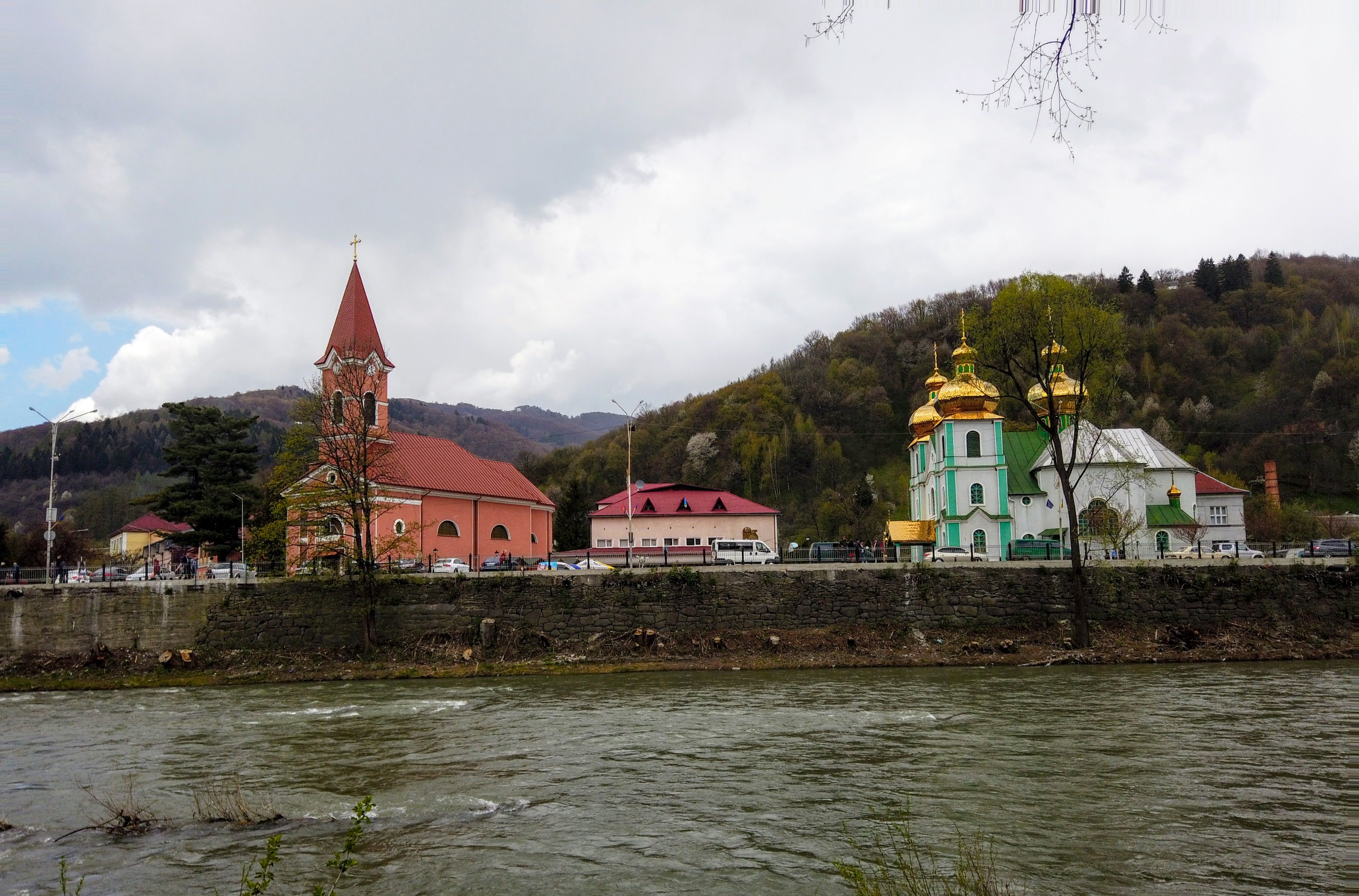
There is no pedestrian "hundred-metre" strip in Rakhiv; the people take their exercise in a promenade on a small patch between the house of culture, the Orthodox Cathedral of the Descent of the Holy Spirit and the Catholic Church of St John of Nepomuk.
Rakhiv. The Church of St John of Nepomuk. 1825
Rakhiv. The Cathedral of the Descent of the Holy Spirit. 1994
Rakhiv. The house of culture
The church with the golden tops was built in 1994; the Catholic church is 170 years older than it. Beneath the walls of the Catholic shrine, a historic landmark of which there are precious few in Rakhiv, the mushroom-like trading stalls "feast to their own profit".
Rakhiv. The Church of St John of Nepomuk. 1825
Around the square children's cars race about, tracing their turns and creating obstacles to the unwanted parking of grown-up motor vehicles.
Rakhiv. The square on Myru Street
Down to the three-kilometre central artery of Myru Street, narrow and short little streets with residential houses, hotels and small shops flow like streams.
Rakhiv. The Church of the Dormition of the Most Holy Mother of God. 1790s
Rakhiv. Ivan Franko Street. The "Tysa" hotel
Rakhiv. Taras Shevchenko Street. A residential building
To the green wealth of Rakhiv, Burkut Park, stretches a street of the same name.
Rakhiv. Burkut Street. Residential development, a hotel, the river
The tourists who come to Rakhiv climb the hill covered with the tallest larches in Transcarpathia.
The woodland is listed among the monuments of landscape-garden art, and the spring of carbonated water by its entrance is a hydrological monument. Despite its nature-protection status, this emerald wealth needs careful treatment from its visitors and the attention of the authorities. Islands of rubbish on the slopes and the steps, the dilapidated state of the souvenir and trading pavilions, and other unattractive moments do not befit the status of a natural monument and spoil the aesthetic pleasure of a stroll along the avenues of "Burkut".
Rakhiv. "Burkut" Park
A three-hour acquaintance with Rakhiv proved enough to draw conclusions not in favour of the tourist appeal of this Transcarpathian town. Rakhiv loses considerably in comparison with the other towns of the region in popularity and in points of interest. Tourists come here as to a base camp before a pass, in order to set off afterwards on a hike along the picturesque mountain ridges, but the town itself does not leave pleasant impressions.




No comments:
Post a Comment
Leave your impression