 |
| Pniv Castle. Ivano-Frankivsk region |
The manor reached its heyday in the seventeenth century after rebuildings and transformations. Four and a half centuries on, from the surviving remnants of the towers, the castle walls and the underground chambers, one can picture what the mightiest stronghold of Prykarpattia once was.
On the eastern side the castle is ringed by a moat, in the hollow of which a stream still runs today. My acquaintance with this historic landmark began not at the entrance gate but with the overcoming of obstacles across the moat, down the slopes of the earthen rampart densely overgrown with thorny thickets.
 |
| Pniv Castle. The moat and the earthen ramparts |
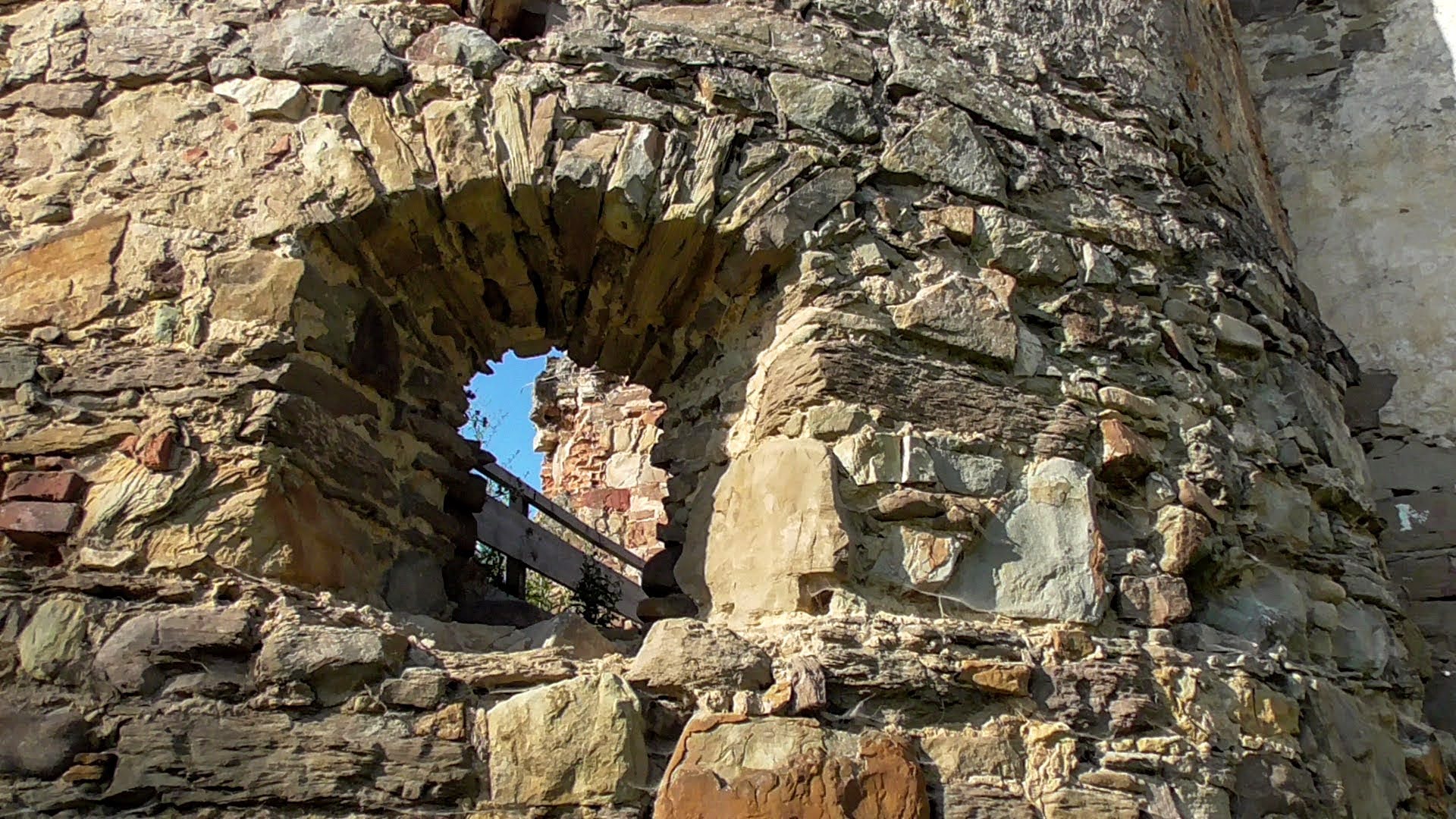
The citadel, which has withstood the test of longevity and impregnability, forms a pentagon in plan, at whose corners rise watchtowers with loopholes. The easternmost is the round tower.


 |
| Pniv Castle. The round tower |
In 2010 a flood added to the ruin of the structure, whose walls are around 1.5 to 1.8 metres thick. The towers were probably linked by underground passages, and there may have been passages to Nadvirna Castle (about 1,800 metres away as the crow flies) and to the Maniava Skete (about 15 km away). One would love to know — is this legend or is it fact? The round tower and the triangular tower are joined by a wall 30 metres long.

 |
| Pniv Castle. The corner tower |
For the building of the castle, hewn stone and red brick were used.
 |
| Pniv Castle. A loophole |
I did not manage to meet a crowd of tourists, but the palace does have residents. In the stony darkness the black silhouette of an unknown dweller flickered and vanished, watching me. The wish to accept a treat from an unexpected guest made a soot-black kitty peek out of the embrasure, and after her a kitten of a Mephistophelean colour plucked up the courage. In the castle courtyard stands the restorers' little cabin, and they feed the four-legged guardians.
 |
| Pniv Castle. A dweller of the fortress walls |
The courtyard runs about 250 metres around its perimeter. One can picture the disposition of a sizeable host and cavalry. On the south-western side we observe the remains of a tower with a buttress. Once these walls withstood a two-week siege by the Cossacks of Bohdan Khmelnytsky under the command of Maksym Kryvonis. The outpost was used by Polish forces too in battles with the Turks, but neither by storm nor by siege did the enemy take the castle. In time the Pniv stronghold lost its strategic importance, and the castle gradually emptied, which allowed the dismantling of the fortress walls to begin, the stone being taken for building.

 |
| Pniv Castle. The remains of a tower |
A drawbridge was thrown across the moat, and by it one drove into the fortress. The entrance arch has survived too.

 |
| Pniv Castle. The arch |
During the tour one could hear the shrieks of chainsaws and other building equipment. Pniv is the largest village by area and by population in the Nadvirna district. The castle stands practically on the administrative border with the district centre. The people of these parts are famed for their craftsmen and their all-round mastery. It is only that, for the preservation of this Carpathian landmark, the hands have not quite reached.


 |
| Pniv Castle. The ruins of the fortress walls and towers |
In the largest block, the one with the tower, restoration began in 2018, but it is plain that there are not enough grants for the restoration of the cultural heritage, and here the work has barely been started.

 |
| Pniv Castle. Restoration |
The castle grounds are overgrown with tall grass; information plaques, most likely, have never been here at all. The acquaintance with this Pniv landmark of the Middle Ages ends by the northern tower, whose walls are made in the form of facets.


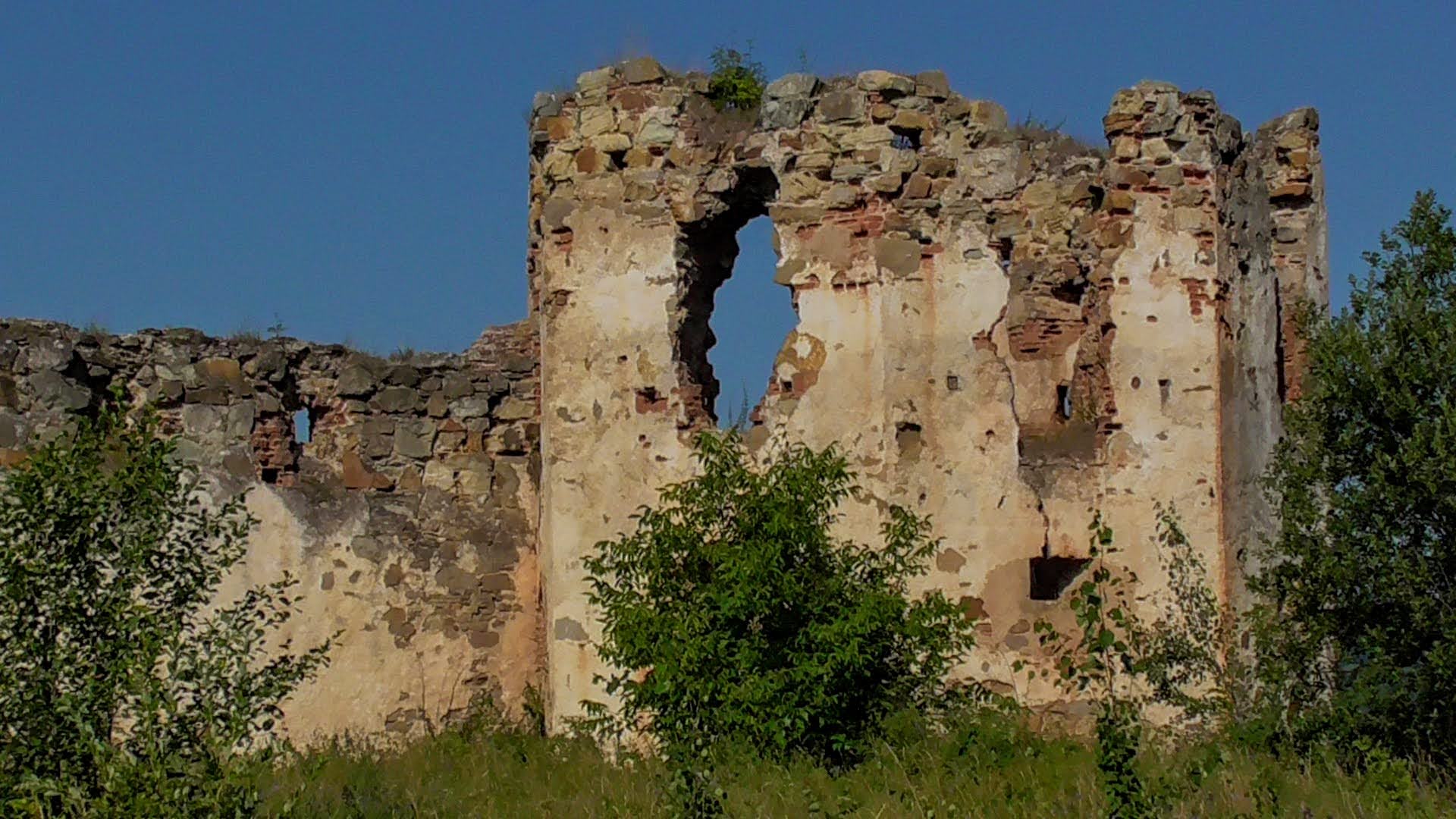 |
| Pniv Castle. The tower with faceted walls |
The ruined remains of what was once a sumptuous structure have a gloomy look. Along with the invalid castle, history too crumbles and vanishes.


 |
| Pniv Castle. The remains of the fortress walls |
The Nadvirna area is a super-mega-popular district with ski and climatic resorts, with a great concentration of assorted hotels, homesteads, kolybas, breweries and jeep tours. The touring fraternity loves such places and is ready to learn the tales of the Pniv legend, and also to make its investment towards preserving this long-lived landmark. The grounds, the history and the architecture of the castle are striking.
 |
| Pniv Castle. The ruins of a tower |
A more detailed history can be found in the publications of local ethnographers, whose research is priceless but has not substantially affected the preservation of this Pniv-Nadvirna pearl. Every effort must be made, and the first steps have already been taken. It simply astonishes that in a region where nature and history have bestowed incredible wonders, a multitude of guest palaces has been built for the reception of tourists, while indifference destroys the cultural inheritance.
Pniv Castle stands on the south-western side, 1.5 km from the centre of Nadvirna; the distances to the nearby resorts are: to Bukovel — 60 km, to Yaremche 25 km. Admission is free.
Coordinates: 48°37'21"N 24°33'16"E
This story is also available in Ukrainian: Пнівський замок. Твердиня-інвалід терміново вимагає відновлення

No comments:
Post a Comment
Leave your impression