Sokal is a town in the Lviv region, situated 80 km north of the regional centre. How does the Galician province, with a population of about 20,000, live?

I went to Sokal by chance — it wasn't even in my plans. I was heading for Zhovkva, but the electric train was cancelled. It was raining that day, and I did not fancy going to the bus station. Hearing that a diesel train to Sokal was departing, I dashed to the platform. At the ticket office they had already refused to sell me a ticket, but I managed to run aboard a moment before departure.
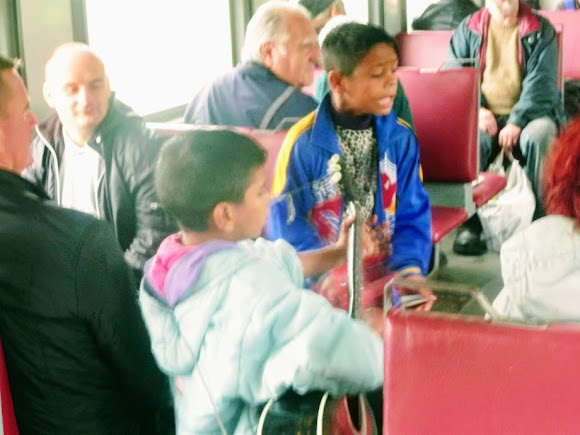
Sokal it is, then. In bad weather even the scenery outside the window brings no joy. But the young talents who roam the suburban trains cheered us with a concert. Future soloists of the 'Romen' ensemble performed hits in Russian, Ukrainian and Romani. The children are 6-7 years old; they will never sit at a school desk, but they have been going through the school of life since birth. Their flawless ear, fine voices, guitar accompaniment and tender age left no passenger indifferent.
The first train arrived at Sokal station in 1884, and mine was exactly on schedule. The station is called Sokal, but the settlement beside it is Zhvyrka.
Wars, fires and enemy raids moved the town from the right bank of the Western Buh to the left and back again.
One of the former unique historical monuments of the Sokal area is in Zhvyrka. Since I had ended up in these parts, how could I not see the Renaissance Roman Catholic church of the Virgin Mary the Consoler, built in 1619 on the grounds of the Bernardine monastery? It once housed the miraculous icon of the Mother of God of Czestochowa, which was destroyed by the flames during a fire. After the Second World War the monks were transferred to another monastery, and the cloister was turned into a special-regime prison. In 2012, as a result of arson, a fierce fire engulfed the church, which firefighters from all over the Lviv region put out together with the police. But it was not the shrine they were trying to save — they feared the escape of the inmates serving life sentences.
Of Sokal's former calling card only ruins remain, and the skeleton of the tower, with the frozen hands of its clock, rises frighteningly above the barbed wire.

I crossed the river by the bridge — and here is Sokal. Once there were many falcons in these parts. It is believed that the town got its name thanks to this strong and agile bird. The image of the feathered predator was on the town's seals from the 17th century, and now it is on the town's coat of arms.

First impression — a quiet, green town, few cars, and pavements there are.

I walk along Andrey Sheptytsky Street, examining new and old buildings,

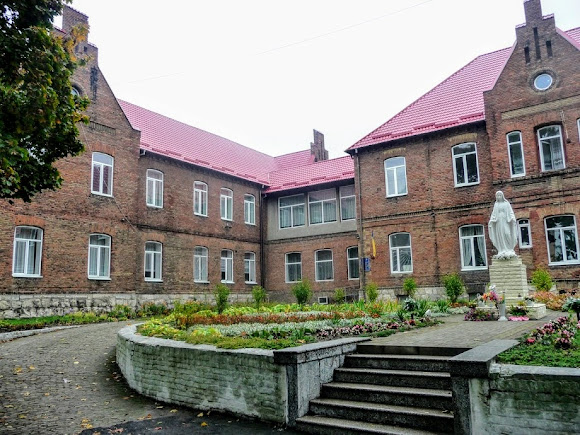
schools and gymnasiums.
The gymnasium was built back in the Austrian period, in 1906.
In the yard there are many flowers, and a sculpture of the Mother of God has been set up.

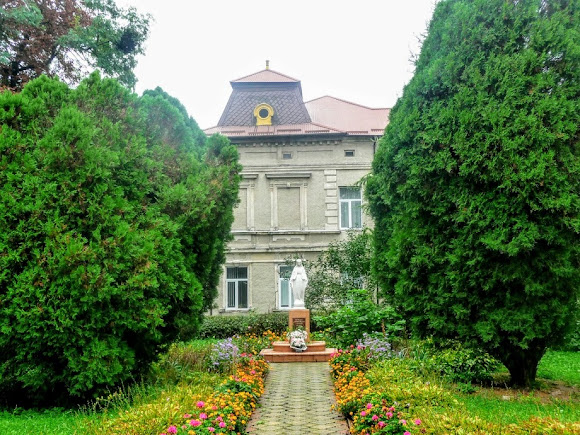
It is obvious that here they care about the education of the rising generation. For the young people of Sokal there is a Junior Academy of Sciences
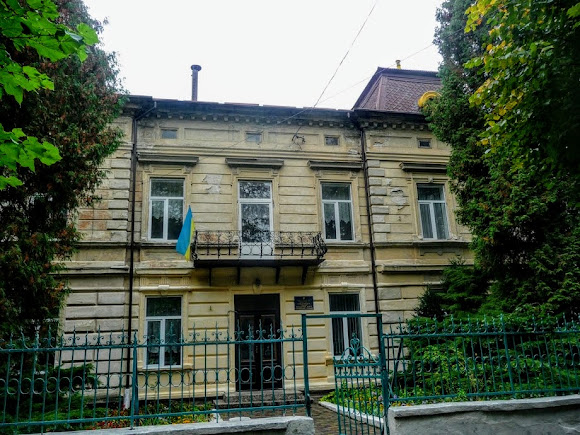
and a Station of Young Technicians, with clubs of a sporting and creative bent.

The main church of the town was built in 1909 by the famous architect V. Nahirnyi in the Byzantine style. Its height is 45 m. Marble steps lead up to the entrance with its marble columns.
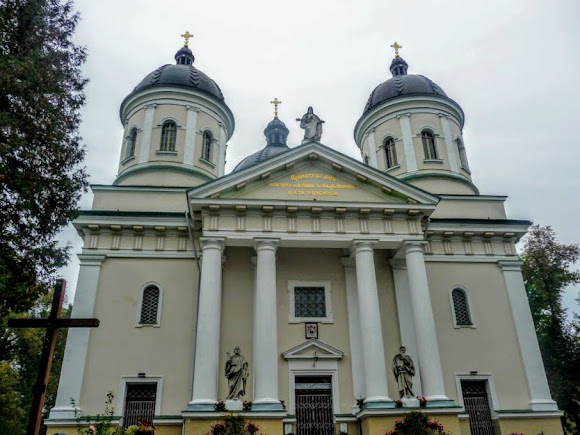

Three sculptures adorn the shrine — of Christ the Saviour and the apostles Peter and Paul, in whose honour the church was consecrated by order of Emperor Franz Joseph I.


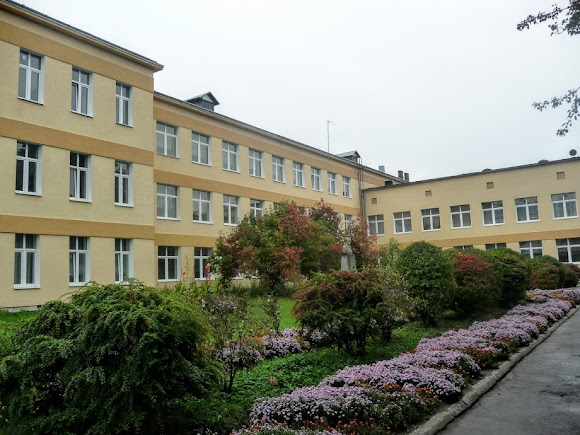
Behind the church is a boarding school.
The monument to the Kobzar has for some reason been placed in the back yard.
The dormitory building was erected in 1910.

Before the Second World War it housed a teachers' seminary, which produced many specialists, as a plaque testifies. The institution was founded in 1895.

On Shashkevych Street stands the brick building of the so-called Red Hospital.

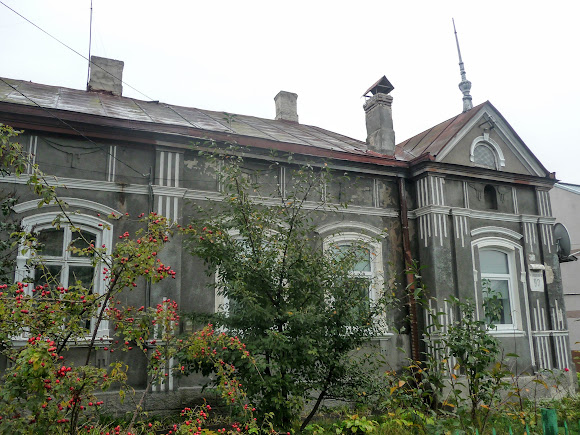
On the same street I saw an old house with a spire,
and another with a wooden veranda.

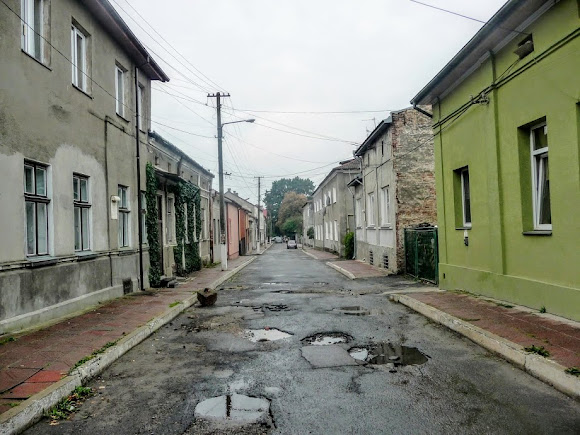
Along St. Volodymyr Street, narrow and with battered asphalt,
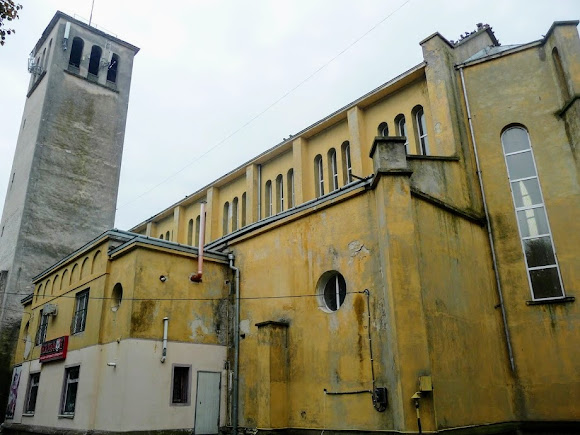
I came out at an unfinished Roman Catholic church of the 1930s.
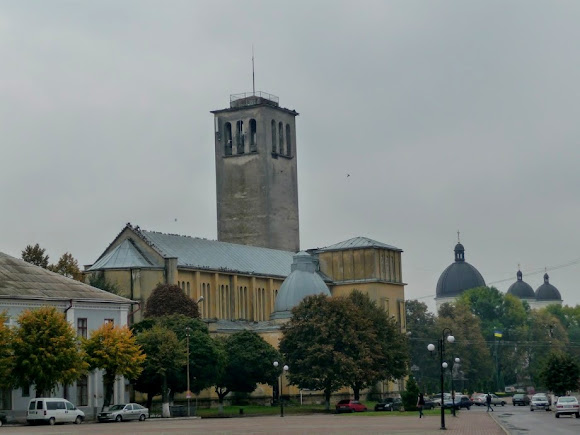
Shops are now housed in the building.
On the square stands our poet, deep in his dumy,
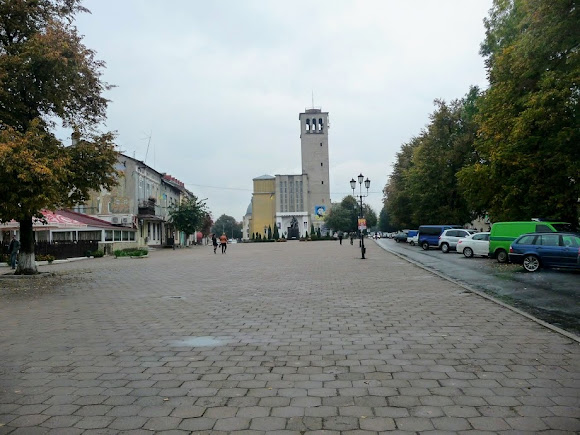
and behind him, on the facade of the church, his portrait in the guise of Che Guevara.
The nonsense was compounded by the fact that from afar I had taken the tower for the town hall.
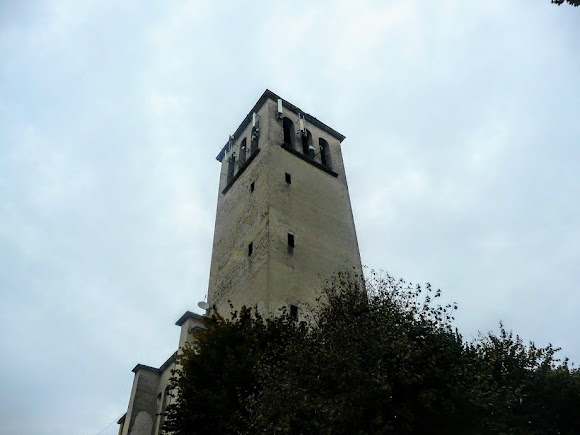
But the town authorities do sit in this town hall, with chimes mounted on all four sides.
The clocks, more than a metre in diameter, showed the correct and identical time.
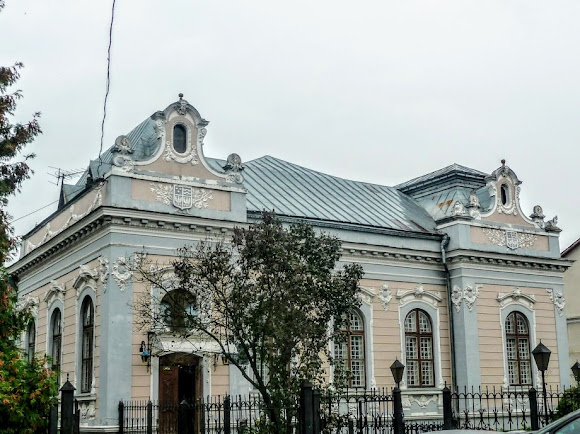
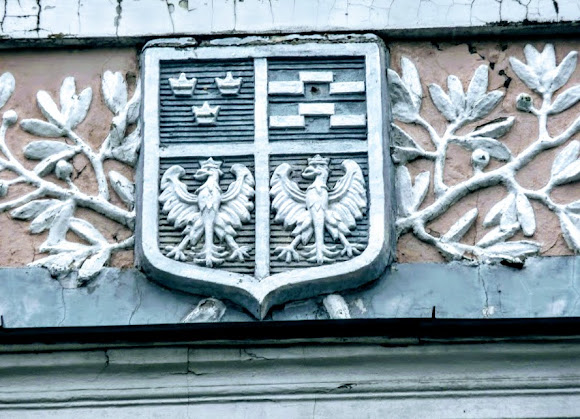
The treasury building was erected in 1906 and decorated with artistic moulding depicting falcons.
Someone had written on the wall of a residential building the prophetic words of the poet Lina Kostenko.

The facades of the old buildings are impossible to make out because of the enormous advertising signboards.
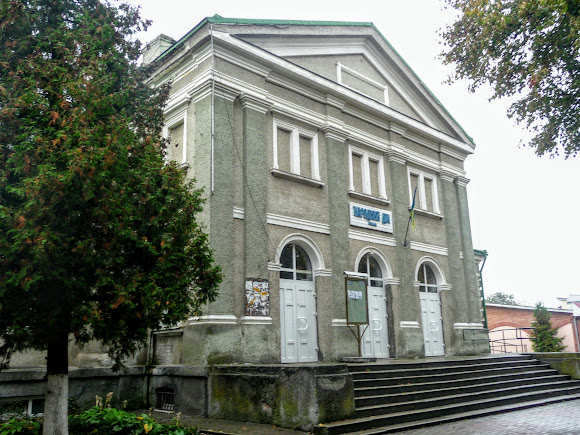
The People's House — in the past the House of Culture — resembles its counterparts in every district centre of the country.
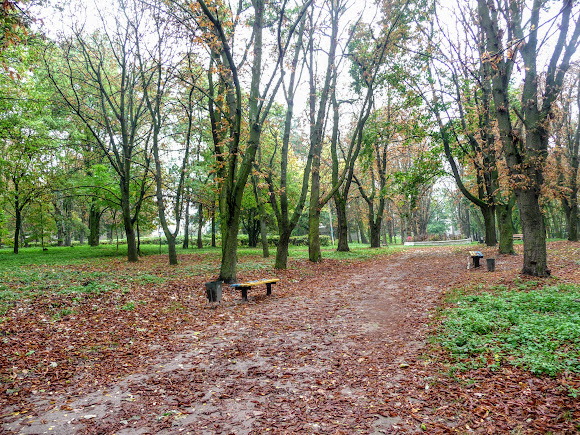
Since I had not prepared for the trip and had only a notion of the town, having read some general information while travelling here, I wandered the streets asking no one about anything. The town is small, and it is easy to find your way. And so, without giving a thought to my route, I came out into the park.
 Here, amid the thickets and rubbish, a synagogue built in the first half of the 17th century is living out its days.
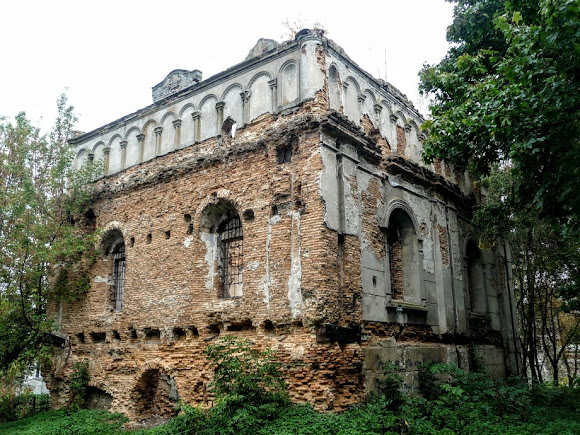
During the Second World War 9,500 Jews of Sokal were murdered. The temple fell into ruin.
It is good that the Church of St. Nicholas has survived.

Built at the beginning of the 16th century in the Renaissance style, it was of a defensive character. Until the 19th century an ancient wooden church stood beside it, and together they were part of a monastery complex.
In the 1970s the St. Nicholas church was restored, given as far as possible its original appearance. In Soviet times a museum was housed here. In 1989 the shrine was opened to worshippers.

In my notes I usually try to notice only the positive sides. But here I cannot do without a fly in the ointment. Since the church was not very well visible, I decided to walk around it. Right behind an architectural monument of national significance there turned out to be heaps of rubbish.
I love rivers very much and tried to go down to the water. The stairs are not merely in a state of disrepair — they are much worse. Without railings and almost without steps, with rebar sticking out — going down and up is very dangerous.


I walked along the bank of the Western Buh. I have seen this river in Belarus, by the Brest Fortress; there it is a little wider.
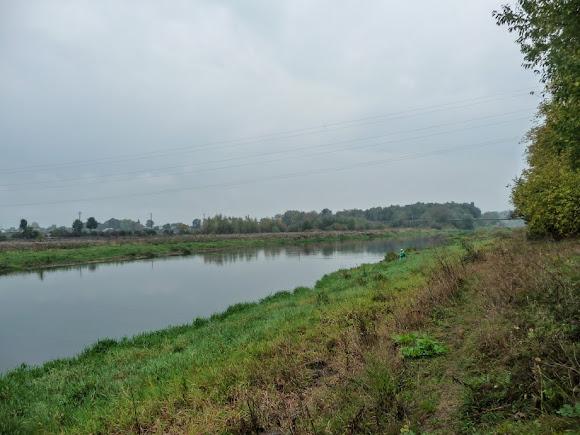
In the distance the mutilated church in Zhvyrka could be seen,
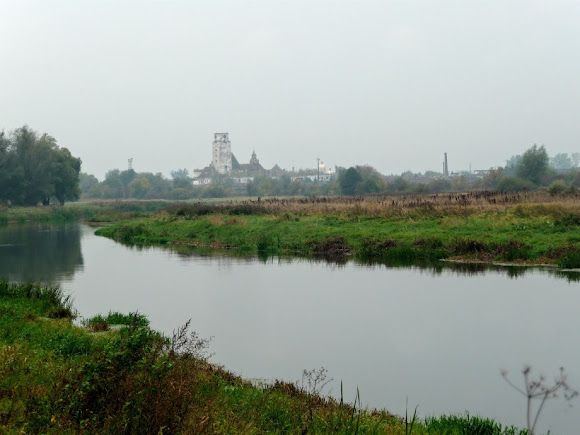
and on the high bank an obelisk without inscriptions jutted into the sky.
From the park I came out again onto the Square of the Sich Riflemen — spacious and beautiful, in the past Market Square.

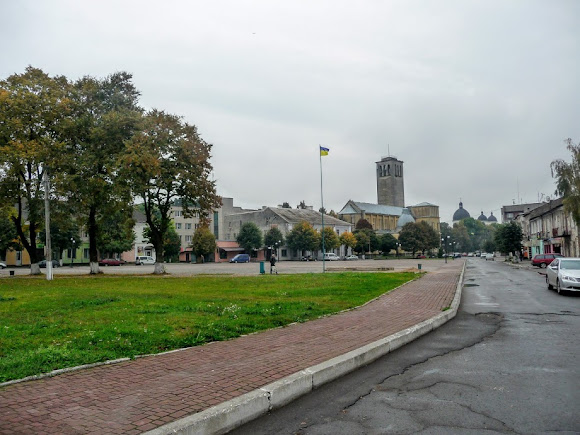
And again I set off along Sheptytsky Street, capturing interesting buildings with my camera.
I did not get to go into the museum 'Man. Earth. Universe'.
Sadly, on a short trip there is never enough time to acquaint oneself with the museum exhibitions. Nor did I see the old tower — the remains of the defensive system of the 17th-century Brigidki monastery.
I drove up to the station by bus, not wanting to walk in the rain. A little time remained, and I strolled around the settlement.
The Church of the Descent of the Holy Spirit was built in 2014, as a plaque on the facade testifies.


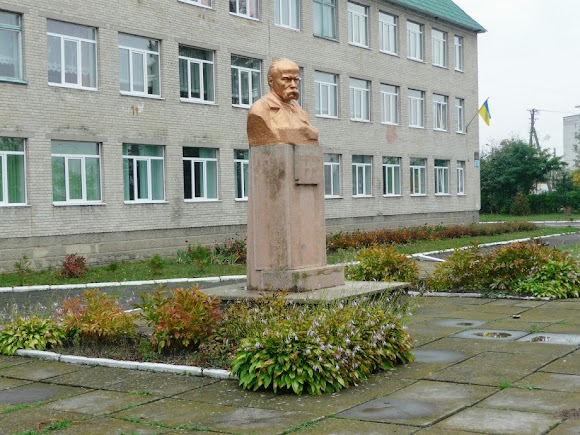
Zhvyrka has its own eleven-year school, with a monument to T. H. Shevchenko in the yard.
And here is the station.
On the platform the 'Nichlava' diesel train was waiting; the driver did not know the meaning of the name. It turns out that it is a river in the Ternopil region.
The trip to Sokal turned out to be impromptu, but on the whole I liked my excursion to yet another district centre of the Lviv region. It was not the rain but a few moments that slightly spoiled my impression of the town. What there is, that is what I share with you.

 |
| The 'Nichlava' diesel train Lviv - Sokal |
Sokal it is, then. In bad weather even the scenery outside the window brings no joy. But the young talents who roam the suburban trains cheered us with a concert. Future soloists of the 'Romen' ensemble performed hits in Russian, Ukrainian and Romani. The children are 6-7 years old; they will never sit at a school desk, but they have been going through the school of life since birth. Their flawless ear, fine voices, guitar accompaniment and tender age left no passenger indifferent.

The first train arrived at Sokal station in 1884, and mine was exactly on schedule. The station is called Sokal, but the settlement beside it is Zhvyrka.
 |
| Sokal station |
Wars, fires and enemy raids moved the town from the right bank of the Western Buh to the left and back again.
One of the former unique historical monuments of the Sokal area is in Zhvyrka. Since I had ended up in these parts, how could I not see the Renaissance Roman Catholic church of the Virgin Mary the Consoler, built in 1619 on the grounds of the Bernardine monastery? It once housed the miraculous icon of the Mother of God of Czestochowa, which was destroyed by the flames during a fire. After the Second World War the monks were transferred to another monastery, and the cloister was turned into a special-regime prison. In 2012, as a result of arson, a fierce fire engulfed the church, which firefighters from all over the Lviv region put out together with the police. But it was not the shrine they were trying to save — they feared the escape of the inmates serving life sentences.
Of Sokal's former calling card only ruins remain, and the skeleton of the tower, with the frozen hands of its clock, rises frighteningly above the barbed wire.

I crossed the river by the bridge — and here is Sokal. Once there were many falcons in these parts. It is believed that the town got its name thanks to this strong and agile bird. The image of the feathered predator was on the town's seals from the 17th century, and now it is on the town's coat of arms.
First impression — a quiet, green town, few cars, and pavements there are.

I walk along Andrey Sheptytsky Street, examining new and old buildings,

 |
| Sokal. Andrey Sheptytsky Street. The prosecutor's office |
 |
| Sokal. Andrey Sheptytsky Street. A building of 1958 |
schools and gymnasiums.
 |
| Sokal. Gymnasium. 1906 |
The gymnasium was built back in the Austrian period, in 1906.
In the yard there are many flowers, and a sculpture of the Mother of God has been set up.


It is obvious that here they care about the education of the rising generation. For the young people of Sokal there is a Junior Academy of Sciences

and a Station of Young Technicians, with clubs of a sporting and creative bent.

The main church of the town was built in 1909 by the famous architect V. Nahirnyi in the Byzantine style. Its height is 45 m. Marble steps lead up to the entrance with its marble columns.


Three sculptures adorn the shrine — of Christ the Saviour and the apostles Peter and Paul, in whose honour the church was consecrated by order of Emperor Franz Joseph I.


Behind the church is a boarding school.

 |
| Sokal. Boarding school. Bust of T. H. Shevchenko |
The dormitory building was erected in 1910.


On Shashkevych Street stands the brick building of the so-called Red Hospital.


On the same street I saw an old house with a spire,

and another with a wooden veranda.

Along St. Volodymyr Street, narrow and with battered asphalt,


 |
| Sokal. Monument to T. H. Shevchenko |
and behind him, on the facade of the church, his portrait in the guise of Che Guevara.
 |
| Sokal. Monument to T. H. Shevchenko |
The nonsense was compounded by the fact that from afar I had taken the tower for the town hall.

But the town authorities do sit in this town hall, with chimes mounted on all four sides.
 |
| Sokal. Town council |
The clocks, more than a metre in diameter, showed the correct and identical time.
 |
| Sokal. Town hall. The chimes |
The treasury building was erected in 1906 and decorated with artistic moulding depicting falcons.


 |
| Sokal. Mickiewicz Street |
The People's House — in the past the House of Culture — resembles its counterparts in every district centre of the country.

Since I had not prepared for the trip and had only a notion of the town, having read some general information while travelling here, I wandered the streets asking no one about anything. The town is small, and it is easy to find your way. And so, without giving a thought to my route, I came out into the park.


During the Second World War 9,500 Jews of Sokal were murdered. The temple fell into ruin.
It is good that the Church of St. Nicholas has survived.

Built at the beginning of the 16th century in the Renaissance style, it was of a defensive character. Until the 19th century an ancient wooden church stood beside it, and together they were part of a monastery complex.
In the 1970s the St. Nicholas church was restored, given as far as possible its original appearance. In Soviet times a museum was housed here. In 1989 the shrine was opened to worshippers.

In my notes I usually try to notice only the positive sides. But here I cannot do without a fly in the ointment. Since the church was not very well visible, I decided to walk around it. Right behind an architectural monument of national significance there turned out to be heaps of rubbish.
I love rivers very much and tried to go down to the water. The stairs are not merely in a state of disrepair — they are much worse. Without railings and almost without steps, with rebar sticking out — going down and up is very dangerous.


 |
| Sokal. Obelisk on the bank of the Western Buh |
From the park I came out again onto the Square of the Sich Riflemen — spacious and beautiful, in the past Market Square.


And again I set off along Sheptytsky Street, capturing interesting buildings with my camera.
 |
| Sokal. Library |
 |
| Sokal. Sheptytsky Street |
I did not get to go into the museum 'Man. Earth. Universe'.
 |
| Sokal. The 'Man. Earth. Universe' museum |
Sadly, on a short trip there is never enough time to acquaint oneself with the museum exhibitions. Nor did I see the old tower — the remains of the defensive system of the 17th-century Brigidki monastery.
I drove up to the station by bus, not wanting to walk in the rain. A little time remained, and I strolled around the settlement.
The Church of the Descent of the Holy Spirit was built in 2014, as a plaque on the facade testifies.


Zhvyrka has its own eleven-year school, with a monument to T. H. Shevchenko in the yard.

 |
| Zhvyrka. The building of Sokal station |
On the platform the 'Nichlava' diesel train was waiting; the driver did not know the meaning of the name. It turns out that it is a river in the Ternopil region.
The trip to Sokal turned out to be impromptu, but on the whole I liked my excursion to yet another district centre of the Lviv region. It was not the rain but a few moments that slightly spoiled my impression of the town. What there is, that is what I share with you.

This story is also available in Ukrainian: Сокаль. Експромт під дощем в місто на Західному Бузі

No comments:
Post a Comment
Leave your impression