I continue my acquaintance with
Bolekhiv — a Subcarpathian town in the Ivano-Frankivsk region.
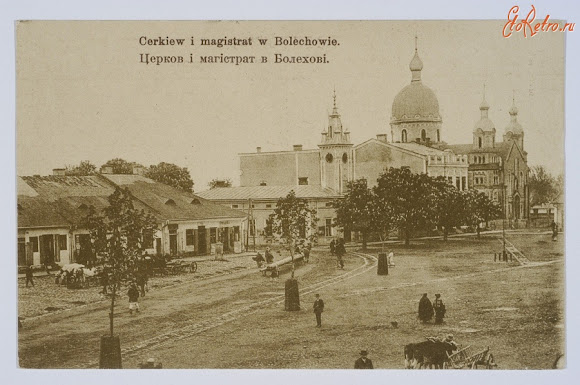
When the town received Magdeburg rights, the building of a magistrate began. The present town hall was built in 1861 on the site of an earlier one.
The town authorities have always been housed here.
The tower clock does not show the exact time, alas. Every quarter of an hour the chimes remind you with a lovely melody of the fleeting nature of time. At the entrance, the powers-that-be of Bolekhiv are guarded by little glinting lions.
Both the town hall and the former Rynok Square,
now named after Ivan Franko, have been restored.
A fountain has adorned the central square, but I have not yet seen it in action.
The bus stops on either side badly spoil the historic centre — such is the mark of a transit town. On the other hand, there is no trouble travelling in either direction, since there is a great deal of inter-regional transport.
You can wait for the bus in a cosy public garden.
In the Ivano-Frankivsk region the greatest number of monuments in Ukraine have been raised to the national poet. Almost every village has immortalised his memory. The Stonemason loved to stay in Bolekhiv as the guest of the writer Nataliia Kobrynska.
The Holocaust destroyed the town's Jewish population, as it did across the whole of Subcarpathia. The walls of the synagogue, built at the end of the 18th century on the site of a wooden one, have survived. In Soviet times the building was used by leather-trade workers as a centre for cultural leisure. Production has dwindled, but the sign on this temple-turned-club has not yet come down.
The Orthodox Church of the Myrrh-Bearing Women was built on the site of a wooden one (18th century) and consecrated by Metropolitan Andrey Sheptytsky in 1909.
And in 2000 a monument to the holy Prince Volodymyr, who baptised Kyivan Rus, was unveiled in the churchyard.
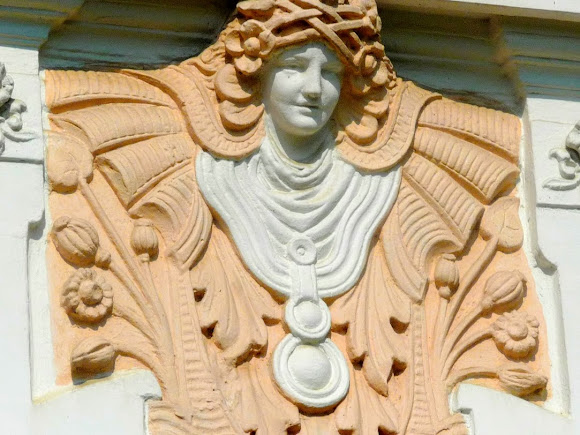
Between the town hall and the church there is another charming building — a town house with unusual stucco in the shape of flowers and buds.
The bridge over the Sukil River — calm at this spot and dotted with stony little islands — bears heavy loads because of the continuous flow of traffic.
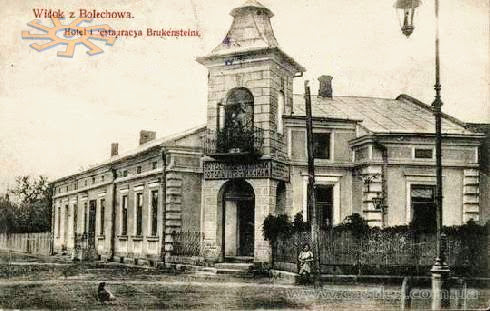
Driving along the highway, you always see the historic building of 1905, a former hotel and restaurant.
Now it houses a post office, banks and shops.
You cannot fail to notice the children's library building with its filigree wooden veranda. Beside it stands a monument to Kateryna Mandryk — a poet and public figure.
On the common grave of Soviet soldiers there are flowers and wreaths. The monument is a copy; the original stands in Lviv.
We give the best to our children.
 |
| The Borenstein Villa. The maternity hospital. |
One of the most beautiful villas in the town, built at the end of the 19th century in the eclectic style, has become a house of happiness for the families of Bolekhiv, because it is here that their children are born.
The therapy department, too, is an architectural monument of local importance.
The high reliefs above the windows all around the building are, most likely, sculpted portraits of townsfolk from the early 20th century. Perhaps of patients too, a hundred years on.
Next was to be a walk to another part of town, where I had not yet been. I was interested in the wooden Church of the Dormition of Saint Anne, and for this I again passed through the centre, heading south-west.
 |
| Dovzhanska Street |
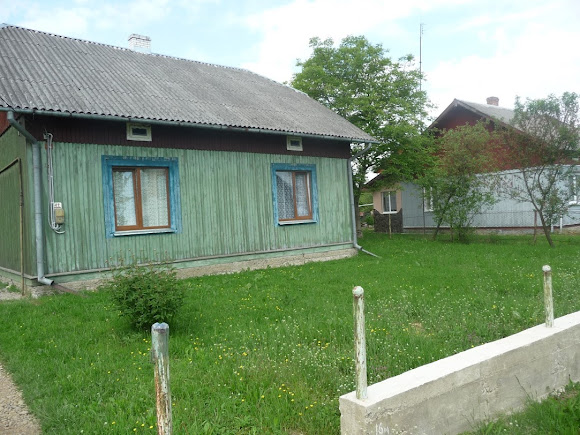
The buildings on Dovzhanska Street are only private houses.
Five hundred metres from the church, at a fork in the road, I asked a couple walking beside me whether I was turning the right way. The husband turned out to be the church warden and promised to come and open the church for me.
The church was built in 1870 with the donations of the faithful, on the site of an earlier one.
Beside it there once stood a monastery, which was demolished along with the church as a result of the reforms of the Austrian Emperor Joseph II.
Above the entrance is a wooden image of Saints Volodymyr and Olha.
To the left and right of the entrance are paintings on biblical subjects.
While waiting for the warden, I walked several times around the well-kept grounds,
looked into the chapel, built in 2000 by the efforts of the parishioners,
and went into the cemetery with its symbolic grave to the Ukrainian Sich Riflemen.
I had no time left, since I had many plans for that day, and I no longer waited for anyone.
Having sent a "thank you very much" to the warden through a neighbour, I set off for the kirkut, capturing the bridges, houses and countryside with my camera.
The residents were laying in hay for their livestock; the grass was tall and lush.
I asked an old woman, who was smiling at me as I photographed the haystacks, how much fodder a cow needs and whether the feed gets wet in winter. The good lady gladly shared with me her formula for working out how much provender a little cow needs: "Three times three months. Three haystacks a month. The hay keeps well."
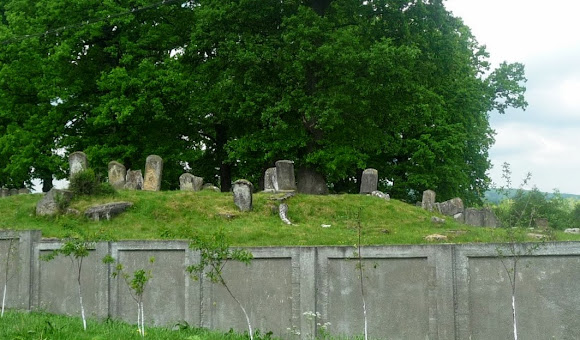
Coming up to the Jewish cemetery, enclosed by a concrete fence, I could not find the entrance.
You can only get into the kirkut through a private homestead, which still had to be found by one sign — a tall gate.
But here everyone has beautiful, tall gates, and my first attempt, of course, was a failure.
The door was opened to me by a man with a gloomy expression. Evidently the duties of gatekeeper weigh on him. Not just anyone is let in here, and I do not look like a Jewish woman, and besides, the days of mourning and remembrance had already passed.
I told the owner of the homestead that Halyna, the museum researcher, had pointed me the way, and I asked him to let me through. Zinovii turned out to be not at all unkind, but very friendly — if that word fits my case. It so happened that he had bought a plot of land to build a house, put in colossal effort and spent several years landscaping it. Great hydro-engineering work has been done to drain the marsh and channel off the surplus water in the form of a pretty little canal. A wonderful garden and coniferous trees have been planted across the whole plot. But the cemetery gates for now stand on his land, and by all appearances no one intends to move them.
The kirkut is set on a rise, so that it does not flood.
In all, there are around 3,000 burials over three and a half centuries.
The graves are surrounded by a solid wall. On the gravestones you come across a date — the year 1648.
There are also common graves of Holocaust victims here.
Buried in this cemetery is a native of Bolekhiv, Dov Ber Birkenthal, an 18th-century writer who knew several languages and could make excellent wine. In his memoirs he shared the secrets of commercial dealings.
At the exit Zinovii was already waiting for me and, together with his wife, invited me for coffee. Thanking them, I declined. For I still had to visit, that same day,
old Dolyna, and my time was short.
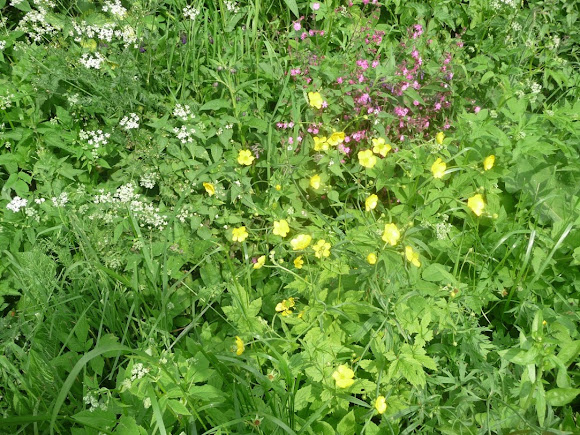
I raced to the railway station across flowering meadows, hopping over the streams on the little bridges.
The great abundance of moisture does the plants good; a pity there was no time for gathering bouquets.
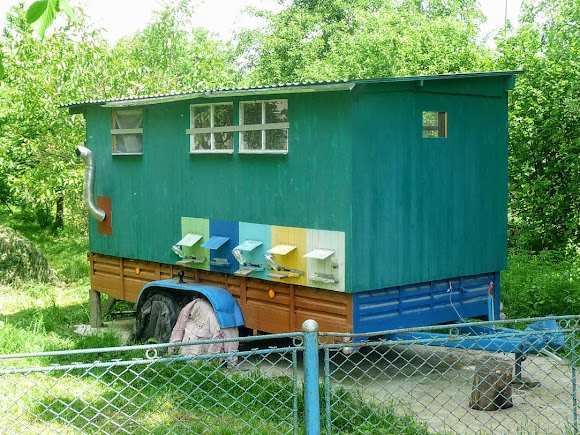
The beekeepers take their bees out to the glades in these large hive-houses.
On Danylo Halytsky Street I noticed a town house with stucco ornament that had long been up for sale.
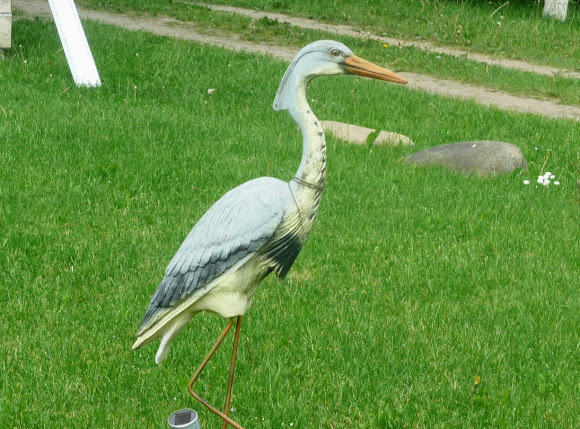
And such a horror I had never seen anywhere before. Either it is a scarecrow to frighten off relatives from the strawberry beds — of which there were none to be seen nearby — or it is some kind of magic.
These days at Bolekhiv station, which came into service in 1875,
only one suburban train stops, running
Stryi — Ivano-Frankivsk.
In the station building the tiled stoves have survived.
Next to it is a timber yard, for the people have been engaged in logging since ancient times.
This trade and salt-making are marked on the town's coat of arms.
The ruined saltworks, which I wrote about in my earlier notes on
Bolekhiv,
 |
| Bolekhiv. The former saltworks. |
was like a sister to the one in
old Dolyna, where I then headed in the second half of the day.
And I like Bolekhiv very much, and I share my wonderful impressions with you.

















No comments:
Post a Comment
Leave your impression