In Jewish communities scattered across the world, the synagogue is a social and spiritual centre. In these beautiful buildings with large windows, one of which faces towards Jerusalem, not only are God's Commandments preached, but public matters are also decided, solemn ceremonies held and guests received. In the 'Houses of Assembly' the community's board sits and a communal court operates. Sadly, many spiritual heirs of King Solomon's First Temple were destroyed by the Holocaust. Some buildings were saved when churches of other denominations, or organisations and institutions, came to occupy their walls. Let us look, through examples, at what synagogues in Ukraine are like.
 |
| Uzhhorod. The former synagogue, 1904. |
The Uzhhorod synagogue, built in the Neo-Moorish style in 1904, is occupied by the Zakarpattia Philharmonic (10 Teatralna Square). The building, decorated with artificial marble, ceramic tiles, a Star of David and the Tablets of the Covenant, underwent substantial changes during reconstruction, and the Jewish symbols were replaced with musical ones.
Coordinates: 48°37’18 "N 22°17’59"E
 |
| Uzhhorod. The former synagogue, 1904. |
The Jewish community in
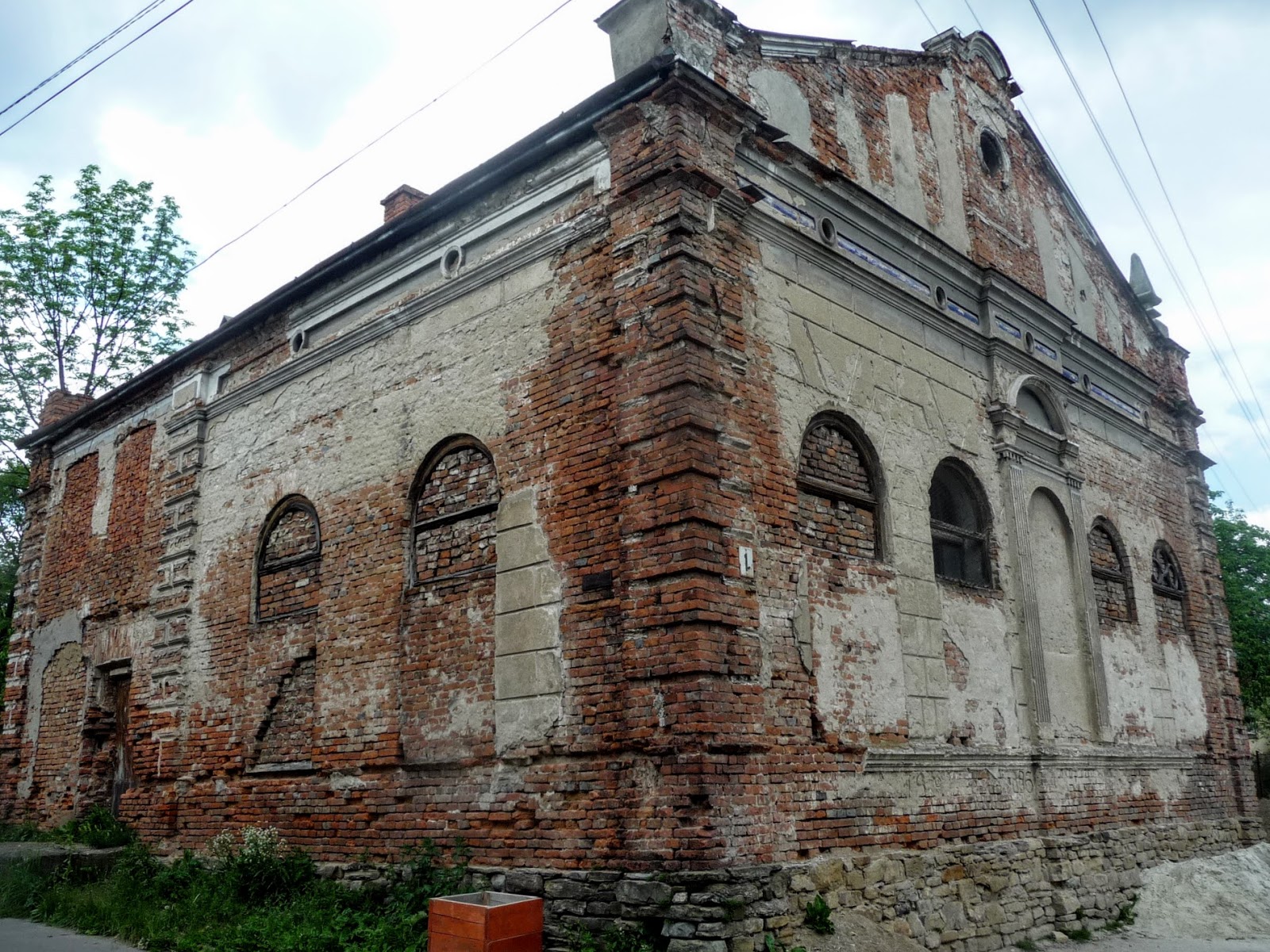
Staryi Sambir was destroyed during the Second World War, and since then the prayer house, built in 1862, has stood in an extremely neglected state in the historic centre of this sub-Carpathian town (1 Professor Zablikevych Street).
Coordinates: 49°26’1"N 22° 59’44"E
 |
| Staryi Sambir. Lviv region. The synagogue, 1862. |
The synagogue in
Turka dates from the mid-19th century (Dzherelna Street). During the Hitlerite occupation the fascists set up a ghetto in it, from which they sent the population off to be shot or to concentration camps. After the war the Soviet authorities forced several Jews to sign their consent to use the temple for economic purposes. The synagogue is now turned into a joinery workshop, and it is hard to reach because of the heap of little sheds and assorted shacks.
Coordinates: 49°9’6"N 23°1’57"E
 |
| Turka. Lviv region. The synagogue, 19th c. |
The synagogue in
Zhovkva was part of the town's defensive system and is considered one of the largest Jewish prayer houses in Europe (8 Zaporizka Street). Built in 1692 in the Renaissance style, with towers and loopholes, in Soviet times it was converted into a warehouse. Although this architectural monument was on the list of a hundred monuments of the world in need of urgent restoration, the restoration of the Zhovkva defensive synagogue is progressing at a very slow pace.
Coordinates: 50°3’26"N 23°58’21"E
 |
| Zhovkva. Lviv region. The defensive synagogue. 1692. |
The synagogue in Dubno was built in 1784 and holds the status of an architectural monument (23 Cyril and Methodius Street). In 2018, after long neglect, the first steps were taken to revive one of the largest 'Houses of Assembly' in Ukraine.
Coordinates: 50°25’1"N 25° 44’40"E
 |
| Dubno. Rivne region. The synagogue, 1784. |
In
Drohobych (6 Pylyp Orlyk Street) the prayer house opened its doors to the faithful in 1865. The fascists set up a stable in it, and in the post-war period salt was stored in the premises of the choral synagogue, which caused substantial damage to the structure. At present, one of Drohobych's former 17 Jewish temples is undergoing large-scale repair.
Coordinates: 49°21’12"N 23°30’40"E
 |
| Drohobych. Lviv region. The synagogue, 1865. |
Through the thicket of trees, the remains of the frescoes and stucco of the defensive synagogue of
Sokal of the 17th century are barely visible. Having seized the town in 1941, the Nazis destroyed the entire Jewish population, 5,000 people. On the site of the former ghetto a park has been laid out, and the object of architectural and cultural heritage, without roof, windows or doors, is overgrown with heaps of rubbish.
Coordinates: 50°28’58"N 24°16’32"E
 |
| Sokal. Lviv region. The synagogue, 17th c. |
The Great Synagogue in
Stryi, built in 1817 in the Classicist style, held up to 1,000 worshippers (7 Mykola Mikhnovsky Street). The German authorities destroyed the Jewish community during the war, and the Soviet authorities destroyed the temple, turning it into a warehouse, later dismantling the floors and planning to install a swimming pool in the synagogue.
Coordinates: 49°15’15"N 23°51’6"E
 |
| Stryi. Lviv region. The synagogue, 1817. |
In
Bolekhiv a synagogue was built in 1789 on the site of a wooden predecessor. Before the Second World War, the Jewish population of this small sub-Carpathian town made up 80 percent. In Soviet times the premises were occupied by the tanners' club, which left an inscription on the facade. For a long time now, with the fading of the hearth of culture, the former synagogue has been in a dilapidated state.
Coordinates: 49°3’52"N 23°51’27"E
 |
| Bolekhiv. Ivano-Frankivsk region. The synagogue, 1769. |
The Dolyna Jewish temple was built in 1897-1932 on the site of an earlier wooden
synagogue (32 Andrii Sheptytskyi Street). In honour of the Jewish population destroyed by the fascists, a memorial sign has been placed by the shrine. After neglect and repair, the premises serve as a house of prayer for evangelical Christians.
Coordinates: 48°57’52 "N 24°0’9"E
 |
| Dolyna. Ivano-Frankivsk region. The former synagogue. 1897-1932. |
In 1822 the Jews of
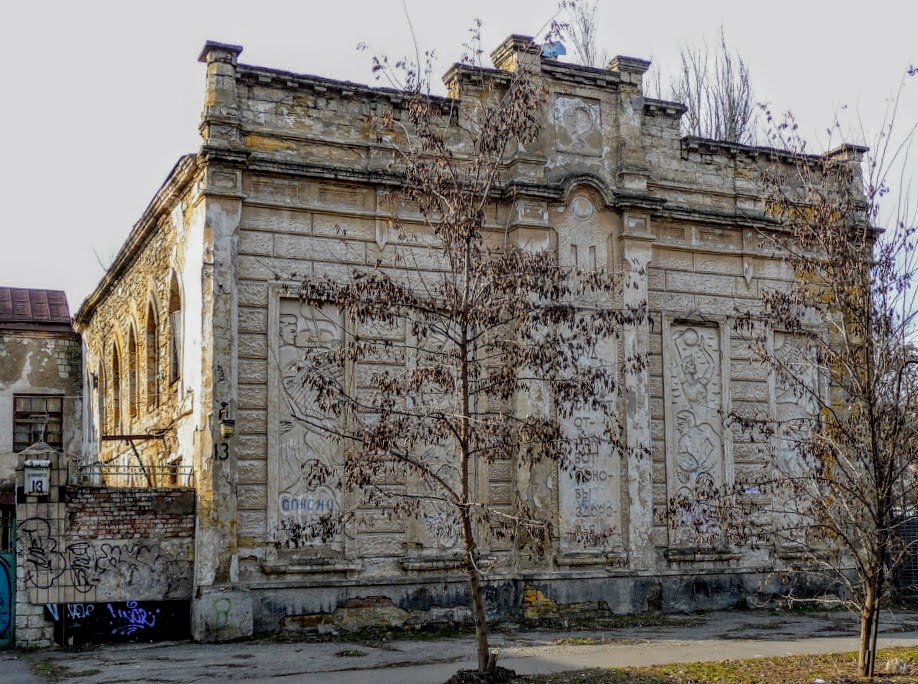
Mykolaiv built the first synagogue in the town (13 Schneerson Street). Services were attended by sailors and servicemen who served in this city of shipbuilders. In 1922 the Soviet authorities closed the temple and nationalised its furnishings. A wall painting on the building's facade, with slogans and symbols of Socialist Realism, attested to the reprofiling of the shrine into a club of medical workers, which in time closed, and the empty building is falling into ruin.
Coordinates: 46°58’16"N 31°59’44"E
 |
| Mykolaiv. The former synagogue. 1822. |
The devoutly believing doctors, musicians and traders of
Bakhmut prayed in their own temple from 1863 (80 Nezalezhnosti Street). In 1923, after the prayer house was closed, the premises were occupied by the workshop of the sculptor I. P. Kavaleridze, the author of the monument to Artem in
Sviatohirsk. Afterwards the building housed an aeroclub, a library, and a production shop of the society of the blind. Now the 19th-century choral synagogue has been adapted into a shop, although under the laws of Halakha even a ruined temple is forbidden to be used for commercial purposes.
Coordinates: 48°35’3"N 38°0’17"E
 |
| Bakhmut. Donetsk region. The former synagogue. 1863. |
Today, mobile synagogues travel around Ukraine and offer those who wish it the chance to learn more about Judaism and Jewish religious objects. Indifference and neglect are leading to a situation where the heritage of our ancestors will be knowable only from the internet and from photographs of years past.






No comments:
Post a Comment
Leave your impression