Not all my travels have been successful and brought me pleasure. My most disastrous and exhausting trip was around the villages of the Bolekhiv town council.
 |
| Tysiv. Bolekhiv town council. Dolyna district. Ivano-Frankivsk region. |
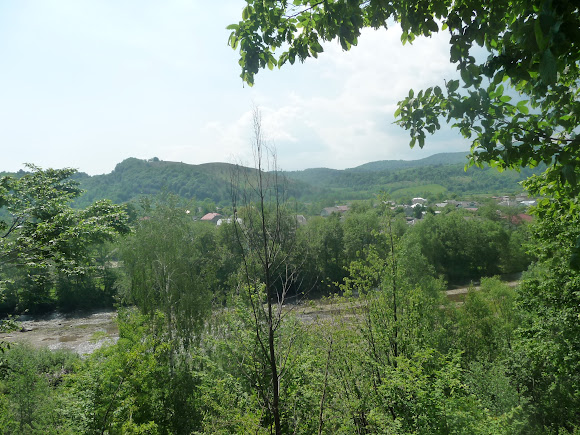
Just 20 km from the town, and there is supposedly a bus service. But no — the Subcarpathian villages have hidden themselves away behind blue mountains and swift rivers, and getting to them is not always simple.
 |
| Tysiv. Bolekhiv town council. Dolyna district. Ivano-Frankivsk region. |
My acquaintance with the north-west of the Dolyna area began with Tysiv, known since the 15th century. In 1990 such a rare event took place here as the moving of a church to a new site. I reached the village by bus from
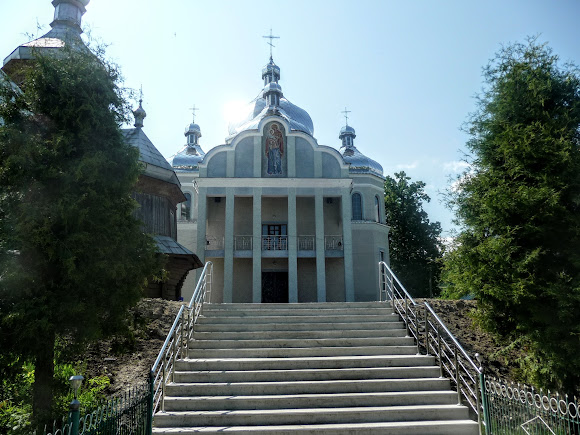
Bolekhiv , and I did not have to search long for the Orthodox Church of the Presentation of the Most Holy Mother of God, built in 2013, since it stands by the road on a hill and is clearly visible from afar.
 |
| The Presentation churches. 1783 and 2013. |
Beside the sun-glinting domes of the young and beautiful successor
 |
| The Presentation Church. 2013. |
nestles the one that yielded to her its place, hallowed by centuries of prayer.
 |
| The Presentation Church. 1783. |
The faithful decided that the new church should stand on the very spot of its predecessors.
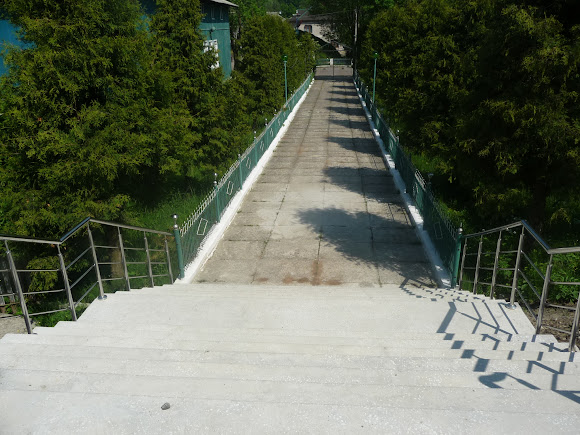 |
| The Presentation Church. 2013. |
Architects and local craftsmen worked on the project of the move.
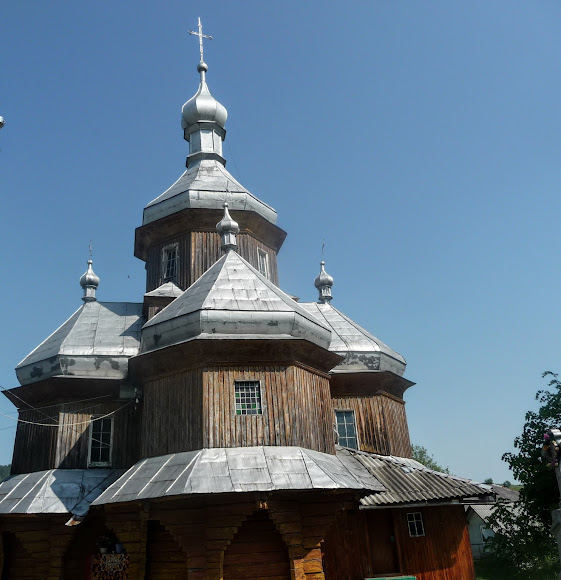 |
| The Presentation Church. 1783. |
First they partly took up the floor and slid a welded frame under the wooden structure. On command, the vehicles moved the structure all at once.
 |
| Tysiv. The Presentation Church. 1783. |
The shrine, built in 1783, was not damaged in the move.
 |
| The Presentation Church. 1783. |
They did not even take down the icons in the church while doing it. I found this information in the
Bolekhiv History Museum , with the help of the researcher Halyna Skvorii. On the internet you come across other versions, claiming that the church was taken apart and then put together again. This is not true.
Today the old lady is not neglected; she is an architectural monument of local importance.
 |
| The Presentation Church. 1783. |
Next to the religious buildings a U-shaped school has been built.
 |
| The Tysiv school |
This two-class school was opened for the village children back in 1874. One of the old buildings was not demolished, and the school workshops are now there.
 |
| The old wooden school |
Firewood is stacked by the culture centre; life in the village club still flickers on, and there is even a library.
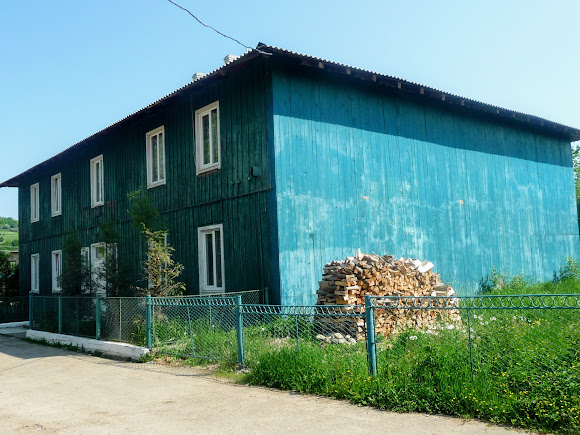 |
| The club |
The Second World War military memorial is not abandoned.
 |
| The Second World War military memorial |
An icon lamp and a wreath bear witness to that.
 |
| The Second World War military memorial |
On the symbolic grave of the Fighters for the Freedom of Ukraine a cross has been raised to the Ukrainian Sich Riflemen.
By an ancient lime tree stands some cross, perhaps in honour of the abolition of serfdom.
In Tysiv, in the 1870s, lived the family of the priest Krushelnytsky, the father of the outstanding opera singer. Little Solomiia was between three and five years old. But the memory of this was once preserved by putting up a small monument on the family's former homestead. Now heaps of paving slabs are piled up beside the Ukrainian Madame Butterfly. Evidently no other place could be found, only right under the nose of this Wagnerian prima donna. She looks rather less than presentable, and there is no inscription on the pedestal.
 |
| The monument to Solomiia Krushelnytska |
Walking along the main street, Hrushevskoho Street,
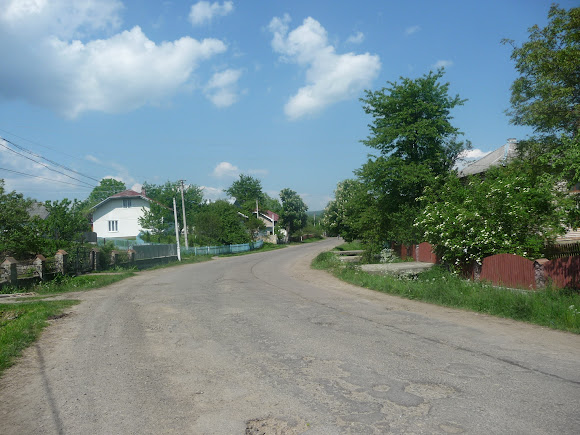 |
| Hrushevskoho St. |
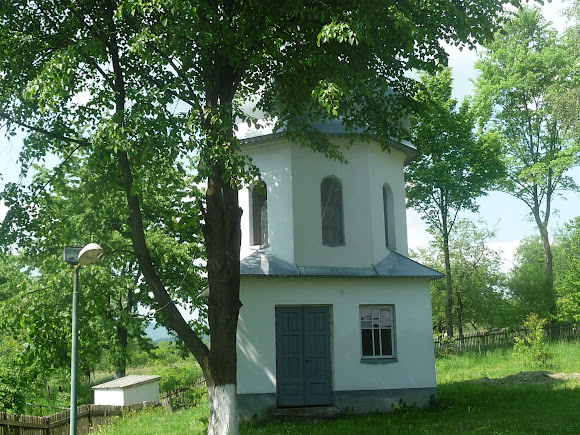
I saw a small church or chapel.
By almost every house there is its own special well.
I wanted to photograph an unusual jug-shaped well.
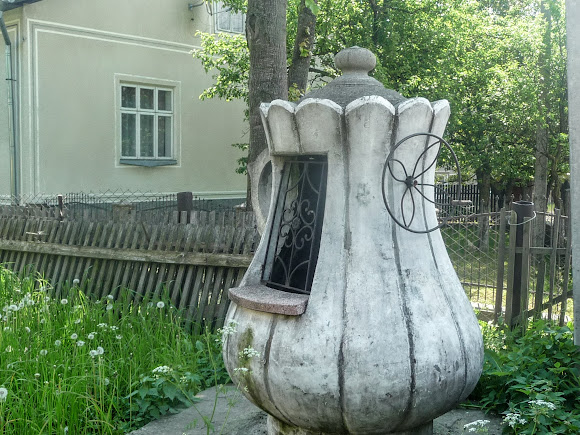 |
| Tysiv. A well. |
The wicket gate was open, which is common in this area. But I still asked permission from a woman in the neighbouring vegetable garden, whether anyone would scold me if I went into the yard to draw some water. "Why ever not? Come in, what is there to scold you for?" the woman answered a question with a question. "Back home they would have scolded me," I thought. We got acquainted, and Yustyna told me a little about the village.
People have lived here since ancient times, settling along the river and taking up salt-making, logging, pottery, sheep-farming and other trades.
 |
| The kindergarten |
The common name for all the surrounding hamlets comes from the evergreen yews.
 |
| The Tysiv village council |
And the name of the Sukil River goes back to the times of the invasion of Batu's horde; translated from the Turkic it means "Su" — water, "kil" — come to us.
 |
| The Sukil River |
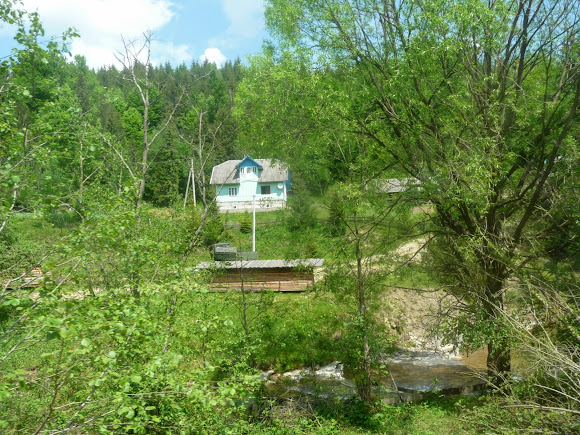
So I headed to the mountain river, which has a multitude of little islands, rapids and waterfalls.
Having crossed the bridge to the other bank,
I climbed up to the Church of St Nicholas, built in 1995 on the site of a 19th-century wooden chapel that had been burned down by the Bolshevik authorities.
On the carved door is a metal plaque with the inscription: "Dear brother, sister! You are entering the house of God. Look into the mirror of your soul and ask yourself — why have you come here?"
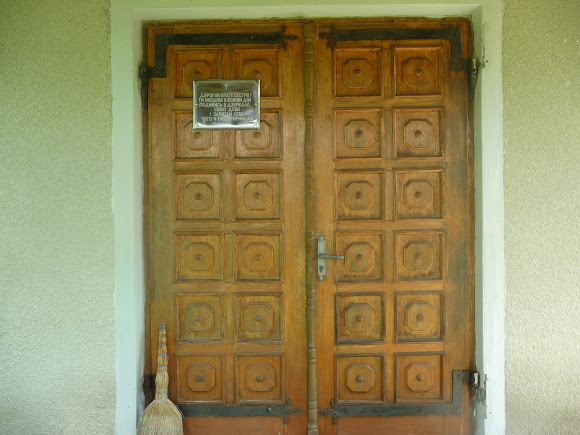 |
| The Church of St Nicholas. 1995. UGCC. |
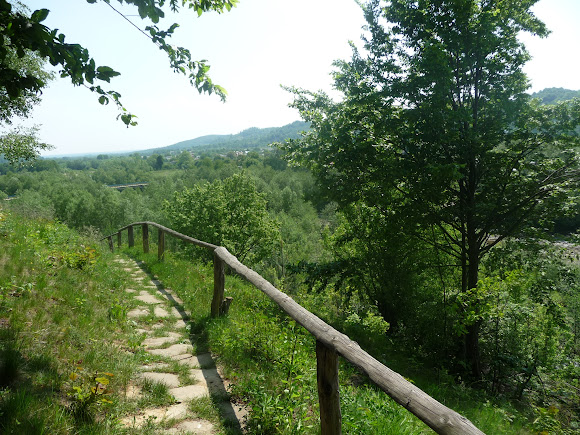
From here a wonderful view opens out over the mountains and the river.
I always admire the Subcarpathian countryside and think: people live amid such beauty, no industrial dust, no smog, no city bustle, drinking clean water.
I had already had occasion to be nearby here, at the
Dovbush Rocks.
But this beauty has its own hidden pitfalls, which I was to run up against in the second half of my journey.
Knowing that there should be a bus from Bolekhiv to the far villages, I sat down on a bench in the shade by the shop, having drunk some of Tysiv's well water.
 |
| The shop |
In an hour not a single vehicle went past in either direction.
No longer hoping to continue the trip, I decided to head back and flag down any car at all, just to get out to the town. Just then a "Zhyhuli" pulled up, and two girls jumped out to stick a notice on the shop. I turned to them: "Girls, give me a lift!"
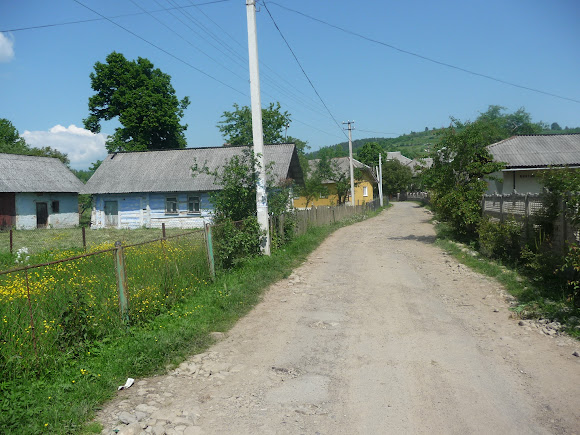
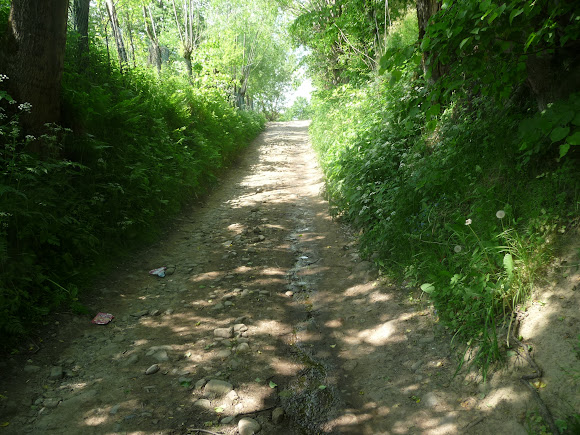
The car went bouncing, jerking and shuddering, tilting almost to its limit, all but toppling over. You could not call the road a road. It is simply a washboard of potholes and stones. How vexing it was to learn that my rescuers were just returning from those very villages I had dreamed of visiting, and had seen all the wooden churches. Had I met them in the morning, I would have helped them stick up all those "windows-and-doors" adverts on every post.
Suddenly, ahead in the dusty haze, appeared the bus I had waited more than an hour for. The girl at the wheel, stern-faced and looking like a tank driver, gave it a honk at my request. Thanking her, I dashed to the halted bus. I would have been better off not doing so. The doors opened, but squeezing in proved very hard. People packed like herrings in a barrel. Surely they must get off at the stops! No, no one gets off; everyone needs to go further.
 |
| The Sukil River |
The bus went very slowly, not along the road but along the verge, because there is no road. Soon something began to smoke, and the driver got out to deal with the breakdown. The passengers did not so much as bat an eye. Everyone is already used to such situations. On the plus side, one could get out and breathe some fresh air.
Whether the bus would go on became clear about an hour later, when the smoking stopped.
The rest of the way to the village of Sukil the bus travelled at no more than 10 km an hour. Arriving at the stop, the driver announced that there would be no more runs and that he was setting off straight back to
Bolekhiv.
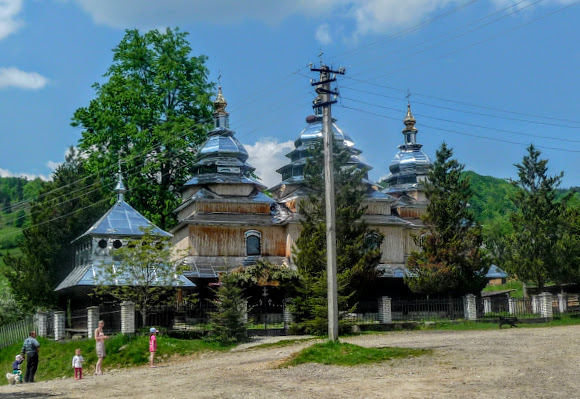 |
| The Church of St Michael. 1886. UOC-KP. |
To my request that he wait even a minute, he answered sharply that he had broken down and had no minute to spare.
Upset, I ran round the wooden church like lightning, managing to take a few shots.
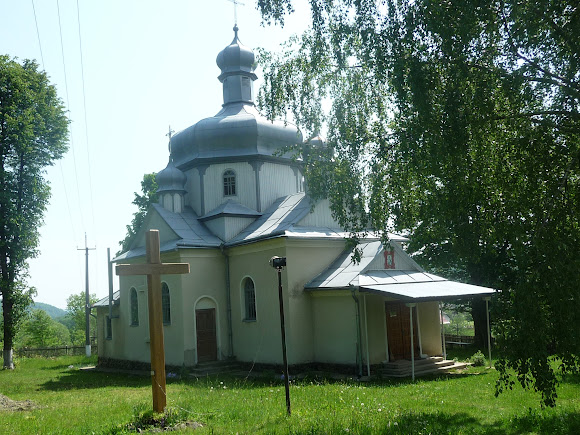
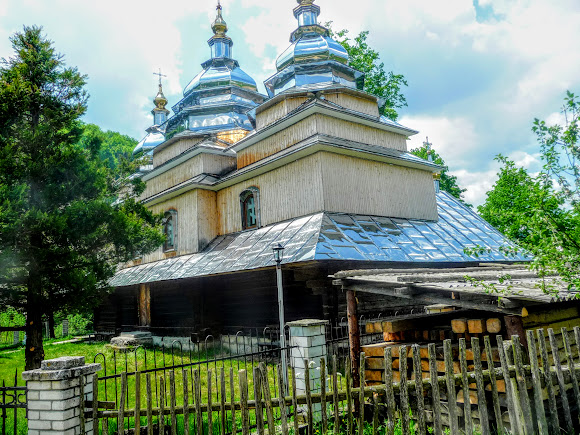
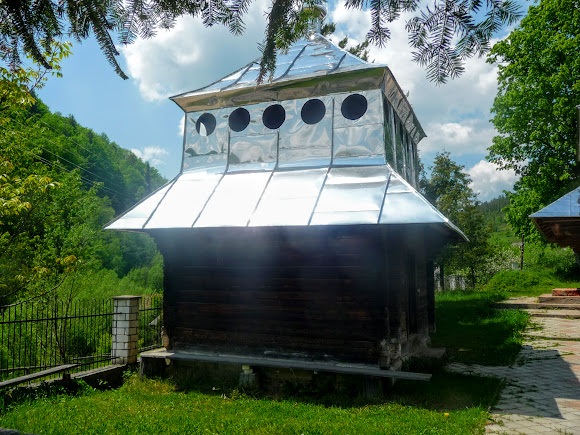
Built in 1886 with its altar facing north rather than east, the shrine has been clad in weatherboarding for protection, and its roof in metal sheets.
 |
The Church of St Michael. 1886. UOC-KP.
Next to the Orthodox one, a Greek Catholic church was built in 2013.
|
I chased after the bus — luckily it was going slowly. And yet I had wanted to see the waterfalls in the surroundings of this village too.
The way back was not one bit easier. Having gone barely a kilometre and a half, the water in the radiator boiled over again. While the driver scooped up cold water from the stream to cool the engine, I got off the bus to feel firm ground underfoot and to photograph the monuments and the school in Kozakivka.
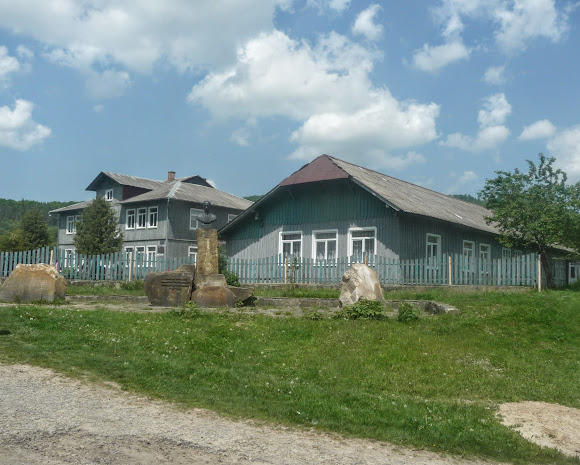 |
| The monument to Yurii Mushak — a teacher, literary scholar and translator |
 |
| The Second World War military memorial |
 |
| The Kozakivka school |
"Is the road always this difficult?" I asked a fellow traveller. It turns out, all the time. And in winter it happens that for several days on end you cannot get out to work in
Morshyn. During a flood all those numerous streams, brooks and little rivers I had admired overflow and become a huge, devastating force of water.
Such is the treacherous side of the Subcarpathian countryside. Though I did not complete my programme, the day proved rich in impressions, which I share with you.










No comments:
Post a Comment
Leave your impression