Sloviansk — an industrial city, a railway hub, a resort — surprised me with the number of beautiful old buildings, both standing and already ruined beyond restoration.
 |
| Sloviansk. Donetsk region. The ruins of the fittings-and-insulator plant |
The fittings-and-insulator plant, created in 1915 on the basis of porcelain production (the famous Kuznetsov porcelain), is the oldest enterprise in Ukraine; for almost 100 years it produced insulators for power stations. After World War II the plant was restored and increased its capacity. Now no hope remains for the revival of the industrial colossus.
 |
| Sloviansk. Donetsk region. The ruins of the fittings-and-insulator plant |
The former kiln building, a splendid example of industrial architecture, is living out its last days.
 |
| The kiln building of the Kuznetsov and Essen faience factory |
The massive walls were erected using various types of masonry with sturdy red brick.
 |
| The kiln building of the Kuznetsov and Essen faience factory |
The administrative buildings, which could still have served for a long time, gleam sadly with the shards of broken windowpanes.
 |
| Sloviansk. The former administrative buildings of the AIZ |
 |
| The former administrative buildings of the AIZ |
What a beautiful and spacious canteen the plant's workers had.
 |
| The former canteen of the AIZ workers |
Enterprising householders have decorated their garden plots and flower beds with the AIZ's unclaimed products, bearing the deservedly awarded Quality Mark.
 |
| The AIZ's unclaimed products — landscape decor |
That which is creative and good will not go to waste.
 |
| The AIZ's unclaimed products — landscape decor |
The service building of the Sloviansk-Vetka railway station, the former station house of Miska station, built in 1900, a historical monument, no longer gapes with broken windows, and that is already something.
 |
| The service building of the Sloviansk-Vetka railway station. 1900 |
Sloviansk, founded in the middle of the 17th century, experienced a surge in development at the turn of the 19th and 20th centuries, in the period of the flourishing of capitalism.
 |
| Sloviansk. The "Drukarskyi Dvir" printing house |
To 29 buildings and structures of that peak time for Sloviansk, the status of architectural landmarks of local significance has been assigned.
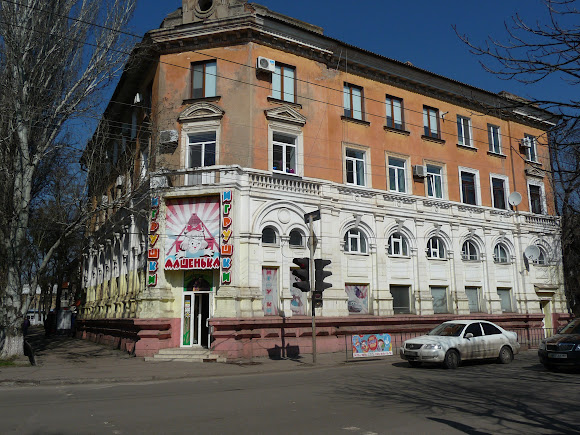 |
| The former city bank |
Some have been lucky with their present owners.
 |
| A merchant's house. 1910. The prosecutor's office |
Over to whom the Palace of Culture — the former Nobility Assembly, built in 1914 — will belong, fierce disputes are now going on.
 |
| The former Nobility Assembly. 1914 |
The house at 4 Shevchenka Street was built in 1905—1911 by the industrialist Aleksandrov.
 |
| The Aleksandrov house. 1911 |
On the ground floor of the lavish house were commercial premises, and on the second — residential ones.
 |
| The Aleksandrov house. 1911 |
It is a pity that the details of the decor cannot be examined because of the intrusive advertising.
 |
| The Aleksandrov house. 1911 |
In the inner courtyard are the former outbuildings and the house of the clerk Khristov, whom Aleksandrov's wife, a merchant's daughter, considered better than her husband.
It is not hard to guess that the house came to belong to the resourceful clerk.
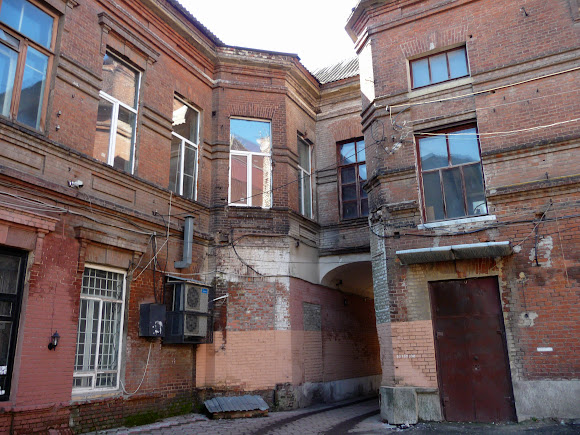 |
| The Aleksandrov house. 1911 |
A merchant city could not do without banks, and the financial institution was built in 1900.
 |
| The former city bank. 1900 |
The educational establishments in the city were very prestigious. The "Red" girls' gymnasium (there was also a "green" one) with columns by the entrance has retained its educational purpose, and now the faculty of primary education of the pedagogical university is located here.
 |
| The former girls' gymnasium. A faculty of the DDPU |
The patron of the construction of the Nobility Assembly and other important structures in the city, A. V. Shnurkov, opened the Commercial School in 1909, where they continue to sow the reasonable, the good, the eternal.
 |
| The former Commercial School. Secondary School No. 5. 1909 |
The Treasury got the former burgher council,
 |
| The former burgher council. The Treasury |
while the prosecutor's office oversees the observance of the laws in a merchant's house built in 1910 in the Art Nouveau style.
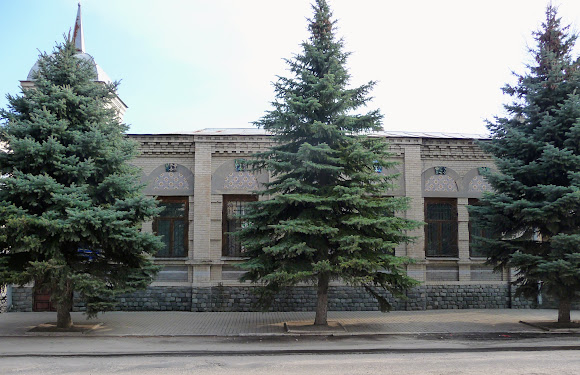 |
| A merchant's house. 1910. The prosecutor's office |
Five years older is the house of the grain merchant Rabinovich, with an ornament resembling a synagogue.
 |
| The house of the grain merchant Rabinovich. 1905. The SBU |
Now, within it, questions concerning the territorial integrity of the state are decided.
 |
| The house of the grain merchant Rabinovich. 1905. The SBU |
How did the patron Avksentii Shnurkov manage everything — he who in 1900 opened the first city hospital!
 |
| The first city hospital. 1900. The surgical department |
They did not build slapdash back then, because to this day the building serves the people of Sloviansk, and the surgical department is located in it.
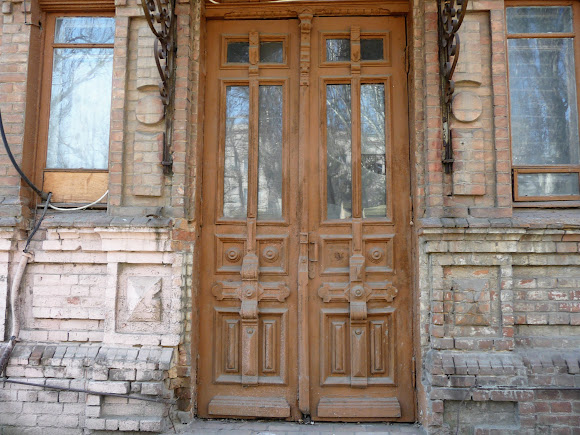 |
| The first city hospital. 1900. The surgical department |
The medical laboratory occupies the premises of the former parish school at the All Saints Church, which, unfortunately, has already been destroyed.
 |
| The former parish school. 1870. The medical laboratory |
It is one of the oldest city buildings, already a century and a half old.
 |
| The former parish school. 1870. The medical laboratory |
Behind it is the first city cemetery, with burials 200 and more years old. I wanted to see the Zaleski tomb-chapel, but there is no entrance to the neglected cemetery. Everything around is built up and the territory is overgrown with trees and weeds. I was disoriented, and to my question "Where is the cemetery?" I was directed to the working one, to which I marched a good two kilometres.
 |
| A war memorial in the cemetery |
 |
| The monument to the victims of fascism in the cemetery |
I found a watchman, who had never heard anything about any crypts. I returned to the starting point and, with the help of one responsive woman, did after all find a way into the cemetery.
 |
| The closed and neglected cemetery. The Zaleski tomb-chapel, 19th c. |
It was right here that the All Saints Church, the first city stone building, was built in 1812.
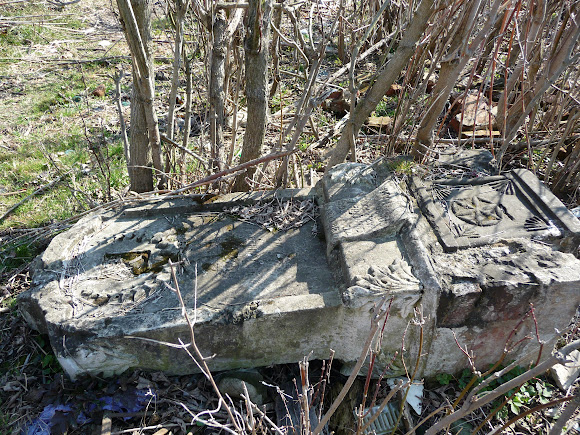 |
| The closed and neglected cemetery |
Here are the burials of the people who created, defined and shaped the directions of Sloviansk's development. Here rest the industrialists and merchants Weiss, the Princes Shakhovskoy, and members of the family of the millionaire A. V. Shnurkov. The crypts and gravestones have been destroyed.
Fragments of monuments and broken crosses lie about everywhere.
Could people really have needed someone's gravestones and slabs? Where did they disappear to? Here and there one can see cave-ins into the graves. Is this the Christian way?
 |
| The closed and neglected cemetery. The Zaleski tomb-chapel, 19th c. |
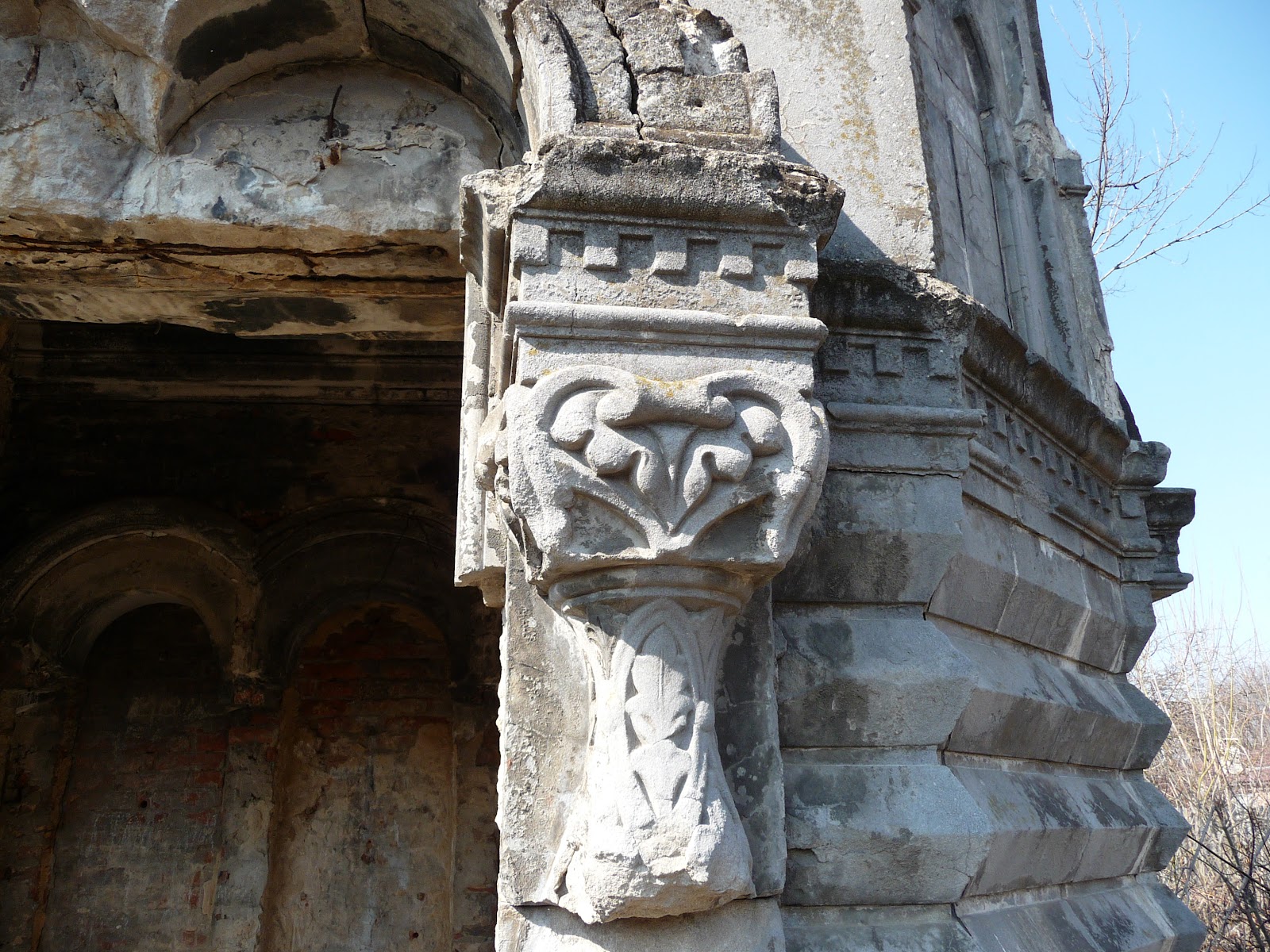
The family tomb-chapel of the entrepreneur Zaleski was built at the end of the 19th century, and only the walls remain of it.
 |
| The closed and neglected cemetery. The Zaleski tomb-chapel, 19th c. |
The pylons, the dome and the decorative ornaments are smashed.
 |
| The closed and neglected cemetery. The Zaleski tomb-chapel, 19th c. |
In a German soldier's photograph the external appearance of the burial vault has been preserved. Let this snapshot be a lesson to the ungrateful descendants, showing the state it was in in 1943, after the devastating war.
 |
| The Zaleski tomb-chapel, 19th c. A photograph from 1943 |
Despite its status as an architectural monument since 1999, no one will undertake to restore the chapel. A clean-up around it was carried out in 2012 and had the character of a one-off action and PR.
 |
| The closed and neglected cemetery. The Zaleski tomb-chapel, 19th c. |
On Poshtova Street I found 2 houses of the salt-works owner Zaleski in a decent state.
 |
| The Zaleski mansion. 19th c. The Renaissance style. |
One would like to hope that Villa Maria will after all be reconstructed.
 |
| Villa Maria. 1905 |
It was built in 1905 by Uspensky, the owner of the Sloviansk factories, for his beloved woman.
 |
| Villa Maria. 1905 |
Around it a park with a lake was laid out. By the way, the people of Sloviansk do not know the name and status of the building. To my question about where such an architectural monument was located, they answered apologetically that they could not help. With pain I wanted to tell them about the unique mansion in their city.
 |
| Villa Maria. 1905 |
The destruction of the former elite boys' gymnasium is the work of human hands.
 |
| The former boys' gymnasium. 1910 |
The 1910 building was in our time a recreation centre for the people of Sloviansk, but it suffered in 2014 during the shelling.
 |
| The former boys' gymnasium. 1910 |
I had a wish to go into the 19th-century palazzo, now the "Solo" beauty salon, but I thought it unlikely that any signs of the merchant's house of Proskuryakov had remained inside.
 |
| The Proskuryakov house. 19th c. A beauty salon |
His other property is across the road; it has survived quite well, if one does not take into account that someone had the idea of dressing the once Renaissance house in a fashionable "fur coat".
 |
| The Proskuryakov house |
It remained for me to find the third house of the fish merchant Proskuryakov, who built mansions for his four children. The streets in Sloviansk were recently renamed, and I needed to look on the map for where Vchytelskyi Lane was located.
I sat down on a fallen post,
 |
| A fallen post on Vchytelskyi Lane |
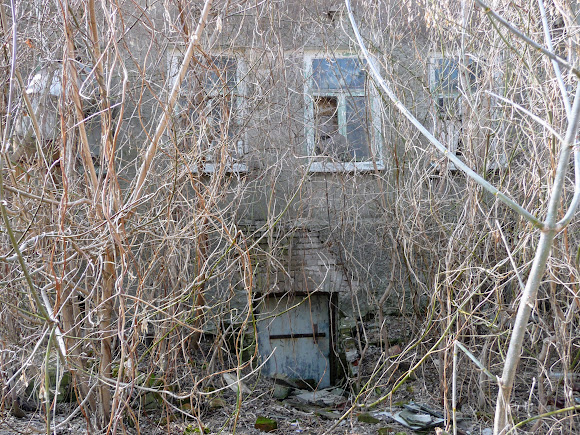
because there was not a single bench in the public garden, and I could not even imagine that the ruins of a lordly estate were only 10 metres away from me!
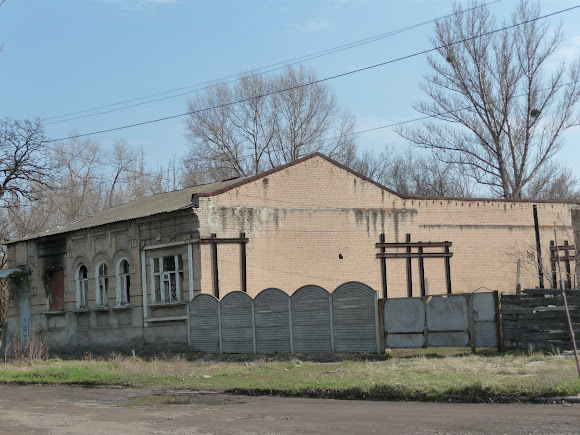 |
| Sloviansk. The former Proskuryakov house. The former House of Culture of the deaf |
Another architectural monument was in a dilapidated state.
 |
| The former Proskuryakov house. The former House of Culture of the deaf |
In the recent past the hearth of culture of the society of the deaf died out.
Have there stopped being hard-of-hearing people in the city? Or is the authority blind and deaf to their problems?
 |
| The former Proskuryakov house. The former House of Culture of the deaf |
The house of Doctor Titov, built in the 19th century in the very centre of Sloviansk at the intersection of Universytetska and Vchytelska streets, was also unlucky.
 |
| The house of Doctor Titov. 19th c. |
Right there the doctor received the sick.
 |
| The house of Doctor Titov. 19th c. |
Nothing remains of the front entrance with columns, and now this ruin is like a thorn in the eye — "repair cannot demolish".
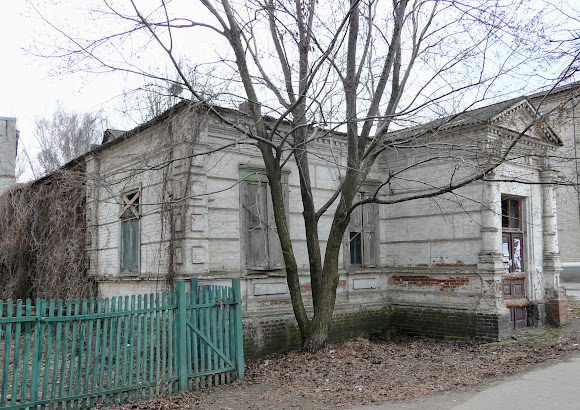 |
| The house of Doctor Titov. 19th c. |
The estate, now a medical department, had 2 owners before the revolution of 1917 and nationalisation — first the owner of the confectionery factory, Mikhailovsky, later the porcelain magnate Kuznetsov.
 |
| An architectural monument. A medical department |
Many buildings draw attention to themselves, although they are not registered or under the protection of the state.
 |
| The Department of Labour and Social Protection |
 |
| A sports school |
I do not know what this building with preserved brick window trim is, but the notices about video surveillance do not stop citizens from strewing it with rubbish.
In Sloviansk there are many interesting "Stalinkas".
 |
| A boarding school. 1965 |
 |
| The House of Children's and Youth Creativity |
 |
| The NAU College. 1953 |
 |
| Shevchenka St, 9. 1956 |
 |
| Shevchenka St, 9. 1956 |
With a spire I saw only one, with the date of construction — 1954.
 |
| A building with a spire. 1954 |
 |
| A building with a spire. 1954 |
The modern buildings are also built of brick.
Some streets have retained their provincial, patriarchal spirit.
 |
| Poshtova St |
 |
| Shevchenka St |
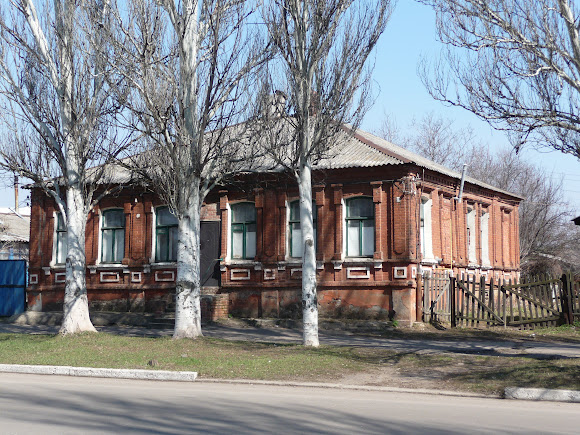 |
| Shevchenka St |
 |
| Literaturna St. The Church of the New Martyrs and Confessors of Russia |
 |
| The Church of the Holy Spirit |
 |
| Torska St |
For a walk through Sloviansk one needs to know that it is difficult to call the roads here roads.
 |
| Svobody St |
 |
| Vchytelskyi Lane |
There are no illusions about the neglected monuments of history and architecture being restored, but the people of Sloviansk are at least obliged to tell about those that remain and to preserve them.
 |
| Shevchenka St |
 |
| Shevchenka St |
Slavkurort is famous for its salt lakes and healing muds.
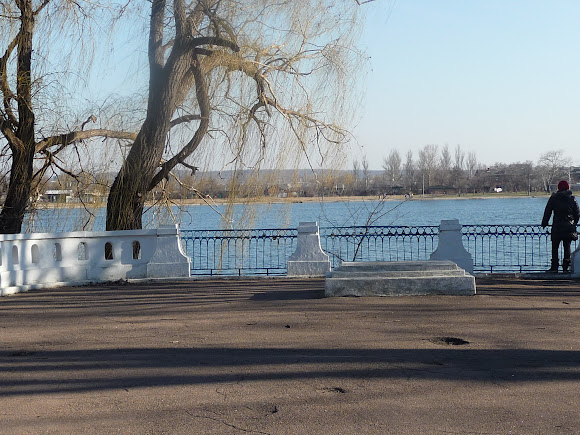 |
| Lake Rapne |
The sanatoriums of Sloviansk are very popular in Ukraine, and in the health resorts a treatment base has been formed for the profile diseases of the residents of industrial regions.
 |
| Lake Rapne |
Holidaymakers could learn more about Sloviansk and its history. On not a single historical building granted the status of a monument did I see a corresponding plaque. How, then, are the townspeople themselves to know that they have such little pearls?
I noticed this kind of blatant vandalism. Now one of the kinds of decorative and applied art — the mosaic — has practically sunk into oblivion. How could a hand rise to smash to bits a beautiful creation of artists, in order to do good for oneself?
 |
| A mosaic on a House of Culture |
At the end of my excursion around the city I managed to drop into the local history museum, in order to learn a little more about the architectural heritage of Sloviansk and the history of the nearby Villa Maria.
 |
| The local history museum |
The museum staff directed me to the culture department, probably because there is nothing to say and no rosy prospect is foreseen. And what can bureaucrats, paper-pushers, tell — those whose indifference is exactly what led to the destruction of the cultural and historical heritage? I wish the people of Sloviansk to treat the city's architectural heritage more attentively.
 |
| A public garden without a single bench and the monument to T. H. Shevchenko |
To remember its founders and creators, who determined the way of life of the glorious town of Sloviansk. And I also wish that the airframe of an unattractive-looking airliner, which landed 40 years ago and stands on inclined supports in the square called "Mriia", would not take you back to the USSR again.
 |
| The Yak-40 aircraft. 1987 |












No comments:
Post a Comment
Leave your impression