Chernihiv is a regional centre of Ukraine, a railway junction, a port on the Desna, and an ancient town with tourist attractions.
 |
| Chernihiv. Myru Avenue. St Catherine's Church. 1715. |
To
Kyiv — a stone's throw away, just 130 kilometres. Everyone who enters from the capital's side is met by St Catherine's Church, the town's calling card, built in 1715 on the site of an even older church in memory of the Chernihiv Cossack regiment and its feat at the taking of Azov in 1696.
 |
| St Catherine's Church. 1715. An architectural monument |
On the eastern side, a ravine separates the shrine from the Chernihiv
Dytynets, on whose territory rise the Transfiguration Cathedral (1036), the Sts Boris and Gleb Cathedral (1123), and other historical landmarks.
 |
| The Dytynets. The Transfiguration Cathedral. 1036. |
 |
| The Dytynets. The Sts Boris and Gleb Cathedral. 1123. The Museum of Architecture |
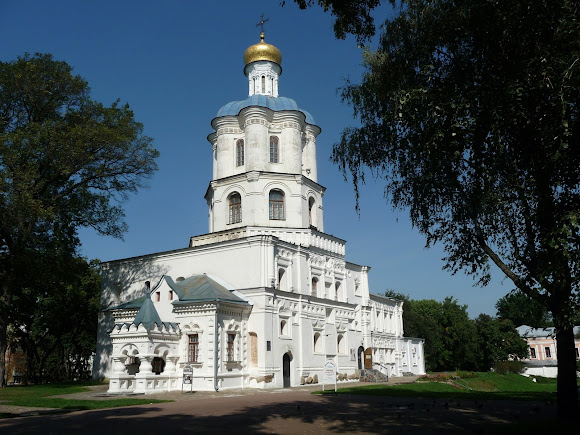 |
| The Dytynets. The Collegium |
On the site of the former fortress stand artillery pieces gifted by Peter I.
 |
| The Dytynets. The cannons |
In the former capital of the Chernihiv-Siverian land, five monuments of ancient sacred architecture have survived. The richest monastery of Kyivan Rus stands on the western side of St Catherine's Church, 600 metres from it.
The Yelets Dormition Monastery is part of the historic panorama of the capital city in the princely period.
 |
| The Yelets Monastery. The Dormition Cathedral, 12th-13th c. |
 |
| The Yelets Monastery. The Sts Peter and Paul refectory church |
Next to the monastery is one of the largest surviving Old Rus kurgans of the 10th century. Legends of deepest antiquity attest that in this kurgan is buried Prince Chornyi, who founded the town and gave it its name. The prince's daughter threw herself from a window, not wishing to become the wife of a Khazar who was besieging the town. In 1872-1873 archaeologists investigated the burial and found ancient weapons — two helmets, chain mail, two swords, a sabre and a spear — which testifies to the powerful military equipment of the retinue.
 |
| The "Chorna Mohyla" (Black Grave) kurgan. 10th c. |
On this same Prince Chornyi Street stands the prison castle, dated to 1803-1806. In two centuries the building has not lost its penitentiary purpose. During the Nazi occupation regime, over 7 thousand victims of Nazism were held and killed within it.
 |
| Prince Chornyi St. The prison castle. 1806. Remand prison (SIZO) |
 |
| The prison castle. 1806. An architectural monument |
Many historic buildings of the 19th-20th centuries stand on Myru Avenue, which begins by St Catherine's Church and divides the historic core of the town into two parts.
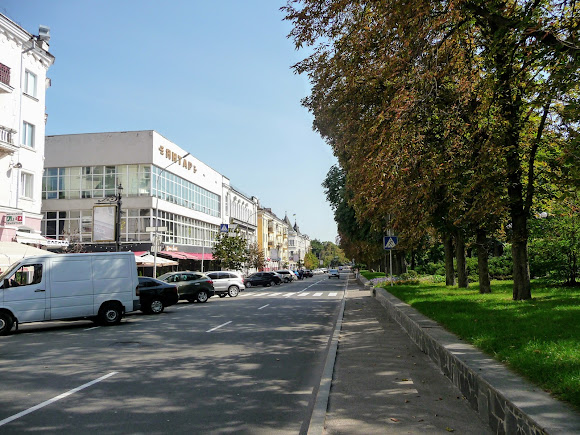 |
| Chernihiv. Myru Avenue |
 |
| 21 Myru Avenue |
 |
| 19 Myru Avenue. The regional directorate of "Oshchadbank" |
During the Second World War part of the landmarks were lost; the house of the fabulist L. I. Hlibov was not destined to survive.
 |
| Myru Avenue. The memorial sign on the site of the house of the fabulist L. I. Hlibov |
The premises of the former St Nicholas Diocesan Brotherhood, built in 1912, were taken over by the philharmonic centre.
 |
| 15 Myru Avenue. The philharmonic centre. The former diocesan brotherhood. 1912. |
 |
| The philharmonic centre. An architectural monument |
The former zemstvo board, built in 1814, is now the Chernihiv regional administration.
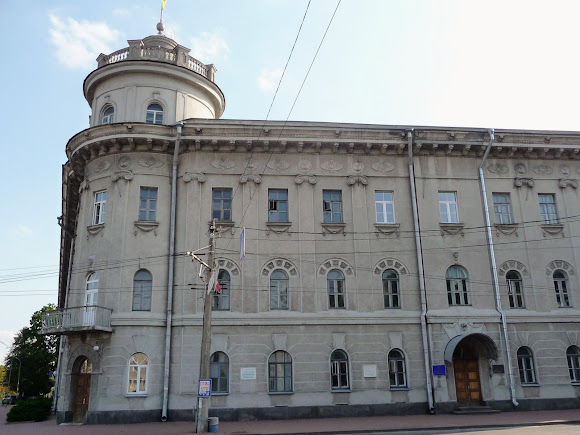 |
| Myru Ave. / Shevchenka St. The regional administration. The former zemstvo board. 1814. |
 |
| The regional administration. An architectural monument |
The Korolenko Regional Scientific Library, with holdings of almost 900 thousand, is housed in a two-storey building erected in 1914 in the Ukrainian baroque style and originally intended for a bank. The facade of this palace of books is decorated with multicoloured majolica.
 |
| 41 Myru Ave. The Korolenko Regional Universal Scientific Library. The former bank. 1914. |
A brick two-storey building, erected in 1912 in the Art Nouveau style with baroque features for a four-form public school. From 1923 a medical institute settled in it, where for the first time in the USSR the method of treatment with healing clays was applied. On the pediment the name of the health resort has survived — the "Vorovsky Institute of Physical Methods of Treatment".
 |
| 36 Myru Ave. Polyclinic No. 1. The former medical institute. 1912. |
 |
| 36 Myru Ave. Polyclinic No. 1. An architectural monument |
A block with a watchtower in the Gothic style was built in 1913. It housed the Voluntary Fire Society, with a stable, carts for eight barrels, and hoses. Now the building belongs to the Chernihiv regional branch of the National Union of Artists of Ukraine.
 |
| 34 Myru Ave. The exhibition hall. The former fire society. 1913. |
Myru Avenue, with its fountain and flower beds, is split by the historic town square.
 |
| Chernihiv. Myru Avenue |
 |
| Chernihiv. Chervona Square |
In olden times Piatnytske Field was a trading ground, and until the 1930s trading rows stood on it.
 |
| Chernihiv. Chervona Square |
And although the former Bazaar Square is officially called Chervona (Red), the townspeople call it Theatralna, after the location of the T. H. Shevchenko drama theatre.
 |
| The T. H. Shevchenko Regional Music and Drama Theatre |
On the central square stand administrative and commercial buildings.
 |
| Chervona Square. The Regional Court of Appeal |
 |
| Chervona Square. The "Desna" Hotel |
The oldest building in this part of the town was constructed in 1799 for the magistracy, but now it houses the regional directorate of the National Bank of Ukraine.
 |
| 16 Kyrponosa St. The regional directorate of the NBU. The former magistracy. 1799. |
And across the crossroads, the city council has settled into the former building of the State Bank.
 |
| 7 Mahistratska St. The city council. The former bank. |
Wherever you find yourself in the glorious city of Chernihiv, numerous churches prop up the sky on every side. The Holy Ascension Church, raised in 1775 in the Ukrainian baroque style, has features characteristic of Renaissance architecture. After the October coup the church was closed, and a road was laid through its grounds which now separates the church from the bell tower.
 |
| Remisnycha St. The Holy Ascension Church. 1775. |
The whole historic centre of Chernihiv can be considered an open-air museum, where a diversity of styles from different epochs is on show.
 |
| 17 Myru Avenue |
 |
| 2 Preobrazhenska St |
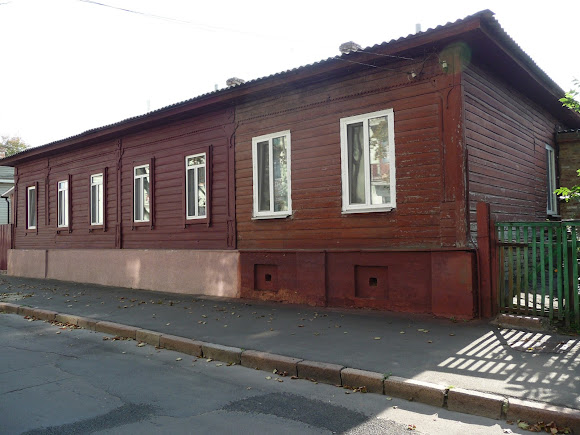 |
| 6 Remisnycha St |
Many wooden houses have survived, recalling the patriarchal character of the centre of the Little Russia Governorate.
 |
| Khlibopekarska St / Remisnycha St |
 |
| 5 Khlibopekarska St |
 |
| 7 Khlibopekarska St |
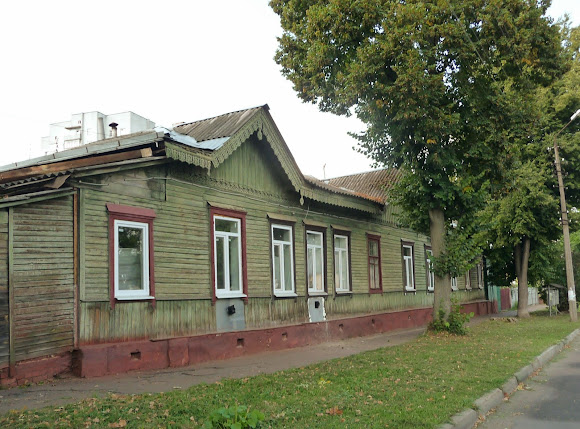 |
| 22 Kotsiubynskoho St |
 |
| 10 Kotsiubynskoho St |
You can learn about the rich history of the centre of the Siverian land in the museums of Ukraine's northernmost regional town.
 |
| 10 Khlibopekarska St. 1906. The "Steep Stairs" Art Gallery |
 |
| Kotsiubynskoho St. The M. M. Kotsiubynsky Literary Memorial Museum-Reserve |
 |
| The M. M. Kotsiubynsky Museum-Reserve. Monuments to Yu. M. Kotsiubynsky, the writer's son, a member of the first Ukrainian government, and to V. M. Prymakov, commander of the Ukrainian "Red Cossacks" |
 |
| The Dytynets. The Tarnavsky Historical Museum. 1804. The former governor's house |
Every house in this town of the Old Rus state is wreathed in legends of hoary centuries and has a modern history. The railway station resembles a pompous palace. It was rebuilt in 1948 to the design of a German prisoner of war who was granted amnesty and did not wish to return to Munich, where his family had perished.
 |
| The railway station. 1928-1948. |
One weekend is not enough to see all the unique historical landmarks of this town, which was among the five largest cities of Kyivan Rus; but there is no doubt that Chernihiv is in the top 5 of Ukrainian towns that leave vivid and unforgettable memories after a visit.
 |
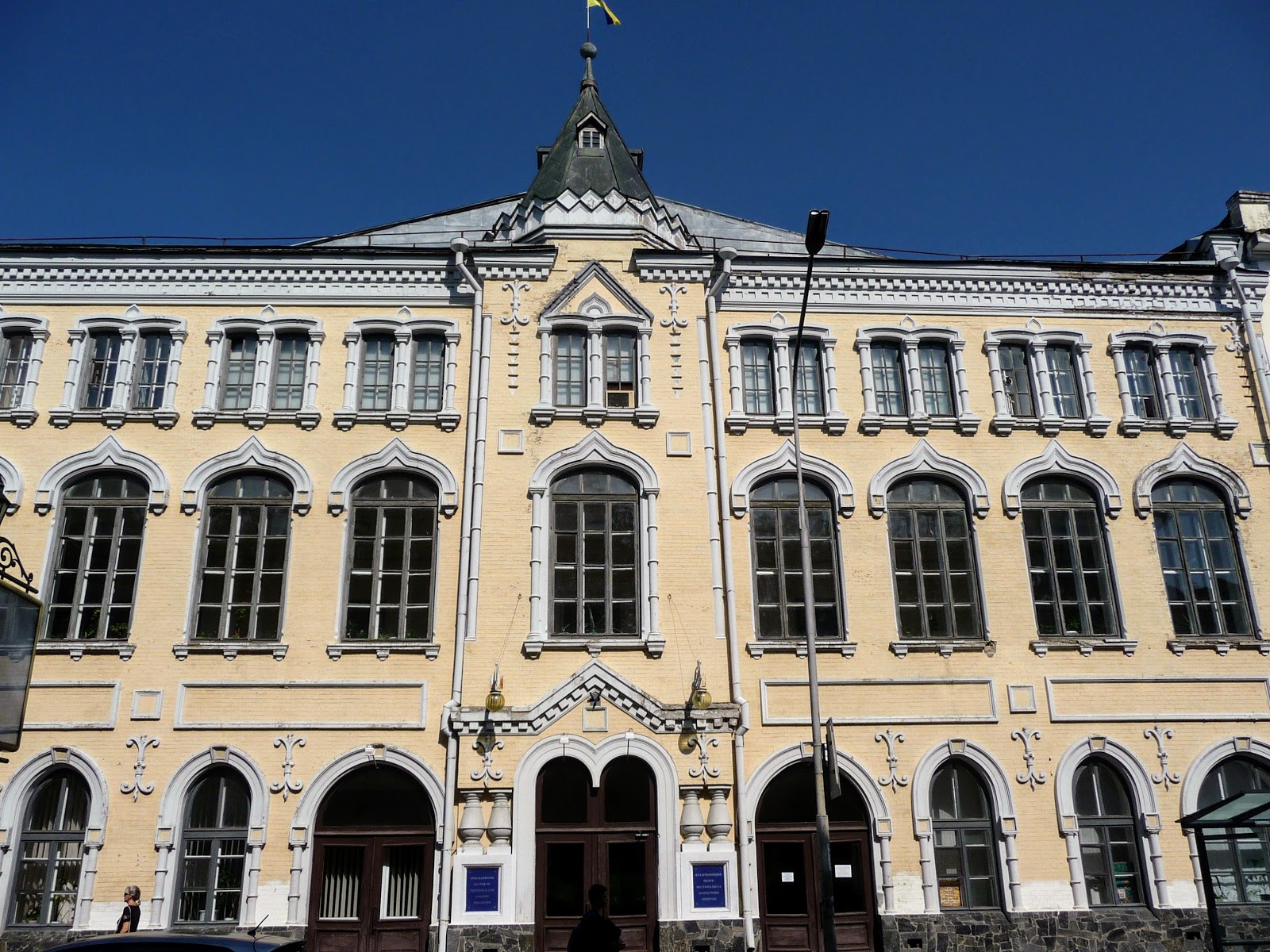
| Myru Avenue |




No comments:
Post a Comment
Leave your impression