While getting to know the unique places of the Donetsk land, I unexpectedly made a discovery for myself. The oldest stone forest on the Eurasian continent lies half a kilometre from the settlement of Oleksiyevo-Druzhkivka.
 |
| Oleksiyevo-Druzhkivka. Petrified trees |
During the development of a quarry in 1973, trunks and fragments of trees were discovered, aged 160-250 million years.
It is quite hard even to imagine such a number or to compare it with anything. And here these centuries-old relics simply lie on the surface.
In 1975, by decree of the Council of Ministers of the Ukrainian SSR, one hectare of the Donetsk steppe, across which fragments of ancient vegetation are scattered, was granted the status of a geological natural monument of national significance.
But this had no effect whatsoever on the preservation of the petrified wood. Access is open, there are no signs, and not every passer-by understands what these beautiful stones are.
And black archaeologists and local residents, taking advantage of the lack of oversight, have carried off the lighter specimens for their collections and to decorate their interiors.
In 2008, during the all-Ukrainian competition "Seven Natural Wonders of Ukraine", people remembered this rare creation of nature.
For similar outcrops of petrified trees are found in only three other places on planet Earth — in Australia, in New Caledonia, and in South America.
Those foreign specimens are of great interest to science and tourism and are under special protection.
Here, even in Oleksiyevo-Druzhkivka itself, not all the residents know about the exceptional nature of their home. Beautiful gullies here and there are heaped with rubbish.
Of course, local historians and geologists have looked for ways to take measures and preserve the landmarks. If the nature reserve zone were to receive the status of a World Heritage site, then no chance passer-by would be able to take fragments of the petrified remains as a souvenir.
The reserve area could have received the status of a National Nature Park in 2008, had the irresolute President Yushchenko not repealed the decree on it.
The largest specimens of the stone forest are about 1 metre in diameter.
The Palaeozoic araucaria, a coniferous tree about 40 metres tall, is very similar to the common pine. By colour and crystalline structure, the petrified wood is indistinguishable from dried timber.
Millions of years ago, araucarias, horsetails and ferns densely covered the earth's surface in this area.
The tropical climate favoured the rapid growth of plants. Probably a powerful hurricane tore the beautiful trees out by the roots and felled them into a sea or a salt lake. There was no contact with oxygen, and the trees did not rot.
Over the course of a millennium, the organic matter was washed out by the salt water, and the voids were filled with mineral substances.
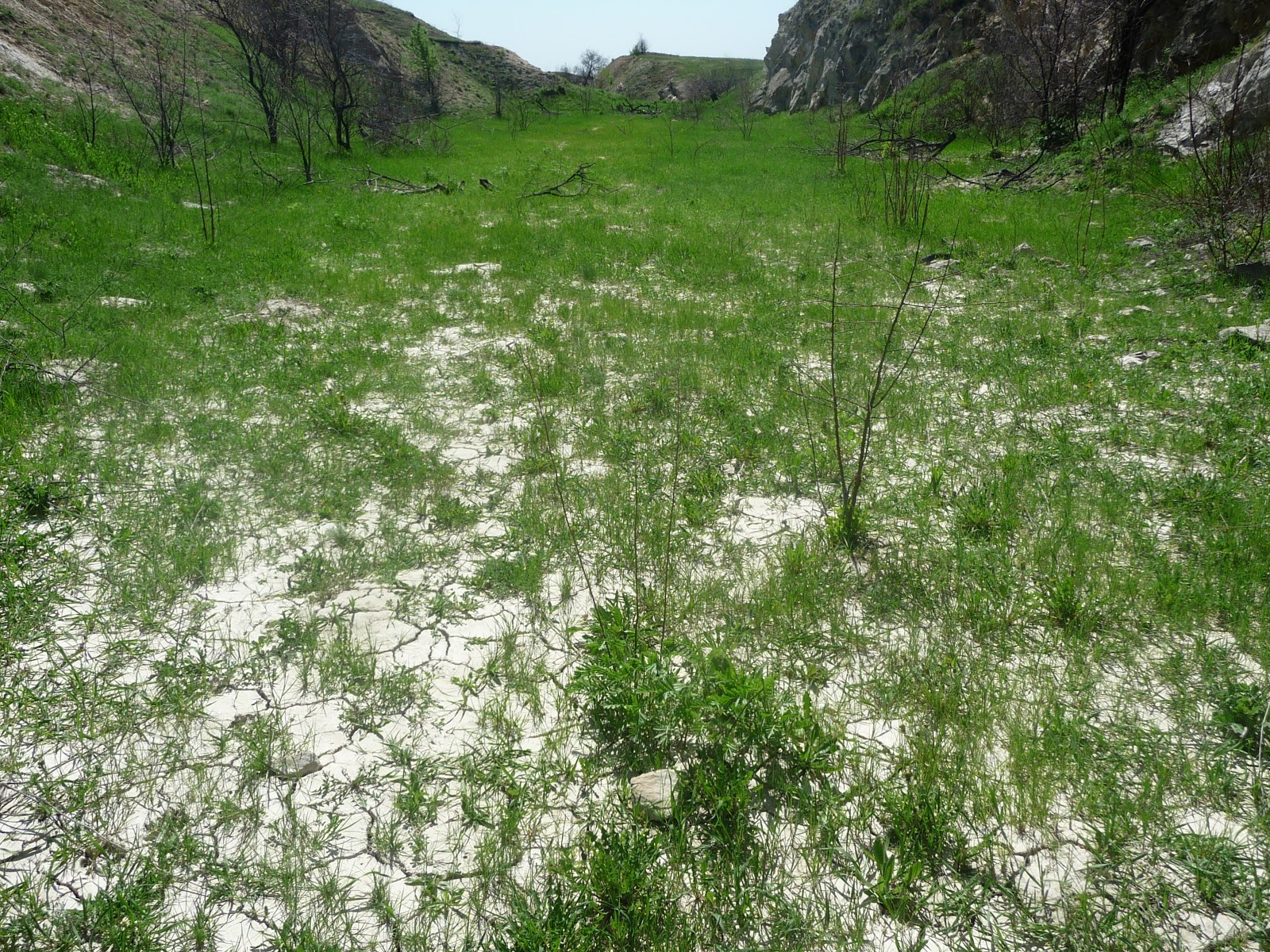
The Druzhkivka wonders of the Carboniferous period lie on the slope of a worked-out quarry and at the bottom of a small ravine.
The mineral seams of the Donets Ridge, whose deposits may lie at a depth of up to 1 kilometre and more, are covered by the boundless steppe, cut through with gullies.
On the eastern side a view of the settlement opens up.
Nowhere else was there room to bury family pets.
The steppe, not yet scorched by the sun, is thick with wildflowers.
People want to leave a memory of themselves, having picnicked by the relics.
The worked-out clay quarry is a pit up to 20 metres deep and over 500 metres long.
If you look at it from below, the quarry resembles a canyon with exposed layers of stone
massifs.
Millions of years ago this was a sea with its own animal and plant life.
Storms raged, and the surge of the waves reached the ninth wave.
The deposits of local clay are of sedimentary origin, formed when the alluvia of water currents carrying clay rocks settled on the sea floor.
Druzhkivka clay is used in the production of refractory goods, building bricks, ceramics, porcelain and faience.
Products made of refractory clay are used in the metallurgical, electrical-engineering, machine-building, oil-refining, chemical and other industrial sectors. Part of the output is exported abroad.
Monoliths of hard rock mass stretch along the entire stone corridor.
Wind and precipitation have given the overhanging boulders the images of mysterious creatures.
At the bottom of the artificial gorge a colony of mole rats has settled, leading an underground way of life. Judging by the turned-up soil, they have dug multi-tiered labyrinths in the thickness of the sedimentary rocks, in which the trunks of the Druzhkivka araucaria have been preserved.
The relics are located to the north-east of the settlement of Oleksiyevo-Druzhkivka, 20 kilometres from Kramatorsk.
How to get there? How to find it? From
Kostiantynivka,
Kramatorsk,
Sloviansk, Izium you can reach Kindrativka station by suburban train.
 |
| Oleksiyevo-Druzhkivka. Kindrativka railway station |
Cross the highway in the direction of the boarding school — a building set on a hill, visible from all sides. From the sign that reads "Sanatorium Boarding School" to the quarry the distance is about two kilometres.
 |
| Oleksiyevo-Druzhkivka. The boarding school |
Then continue eastward along Toreza Street.
 |
| Oleksiyevo-Druzhkivka. Toreza Street |
On the left will be the closed school No. 14, and 150 metres beyond it — a turn to the left.
 |
| Oleksiyevo-Druzhkivka. Toreza Street. The closed school No. 14 |
The asphalt road will lead to the cemetery, but you need to take the dirt road towards the lake.
 |
| Oleksiyevo-Druzhkivka. The turn to the lake |
The little gully by the lake is filled with rubbish, although the household-waste collection truck passes through the settlement on Fridays — and that day it was literally following on my heels.
The spring that feeds the lake was not spared by the lovers of open-air barbecues either, who left plastic litter behind.
 |
| Oleksiyevo-Druzhkivka. The spring |
Straight ahead you will see the Kindrativka Refractory Plant, which uses those very same refractory clays in its production.
At the fork, turn right and then left, so that the plant is on your left.
 |
| Oleksiyevo-Druzhkivka. The Kindrativka Refractory Plant |
Next you should walk along the dacha plots to the quarry pond with steep stony banks, on whose slopes the petrified parts of the trees were found.
 |
| The worked-out quarry. The pit was left after a search for scrap metal |
 |
| The dacha plots. The road to the quarry |
The place would look more picturesque if people did not dump rubbish here.
 |
| Oleksiyevo-Druzhkivka. The quarry pond |
The body of water lies on the same level as the worked-out quarries, in which you can still see specimens of the oldest trees on Earth.
 |
| Oleksiyevo-Druzhkivka. Petrified araucaria |
Coordinates:
48°35’37"N 37°36’47"E




No comments:
Post a Comment
Leave your impression