We know little of the history and landmarks of the provincial cities of Ukraine, remote from the capital and the regional centres. Pavlohrad is one of those cities that tourists do not aspire to visit. For travellers the stereotype of an industrial city without landmarks kicks in. If fate casts you into the centre of the coal basin of the Western Donbas, you will find much of interest. Let us begin with the religious buildings, whose number approaches twenty.
 |
| Pavlohrad, Dnipropetrovsk region. The Holy Dormition Church |
The Holy Dormition Church — the oldest in the city, located on one of the main thoroughfares, Kharkivska Street — has the status of an architectural monument. The shrine was erected in 1896 by the city cemetery with the donations of the townspeople.
The church, executed in the classical style, was adorned with decor of wood carving.
An even earlier church dates from 1845, but in 1936, in godless times, the Bolsheviks removed the domes and blew up the church. On the site of the destroyed three-altar Holy Ascension Cathedral, a memorial sign has been set up.
 |
| The cross on the site of the Holy Ascension Cathedral |
At the end of the 19th century this church could not accommodate all the parishioners living in the centre of Pavlohrad. The patron, city Duma deputy and merchant Yakiv Holubytsky, already in his old age, bought a plot 400 metres from the cathedral where there was a lake, drained it and built a majestic church in honour of the Image of the Saviour Not Made by Hands.
 |
| The cathedral in honour of the Image of the Saviour Not Made by Hands |
In 1898 the Saviour Cathedral was consecrated by the miracle-worker and seer John of Kronstadt, who foresaw the persecution of the church but its preservation by believers for long ages. During the years of the Hitlerite occupation the building was damaged, and later the God-fighters turned it into a warehouse. The graves of the benefactor Holubytsky and members of his family were desecrated, the bones buried in an unknown place in the cemetery. In 1991 Holubytsky's church was returned to the believers and is considered the main church in the district. The decor of this architectural monument of local significance and calling card of the city is executed in the eclectic style.
 |
| The cathedral in honour of the Image of the Saviour Not Made by Hands. 1898 |
The only surviving cemetery religious building of the Dnipropetrovsk eparchy is the chapel in honour of the icon of the Mother of God "Unexpected Joy", built in the 19th century. After the revolution of 1917 the house of prayer was closed and later a store for cylinders of liquefied gas was set up in it. A fire turned the building into ruins. In 2001 the chapel was restored through the efforts of the parish, and now funeral services for the dead are held in it.
 |
| The chapel in honour of the icon of the Mother of God "Unexpected Joy" |
The Catholic church of St Michael the Archangel was built on Robocha Street with the funds of the notary Karl Hebda in 1898. In Soviet times the church was closed and served as a shop and a warehouse. A hundred years after its erection the shrine was returned to the Roman Catholics.
 |
| The Roman Catholic church of St Michael the Archangel |
The spiritual life of the inhabitants of the industrial city grows richer thanks to yet another spiritual centre — the temple of Melpomene. The people of Pavlohrad are proud of their theatre, which is housed in the building of the former Count's Theatre and bears the name of their fellow countryman Boris Zakhava. The landmark was built by the educator and poet Golenishchev-Kutuzov in 1896. In that same year the future director of the Shchukin Moscow Theatre School, Boris Zakhava, was born in Pavlohrad. At the invitation of the chief director of the Pavlohrad theatre, many capital-city masters, pupils of B. Ye. Zakhava, performed on the boards of the small provincial theatre of the Dnipropetrovsk region. The municipal theatre company has staged more than a hundred plays by domestic and foreign authors. Children's productions enjoy particular popularity among young theatregoers. The buffet — an obligatory theatrical attribute — is decorated with playbills from the repertoire of the Pavlohrad theatre.
 |
| The Zakhava Theatre |
The winter settlement was founded on the terraces of the river Samara, where it merges with the Vovcha, by the Cossacks of the Kalmius and Samara palankas.
 |
| The memorial sign "Let us value life and freedom" |
The bas-relief image of the military elder Matviy Khyzhniak, immortalised in granite on Tsentralna Street, provoked an ambiguous reaction. But all the same this historical sign is a tribute of respect to the ancestors and their glorious victories.
 |
| The memorial sign to Matviy Khyzhniak |
Since 1784 Pavlohrad has had the status of a city.
 |
| Soborna Square |
In the middle of the 19th century tallow-melting and leather works and tobacco and calico factories operated in Pavlohrad.
 |
| A building on Shevchenko Street |
 |
| A building on Kharkivska Street |
 |
| A building on Tsentralna Street |
The fertile lands and the opening of the Katerynoslav Railway served the development of the flour-milling and grain industry, in connection with which banks and joint-stock companies opened. Merchants and capitalists built enterprises, mills, schools, churches, tenement houses, eating houses and trading shops, and made an enormous contribution to the development of pre-revolutionary Pavlohrad.
 |
| Vengerovsky's steam mill |
 |
| Hanna Svitlychna Street, 53 |
 |
| Hanna Svitlychna Street, 64. The former girls' gymnasium. The Palace of Children's and Youth Creativity |
 |
| Hanna Svitlychna Street, 63. The former Alexander II higher primary school. A building of the machine-building technical college |
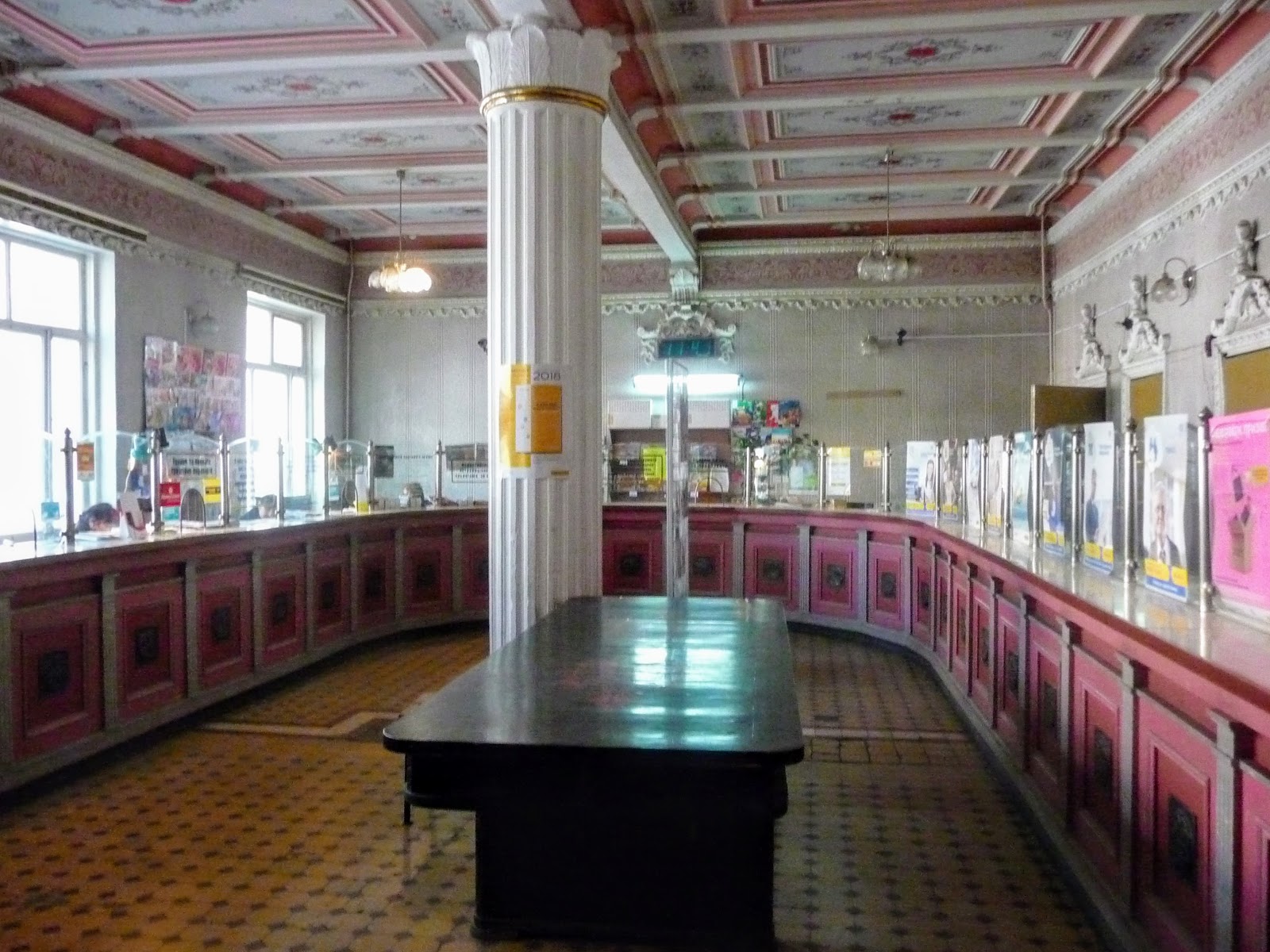
One of the most famous merchants was O. V. Parmanin, who headed the city Duma for 25 years before the October coup. This quarter of a century is considered the heyday of Pavlohrad's town planning. The city council building was opened in 1912.
 |
| The former city council. The post office |
 |
| The entrance to the former city council |
In 1917 Soviet power was proclaimed here and the party apparatus was housed here. Now the large building is occupied by the post office. Despite the long-ago repair, the building has preserved its former refinement. It would be logical if the city administration returned to its native home and restored the artistic design of the historic landmark.
 |
| The former city council. The post office |
The city was built according to a plan signed by Emperor Nicholas I. The streets in the historic centre are straight, parallel and perpendicular to one another; it is easy to find your way in the city.
 |
| Tsentralna Street |
Not all pre-revolutionary buildings have the status of an architectural monument.
 |
| Kharkivska Street, 63. A former merchant's house |
 |
| Tsentralna Street, 82 |
 |
| Tsentralna Street, 57 |
 |
| Soborna Street, 109 |
 |
| Soborna Street, 113 |
 |
| Tsentralna Street. The House of Culture |
 |
| Ozerna Street, 37 |
 |
| Hanna Svitlychna Street, 55. The editorial office of the newspaper "Ridnyi Krai" |
 |
| Hanna Svitlychna Street, 57 |
 |
| Soborna Street, 91 |
It is a pity that the facades of these architectural gems are hung with banners.
 |
| Shevchenko Street, 120. A mosaic panel |
 |
| Shevchenko Street, 122 |
 |
| Soborna Street, 99 |
 |
| Soborna Street, 103 |
 |
| Soborna Street, 138 |
The residential development is represented by modern multi-storey buildings, but in the private sector there are many little old homesteads with wooden shutters and the four-sloped roofs traditional in Ukraine.
 |
| Dniprovska Street, 121. The pump room |
 |
| Kharkivska Street, 90 |
 |
| Kharkivska Street, 43 |
 |
| Shutters. The old buildings |
One's attention is drawn by a ruined building of red brick, over 100 years old. According to local residents, it housed the tsarist prison. After the revolution the building's purpose did not change, and in its casemate the anarcho-communist Father Makhno served his sentence. An escape was arranged for the leader of the peasant insurgent army. Later the premises were taken over for residential flats, but in the 1990s, because of the residents' non-payment for utilities, the building was cut off from the electricity supply, which led to neglect and ruin.
 |
| Robocha Street. The old prison |
In February 1943 the underground fighters managed to raise the only anti-fascist uprising on the territory of Ukraine, as a result of which, with the support of the Red Army, Pavlohrad was liberated from the fascists and held its positions for 5 days. The final victory came to the Pavlohrad land on 18 September 1943, and this day is considered the city holiday — the City Day.
 |
| Tsentralna Street. The memorial sign to the underground fighters and partisans |
Now more than 105 thousand people live in Pavlohrad.
 |
| Gorky public garden |
Machine-building works, coal enterprises and other companies are in operation.
 |
| School No. 17. A mosaic panel |
 |
| Soborna, 58. A mosaic panel |
About the historical past of one of the oldest cities of the Dnipropetrovsk region you can learn at the local-history museum, with an exhibition collection of 44 thousand items (Muzeinyi Lane, 8).
 |
| The Museum of History and Local Lore |
Pavlohrad is surrounded by expanses of pine forests and an agglomeration of burial mounds, the most famous and mysterious of which is the Mavryn Maidan. This place of folds of high ground and clusters of lowlands was used by ancient people for prayers and sacrifices. The archaeological monument dates from the 2nd millennium BC. (Coordinates: 48°33'58"N 35°43'31"E).
In the city there are many public gardens, parks and children's playgrounds.
 |
| The children's park |
 |
| Gorky public garden. The monument to T. H. Shevchenko |
Pavlohrad was glorified by their labour and creativity by designers, architects, sculptors, artistes and people of other professions.
 |
| The monument to Zh. Ya. Kotin, one of the creators of the IS-series heavy tanks. |
A stand with photographs of fellow countrymen is dedicated to the famous writers and men of letters who were born and worked in this bountiful land. Pavlohrad deserves for travellers to include an acquaintance with it in their routes.
 |
| The stand "Literary Pavlohrad Region" |
One would like the city to have more atmospheric places, creative cafes and tourist information.
 |
| A map of the city |
An embankment should always be an adornment of a city, and the shoreline of the Vovcha needs a major reconstruction.
 |
| The embankment. The river Vovcha |
The city has 2 railway stations. Pavlohrad-I can be reached by suburban trains from
Dnipro,
Sloviansk,
Kramatorsk, Pokrovsk, Synelnykove.
 |
| The Pavlohrad-I railway station |
Coordinates of the centre of Pavlohrad: 48°32'4"N 35°52'12"E




No comments:
Post a Comment
Leave your impression