One of the many human passions urges us to see uncharted distances, getting to know not only the popular tourist landmarks but also that which is not found in advertising brochures and catalogues. From the top of
Castle Hill in Halych the grace of the Subcarpathian village opens to the view, its outskirts merging with the forests, the mountains and the clouds of heaven.
 |
| Zalukva, Halych district, Ivano-Frankivsk region |
What kind of village is it? What is it called? What is there? I do not look at the map and go there straight after
a walk through the streets of Halych.
From the western side, by the road roundabout, a four-sided stele without any designation or inscriptions rises on a hillock.
The road bridge over the river Lukva, in whose valley lie the Halych National Nature Park and the "Ancient Halych" national reserve.
The river got its name from the peculiarity of the direction of its channel and the relief of the terrain through which it flows.
At this spot it is on the finishing straight and, in just 700 metres, will merge with one of the largest blue arteries of the Black Sea region, the mighty Dnister.
The signpost was left behind ancient Halych.
On the border of the two settlements a sculpture of the Mother of God and angels has been set up. By the roadside chapels cars slow down, and passers-by stop and bow their heads to honour the Mother of God, to feel her mercy and protection.
Not often does one come across a memorial cross with a crucifix in honour of the fellow villagers who perished in the years of the First World War. In these parts bloody military operations were waged, which led to destruction and great loss of life.
And here is an originally designed bus stop with a skilfully made sign, thanks to which it finally becomes clear that the village is called Zalukva. That is what it used to be called — Halych beyond the Lukva.
In this two-storey building — a former four-class bilingual school and a one-class Polish school — the village administration is located.
The main street is called Halytska, and I continue my walk along it, getting to know Zalukva. A dwelling house and a commercial building.
A People's House of considerable size, with a little tower and dormer windows, resembling a castle.
On the facade is mounted a high-relief memorial sign to Oleksa Pylyponko, head of the local OUN organisation.
The Ukrainian nationalists in Zalukva conducted anti-Polish activity as early as before 1939. With the coming of Bolshevik power, the activists led the anti-communist movement and were destroyed by the NKVD organs. In 1994, in honour of the fellow villagers — victims of the totalitarian Stalinist regime — a monument was set up by the Church of the Holy Apostles Peter and Paul.
This is a new church of the Ukrainian Greek Catholic Church, consecrated in 1992. The former one, from the 18th century, was closed in 1961 on ideological grounds and, after falling into ruin, was dismantled.
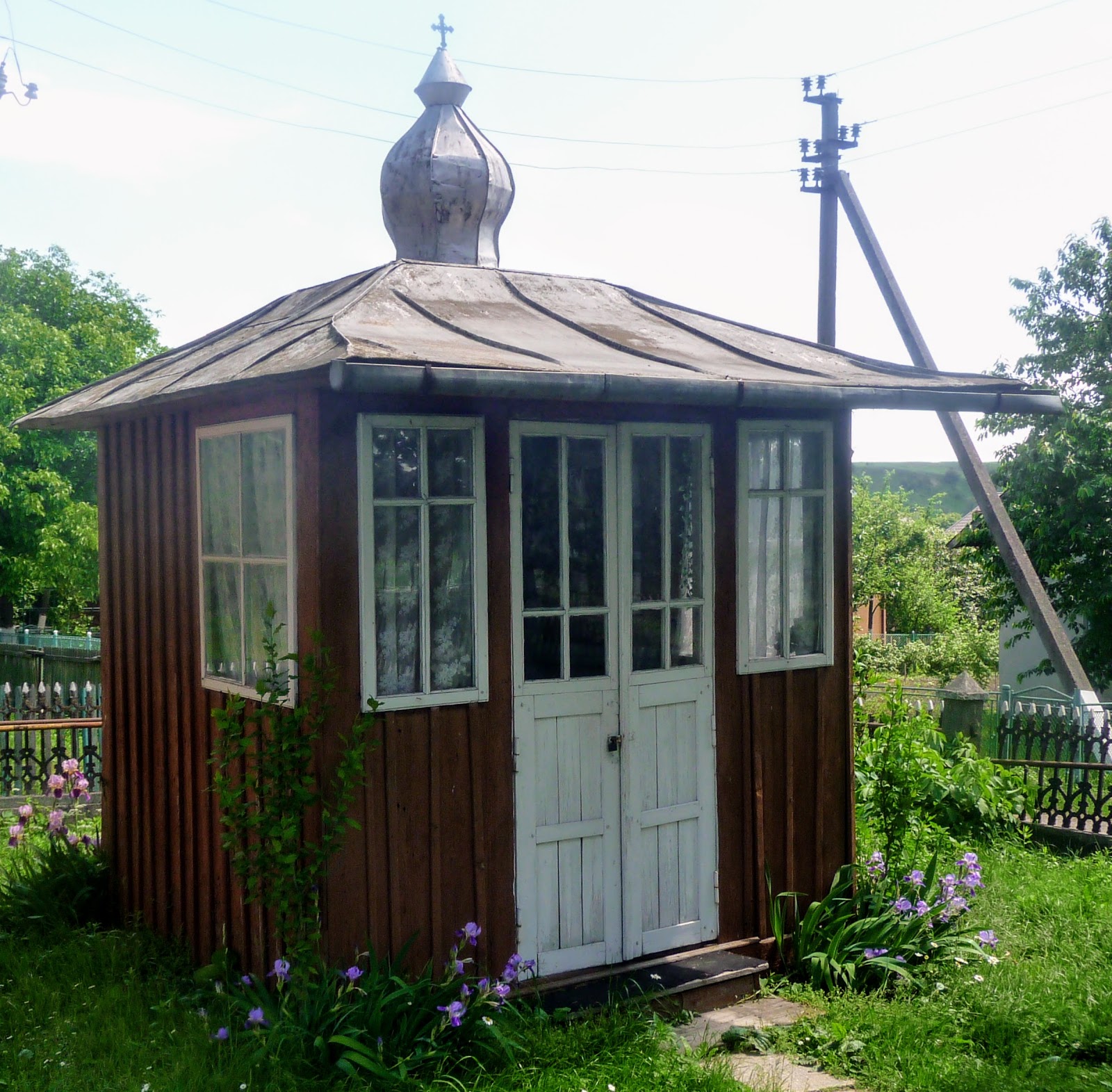
A wooden bell tower and a small chapel have remained from its predecessor.
The village school moved into new premises with spacious classrooms and subject rooms in 1966. Physical education lessons are held on the sports ground with exercise machines and a football pitch with an artificial surface.
The school bears the name of the educator and children's writer Ivanna Blazhkevych. In memory of the former teacher, a bas-relief memorial plaque has been mounted on the facade.
Preserving the history of the village, enterprising residents of Zalukva have restored an old sweep-well on the school grounds.
Having made a loop around the school, I again came out onto Lvivska Street, stopping at the crossroads by the roadside cross, on which it is written just so: "Stop for a minute, bow to the cross and to God".
One more shot: a grocery shop with the signboard of the former cooperative.
And in conclusion — a bus stop with an image of representatives of the flora and fauna characteristic of the Subcarpathian forests. It is a pity that the bill-stickers do not respect the artists' work and spoil the aesthetic perception of the panel.
The 40-minute walk proved productive and left pleasant impressions of the small village in the Ivano-Frankivsk area. It is a pity I did not see the monument to Bohdan Khmelnytsky, under whose leadership the War of Liberation against the Polish-Lithuanian Commonwealth was waged.
Address: the village of Zalukva, Halych district, Ivano-Frankivsk region.
Coordinates: 49°7'18"N 24°42'48"E




No comments:
Post a Comment
Leave your impression