Pryluky is the administrative, industrial and cultural centre of the Chernihiv region. Many architectural monuments have survived in the town, and through them one can picture the chronicle of one of the oldest cities of Ukraine. In the
first part I told of a walk through the squares of the historic centre, with an account of its churches, public gardens and memorial signs. Other notable landmarks located in the northern part of the town also draw the traveller's eye. Half a kilometre from the central core of Pryluky, where the squares run one after another in a chain, lies yet another small square — Teatralna (Theatre) Square.
 |
| Pryluky. Teatralna Square |
The name comes from the original purpose of this sumptuous building, in which the townsman Brodsky and the brickworks director Shtonda planned, at the end of the 19th century, to open a temple of Melpomene. For want of funds the ambitious construction dragged on until 1930. Today several artistic ensembles work in the municipal palace of culture, one of the best in Ukraine for its acoustic qualities. The historical name of this cultural hub has not been lost, and people still call it the "Brodsky Theatre".
 |
| Palace of Culture. The "Brodsky Theatre" |
On the square, a sculpture immortalises the Pryluky-born stage and film actor Mykola Yakovchenko, remembered for his gifted roles in the films "Evenings on a Farm near Dykanka," as Patsiuk, and "Chasing Two Hares," as the father of Pronia Prokopivna.
 |
| Pryluky. Monument to Mykola Yakovchenko |
On the opposite side of the square a two-storey building catches the eye, painted in patriotic colours, with the surviving letters "ZhBK" on its facade and the date of construction — 1928. In 1945 this building housed the headquarters of the 184th (36th) Guards Poltava-Berlin heavy bomber aviation regiment, which liberated Pryluky in September 1943, as a memorial plaque on the facade attests.
 |
| The 1928 building |
On pre-war houses the date of construction used to be marked.
 |
| Kostiantynivska Street, 108. The 1927 building |
The Church of St John the Forerunner was built in 1865 on the site of a burnt-down wooden church, founded in 1708 by Ivan Mazepa, in whose honour the shrine is called the Ivanivska (St John's) Church.
 |
| The Church of St John the Forerunner. The Ivanivska Church |
The Church of All Saints, rebuilt in the 19th century after a devastating fire, was destroyed by the Bolshevik authorities in the 1930s.
 |
| The gate of the destroyed 19th-century Church of All Saints |
Kyivska Street is the town's main thoroughfare, along which priceless historical and architectural monuments have been preserved. The former merchant house of Zolotariov (second half of the 19th century), which once housed the public assembly, is now occupied by the town council.
 |
| Pryluky Town Council |
The art school opened in the two-storey mansion of the merchant Moskovchenko.
 |
| Kyivska Street, 176. The art school |
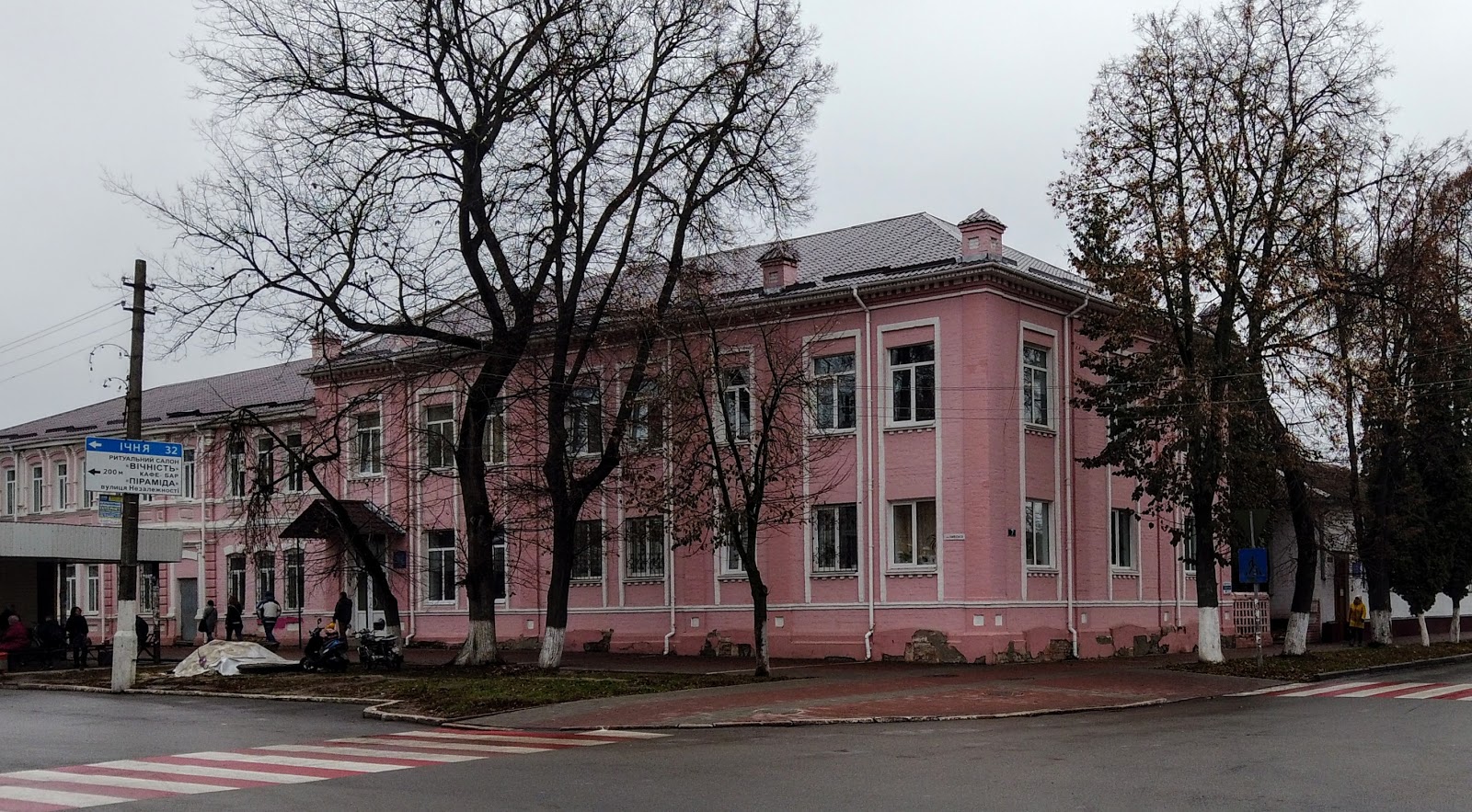
The polyclinic building — the former Lapshuk Hotel.
 |
| Kyivska Street. The polyclinic building |
In the former house of the town mayor M. I. Kyslovsky (end of the 19th century), the local history museum arranged its exhibitions.
 |
| Kyivska Street, 277. The Maslov Local History Museum |
Until recently a branch of the museum operated in the house-museum of Oleh Koshovy, a Pryluky native and an active underground member of the youth organisation "Young Guard" in Krasnodon, Luhansk region.
 |
| Kyivska Street, 255. The house-museum of Oleh Koshovy and a bust of the underground fighter |
Next to the museum, in a handsome mansion adorned with stone decor, stands a library.
 |
| Kyivska Street, 257. The Biletsky-Nosenko Children's Library |
The Pryluky Medical College is considered a forge of junior medical specialists.
 |
| Kyivska Street, 243. The medical college |
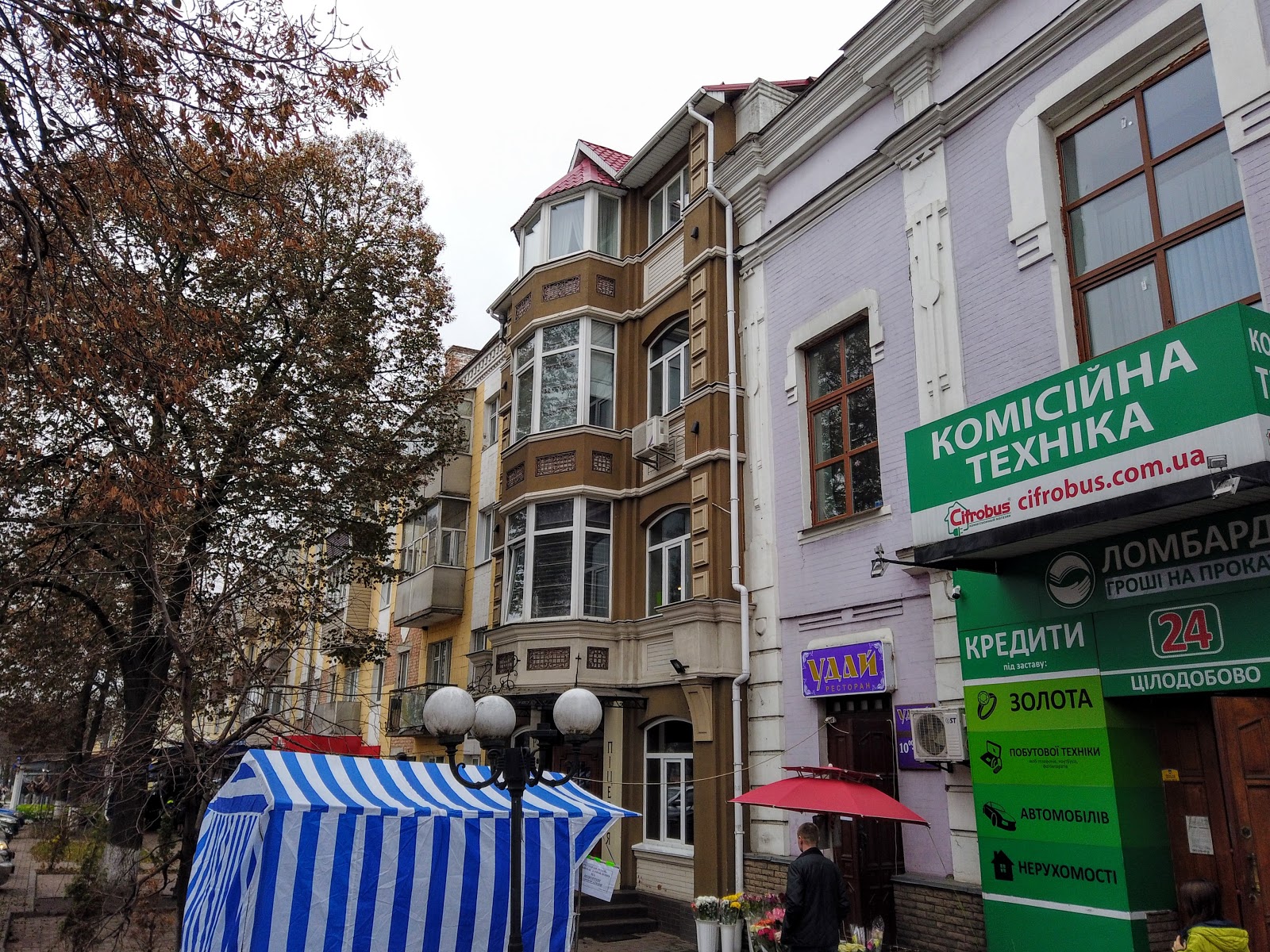
The house of the merchant Kosytsky, in which the Russo-Asiatic Bank opened and which now holds shops and the "Uday" restaurant, was built in the Art Nouveau style.
 |
| Kyivska Street, 172. The "Uday" restaurant |
Advertising banners and garish signboards give the historic buildings a jumbled look.
 |
| Kyivska Street, 172 |
 |
| Kyivska Street, 265. A commercial building |
 |
| Himnazychna Street. The former caramel workshop |
A special source of pride and an architectural adornment of the town is Gymnasium No. 1 named after Voronyi, the former estate of the Skoropadskys. The historic building, destroyed during the Second World War, was rebuilt in 1951.
 |
| Kyivska Street. Gymnasium No. 1 named after Voronyi |
On the facade there are memorial plaques to graduates of the gymnasium — renowned scholars and public figures.
 |
| Gymnasium No. 1 named after Voronyi. Memorial plaque to the public and political figure A. M. Livytsky |
 |
| Gymnasium No. 1 named after Voronyi. Memorial plaque to the literary scholar S. I. Maslov |
It is worth noting that a good many memorial plaques and bas-reliefs to famous figures have been set up in the town, and there are around 20 monuments in all.
 |
| Kyivska Street. Monument to V. I. Maslov, brother of S. I. Maslov, by the local history museum |
The "Pryluky" television company operates in the courtyard of the educational institution, in a building resembling a watchtower.
 |
| Pryluky. The "Pryluky" television company |
The inscription on the portico of the agrotechnical college's teaching block recalls that it was formerly called the hydro-reclamation technical school.
 |
| Kyivska Street, 178. The agrotechnical college |
Another administrative building with columns stands on Vokzalna Street, 4.
 |
| Vokzalna Street, 4. An administrative building |
Strolling through the town centre, one cannot help noticing the distinctive facades of public buildings and private houses.
 |
| Ivanivska Street, 17. Residential building |
 |
| Veteranska Street, 2. School No. 2 |
 |
| Veteranska Street, 2. School No. 2 |
 |
| Ivan Skoropadsky Street |
 |
| Zemska Street, 11. The Revutsky Music School |
 |
| Himnazychna Street, 70. Residential building |
 |
| Himnazychna Street, 67. Residential building |
 |
| Himnazychna Street, 74. Residential building |
 |
| Himnazychna Street, 16. Residential building |
 |
| Himnazychna Street, 90b. Residential building |
 |
| A railway service building and a library |
Sadly, more and more stucco moulding, decorative ornament and brick patterns are being hidden under plastic and siding.
 |
| Vokzalna Street, 53. Residential building |
 |
| Residential building after renovation using plastic |
The former private gymnasium of T. I. Fedorenko (a dormitory of the auxiliary school on Sadova Street) is an example of wooden architecture in Pryluky.
 |
| Sadova Street, 52 |
Remarkably, the town's green plantings have the status of a natural monument, and its centuries-old oaks are under state protection.
 |
| Kostiantynivska Street. Two centuries-old oaks; the third has not survived. The plaque lists three trees |
All the public gardens in the town are well tended, with benches and lanterns in place. The memorial garden is dedicated to the memory of fallen Pryluky townsmen and soldier-liberators.
 |
| The memorial garden |
Travellers will find it worthwhile to see the architectural complex and spiritual shrine, the
Holy Trinity Monastery in the village of Hustynia. The monastery was founded in 1600 and lies ten kilometres from the district centre.
 |
| Hustynia. Holy Trinity Monastery |
A trip to Pryluky can make an interesting and instructive day-off excursion. You can reach Pryluky by road or by suburban train from
Nizhyn, Bakhmach and Hrebinka, or by passenger train from
Kherson and
Mykolaiv.
 |
| Pryluky. Railway station |






No comments:
Post a Comment
Leave your impression