 |
| The Carpathians. Ivano-Frankivsk region |
At first my path lay along a stony road travelled by timber trucks overloaded with wood, which turn the forest track into ruts impassable for any lighter vehicle.
Water from the downpour had gathered in the ditches, making it harder for a visitor on foot to move through the green kingdom.

The day turned out sleepily autumnal; the sorceress of colour had only just begun to transform her canvases and had shyly touched her brush to the crowns of the oaks, ashes and beeches. The conifer members of the mixed forest community do not grieve in the leaf-fall season, and to the rustle of the russet fairy they answer with stoic invincibility. Thanks to the masses of rain, the flow had strengthened in a nameless mountain stream that had almost lost its crystal ring over the summer. Lively streams of water wind in restless blue ribbons down from the Yavirnyk ridge, cut deep gorges into the mountain monolith and merge with the rebellious Prut. Countless energetic tributaries feed this water artery of Europe with crystal-clear water, yet this does not make the Prut ecologically safe.


Near the stream the road scatters into paths by which you can climb up or descend to other levels of the emerald massif. One of the trails, barely visible in the grass, leads out beyond the curtain of the coniferous palisade, and before your eyes, as in fairy tales about forest thickets, a treeless expanse opens up with a dizzying panorama of mountain peaks.


Perhaps the clearing was formed after logging and used for haymaking and grazing cattle, but now it proved to be exceptionally rich in mushrooms. It does not matter that these handsome fellows are poisonous and inedible. Every specimen is a child of Mother Nature and part of the single Carpathian forest complex.


The picturesqueness of the scene was heightened by a little cabin that lay hidden in the clearing - abandoned and neglected, judging by its caved-in roof.

On closer inspection the building proved unlike a kolyba, the temporary dwelling of shepherds during grazing in the mountains. A byre and a shed had been built onto the living quarters at a right angle, which is not typical of Hutsul dwellings.


In the yard, under the oak crowns, an outhouse was holding on with all its might, and under a wild apple tree stood a dog kennel with an insulated roof.

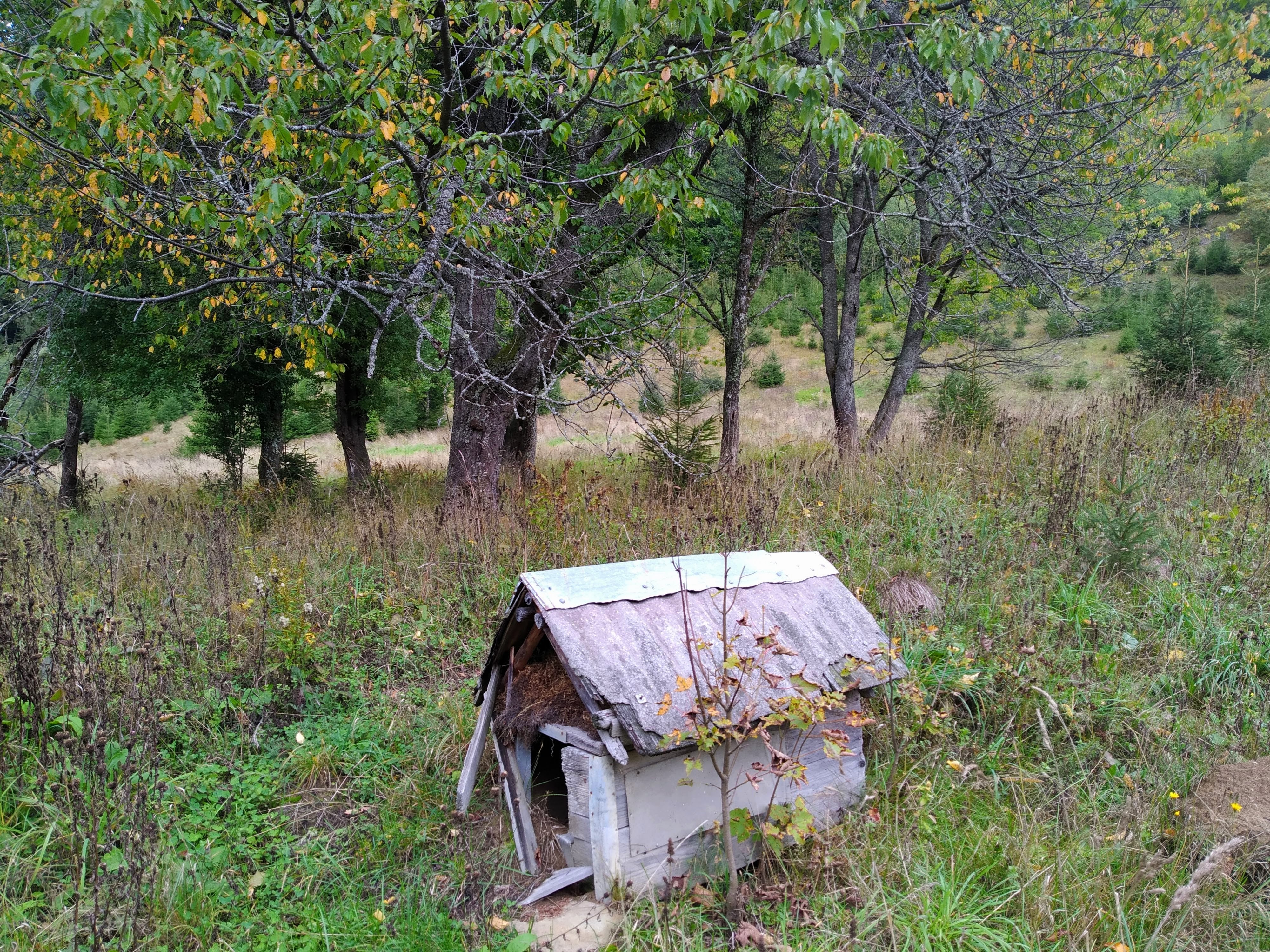
The owner had been a beekeeper and had kept domestic animals, as the scattered beehives and the remains of barbed wire for fencing testify.


With neither electricity nor a gas supply, the settlement was the highest in this area. The source of water was a well in the hollow about 150 metres from the house.
 |
| The well |
Later I learned that the owner of the homestead had been elderly and died a few years ago. No one was found willing to restore the orphaned house and live as a hermit surrounded by scenic landscapes. It is a pity that the ceilings have rotted through and no longer let travellers or mushroom-pickers take shelter in the little house in bad weather or for a rest stop.


Although the finish turned out sad, on the whole the outing proved rich and rewarding, with the admiring of the views and an acquaintance with an example of folk wooden building. Over five hours, in gloomy but calm weather, with a climb of about 200 metres, I covered a distance of around 8 kilometres along various forest trails.

This story is also available in Ukrainian: Похід в Карпати. Покинута хатинка на полонині. Гриби, краєвиди, гірська річка

No comments:
Post a Comment
Leave your impression