Mykulychyn. Holy Trinity Church and Bell-Tower Museum
It conforms to the canons of wooden Hutsul sacred buildings, it has kept a refined interior, its parishioners preserved the shrine through the years of wartime calamity and Bolshevik atheism, restored it after a flood and created a museum. The Church of the Holy Trinity in Mykulychyn, in the Ivano-Frankivsk region, has been granted the status of an architectural monument of national significance.
Mykulychyn, Ivano-Frankivsk region. The Church of the Holy Trinity. 1868. UGCC
In the era of Soviet godlessness and the destruction of all that was holy, the Mykulychyn church was preserved as an architectural monument of the Ukrainian SSR, and its doors stood open to the faithful. The Church of the Holy Trinity stands on the main street of the largest Ukrainian village, beside the H09 highway Mukachevo-Ivano-Frankivsk-Lviv and it is clearly visible from cars and buses.
A predecessor of this Carpathian landmark existed as far back as the eighteenth century, in what was then the largest settlement of the Poland of that day, but the unpredictable manifestations of the mountain climate — squally winds and downpours — destroyed the place of worship. Only a hundred years later did the parishioners come to the decision to build a new church, yet they could not choose a site for the house of prayer. The residents of the Horby quarter wished to raise their church in the northern part of the village, while the inhabitants of the Pidlisniv quarter insisted on the southern side. After two years of disputes a sensible solution was found, and in 1868, in the very centre of Mykulychyn, on the day of Saint Paraskeva, the new church was consecrated.
Mykulychyn. The Church of the Holy Trinity. Early 20th century. A drawing by Petro Hrytsiuk
The church was built by the parishioners' own efforts, using Carpathian spruce and the stones of the mountain river Prut. The design was drawn up by an engineer-architect from Nadvirna, Ya. Chaikovetsky, and the murals were executed by the Ukrainian iconographer Kornylo Ustiianovych. The Hutsul church is cruciform in plan and consists of a large central square to which, on four sides, smaller log frames are attached. Floods and rainfall affect the state of the timber, and the community had to sheathe the structure in a metal covering.
Mykulychyn. The Church of the Holy Trinity
The lower tier has remained authentic, without an aluminium sheathing. All the parts of the building are crowned by 5 cupolas with wrought-iron crosses, which replaced the wooden ones in 1929.
Mykulychyn. The Church of the Holy Trinity. 1868
The altar of the Church of the Holy Trinity faces north; a vestibule is attached to the southern log frame, and the entrance is on the eastern side.
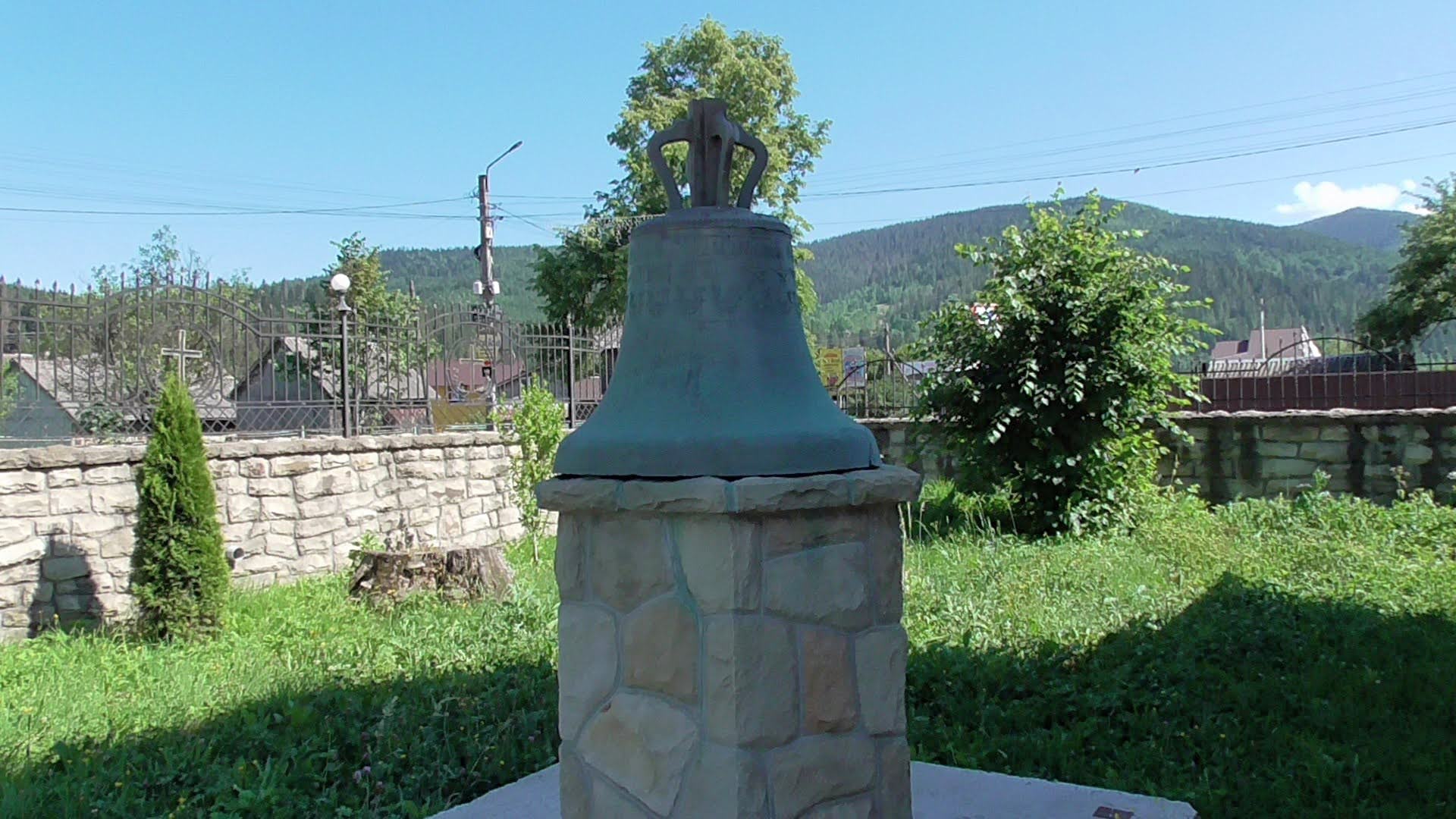
A protected status is held by the four-tiered bell tower, a contemporary of the church. In the years of the Second World War the Hitlerites stole the silver bells, whose echo could be heard ten kilometres away.
The bell tower of the Church of the Holy Trinity
Since 2002 the services have been announced by the gate bell tower, adorned with sculptures of Jesus Christ and the Most Holy Mother of God.
Mykulychyn. The Church of the Holy Trinity. The new gate bell tower
In the Hutsul national style, a chapel has been built in the church courtyard.
The restored wooden bell tower, covered with shingle, serves as a museum, in which are gathered church utensils, holy images, old printed books and photographic documents.
Mykulychyn. The bell-tower museum
On the first floor are displayed canvases depicting the Mother of God, biblical scenes and religious symbols.
Mykulychyn. Exhibits in the museum of the Church of the Holy Trinity
Several examples of towels embroidered with Hutsul patterns adorned the icons and the church banners. A collection of liturgical books in the Old Church Slavonic language has been assembled.
Mykulychyn. The bell-tower museum. Old printed books and photographic documents
Wooden stairs lead up to the second floor.
Mykulychyn. The bell-tower museum. Wooden structures
In the round chamber of the second tier they have placed reproductions of images of the saints and old icons brought by the parishioners.
Mykulychyn. The bell-tower museum
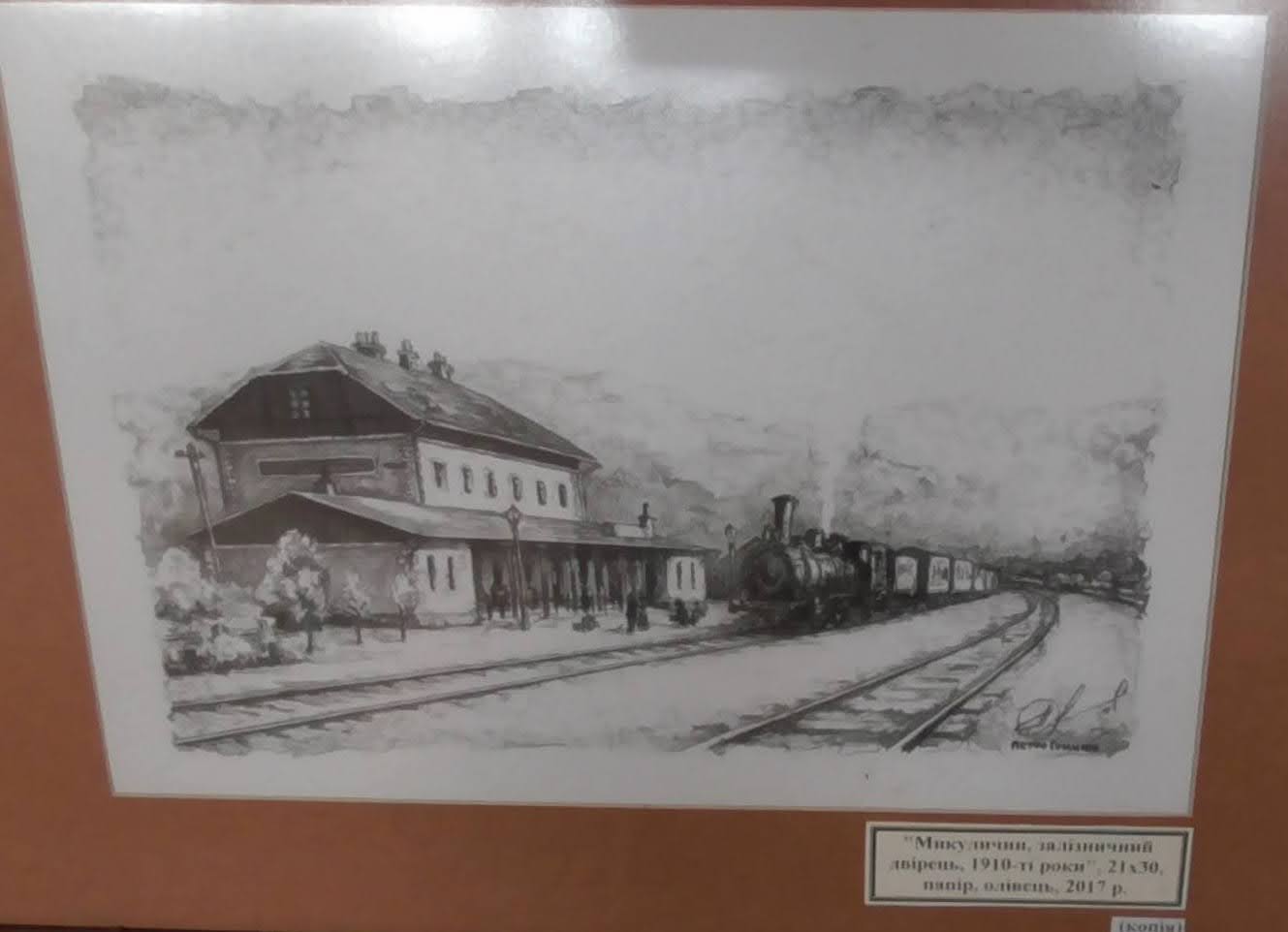
Particular attention is deserved by the copies of the works of Petro Hrytsiuk, a native of Mykulychyn, whose aim is to preserve the cultural and architectural heritage of his native land. The subjects of these works are the memorable places of Mykulychyn, Vorokhta, Yaremche and Deliatyn at the beginning of the 20th century.
Deliatyn. The town hall
The Carpathians. The observatory
The station building at Voronenko
The station building at Mykulychyn
Vorokhta. The house of culture
Mount Khomiak and a shepherd
The border guards' barracks in Yablunytsia
Yaremche. The "Nadiia" guest house
Tatariv. The "Strashnyi Dvir" guest house
Yaremche. A guest house
Yaremche. The Roman Catholic church
In the centre of the arcaded gallery is shown a wooden figure of the crucified Jesus Christ, before which a votive lamp was once lit.
Mykulychyn. The bell-tower museum. A wooden figure of Jesus Christ
The residents brought to the museum store not only religious relics but also household objects, tools of village labour, implements, small rugs and paintings.
Mykulychyn. The bell-tower museum
The labour of the initiators and creators of the museum is worthy of thanks and gratitude, and the spiritual and cultural stratum of Mykulychyn, presented in the museum, deserves to be studied and made known.
Address of the Church of the Holy Trinity: Mykulychyn, Nadvirna district, Ivano-Frankivsk region, Hrushevskoho Street, the centre of the village.




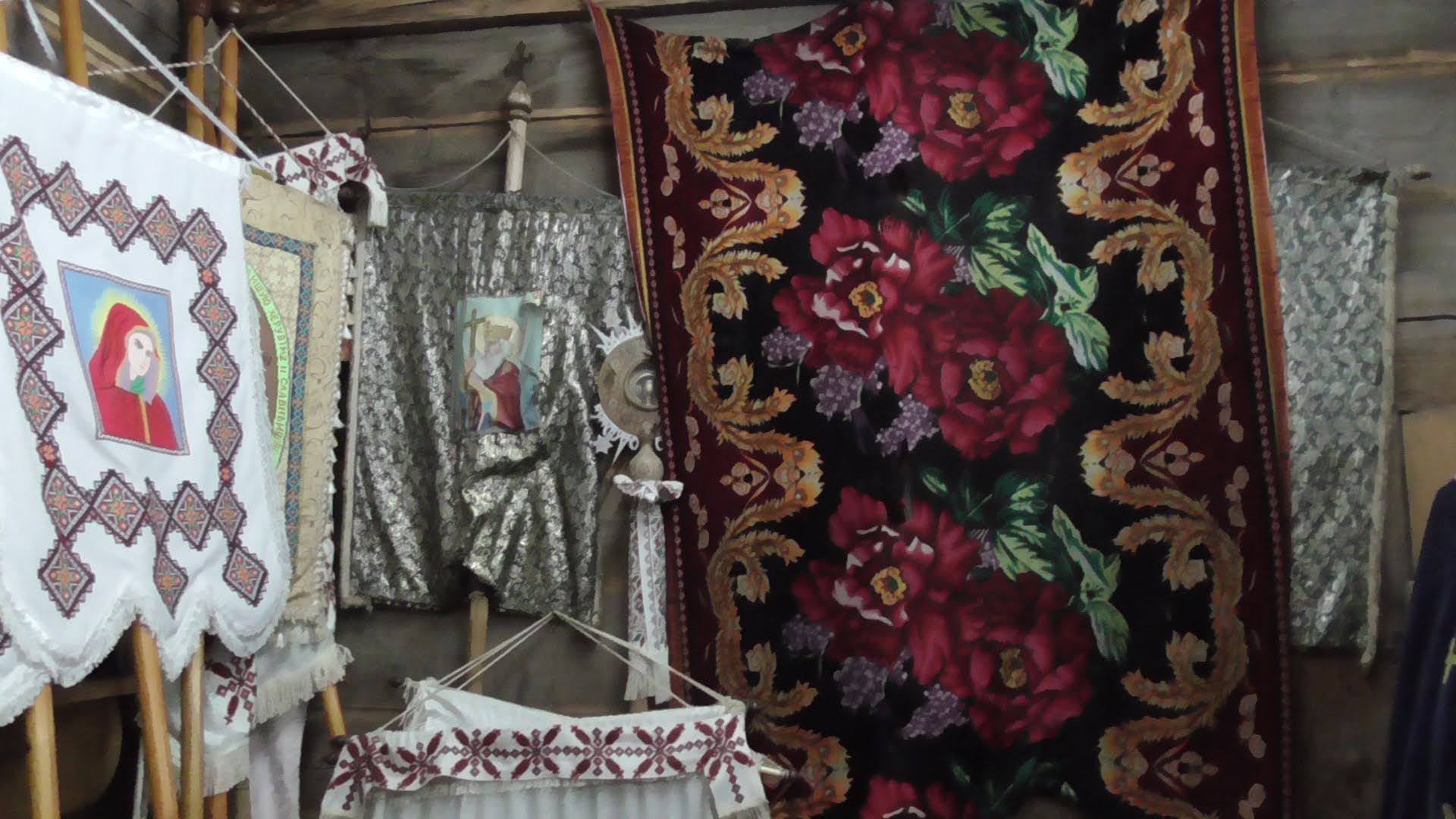


.JPG "Mykulychyn. The bell-tower museum. Embroidered towels and liturgical books")


.JPG "Mykulychyn. The bell-tower museum. Old printed books and photographic documents")




No comments:
Post a Comment
Leave your impression