In 2016 a bill was registered on the Verkhovna Rada's website to rename the settlement of Novhorodske in the Donetsk region as New York. This was the name the former German colony bore until 1951. What of note has survived in this workers' settlement, founded by Mennonites in the 19th century, who gave it its overseas name?
 |
| Novhorodske. Donetsk region. |
In 1871 the Mennonite community bought, for 929,000 gold roubles, a large expanse of fertile land with deposits of natural minerals in the valley of the Kryvyi Torets from Princess Golitsyna, who had owned it since the 1820s.
The enterprising new owners had families of 15-17 children and quickly took the farmland in hand, building industrial enterprises, mills, schools, shops and pharmacies.
The opening of the Kharkiv-Mariupol railway line strengthened the development of the settlement's economy.
 |
| Novhorodske. The Fenolna railway station |
New York Street and Sadova Street (German name Gartenstrasse) — the historic centre of the German colony.
 |
| New York Street |
Here you can still see what cobblestones the streets were paved with, and the buildings put up at the turn of the 19th and 20th centuries.
 |
| New York Street. The cobblestones |
 |
| Sadova Street. A residential house, early 20th c. |
Deposits of clay and stone from local quarries served as building material. For the construction of their enterprises, the capitalists had their own brickworks, which produced bricks bearing the maker's stamp.
In 1894 the German industrialist Jacob Niebuhr founded a plant for the manufacture of agricultural machinery. Today this engineering works has lost its potential.
 |
| The production buildings of the former Petrovsky plant, founded by Niebuhr |
But the settlement's unusual name lasted more than half a century. During a journey through Europe, Niebuhr met a US citizen, Mary, who later became his wife. The owner of factories and works named the workers' factory settlement New York, reminding his wife of her homeland and hoping to create in the German colony an economic, financial and cultural centre.
 |
| Novhorodske. The former New York |
The rich grain harvest spurred entrepreneurs to build mills. Of Rempel's steam mill there remains an indestructible hexagonal chimney, crowned with patterns in brick.
 |
| The chimney of Rempel's former steam mill |
The building of P. P. Dyck's steam mill belongs to the grain-products combine.
 |
| The building of P. P. Dyck's steam mill |
One of the very first village bookshops was built in the Donbas New York.
 |
| The shop on the corner of Sadova and New York Streets. A photo from the early 20th c. |
Fiction, reference, scholarly and religious books arrived from all over Europe. The building housed jewellery and watchmaking workshops, a credit-and-pawn office and a small hotel. With the coming of Soviet rule the shop's owner, one of the Hamm brothers, Heinrich, was shot for refusing to destroy theological literature. In the dress shop, fashionable ladies ordered their wardrobe from Petersburg. Sadly, these buildings are now in private ownership and in a state of neglect.
 |
| The shop on the corner of Sadova and New York Streets. 2018 |
The altruists' idea of creating a cultural centre and museum in the shop's premises, whose exhibits would be objects, photographs and documents from family collections, cannot be realised because of the high price set for the unique building.
 |
| A memorial plaque about the building of the shop |
The Germans paid great attention to education. Several educational establishments with libraries and teaching aids were founded in the settlement. Fifty girls studied at the school for girls, the first village school in Katerynoslav Governorate. For this the Thiessen brothers converted their house and provided the pupils with everything they needed. The Central School, built in 1905, was located in the building of the present fire station.
 |
| Sadova Street. The former Central School |
The former Janzen house was occupied in Soviet times by an evening school, and in the 2000s it was handed over to the Orthodox community.
 |
| Sadova Street. The former Janzen house. The Church of the Holy Spirit |
The experimental station of the O. N. Sokolovsky Institute of Soil Science and Agrotechnics is housed in the brick Goetzen mansion.
 |
| Sadova Street. The Goetzen mansion. The experimental station of the O. N. Sokolovsky Institute of Soil Science and Agrotechnics |
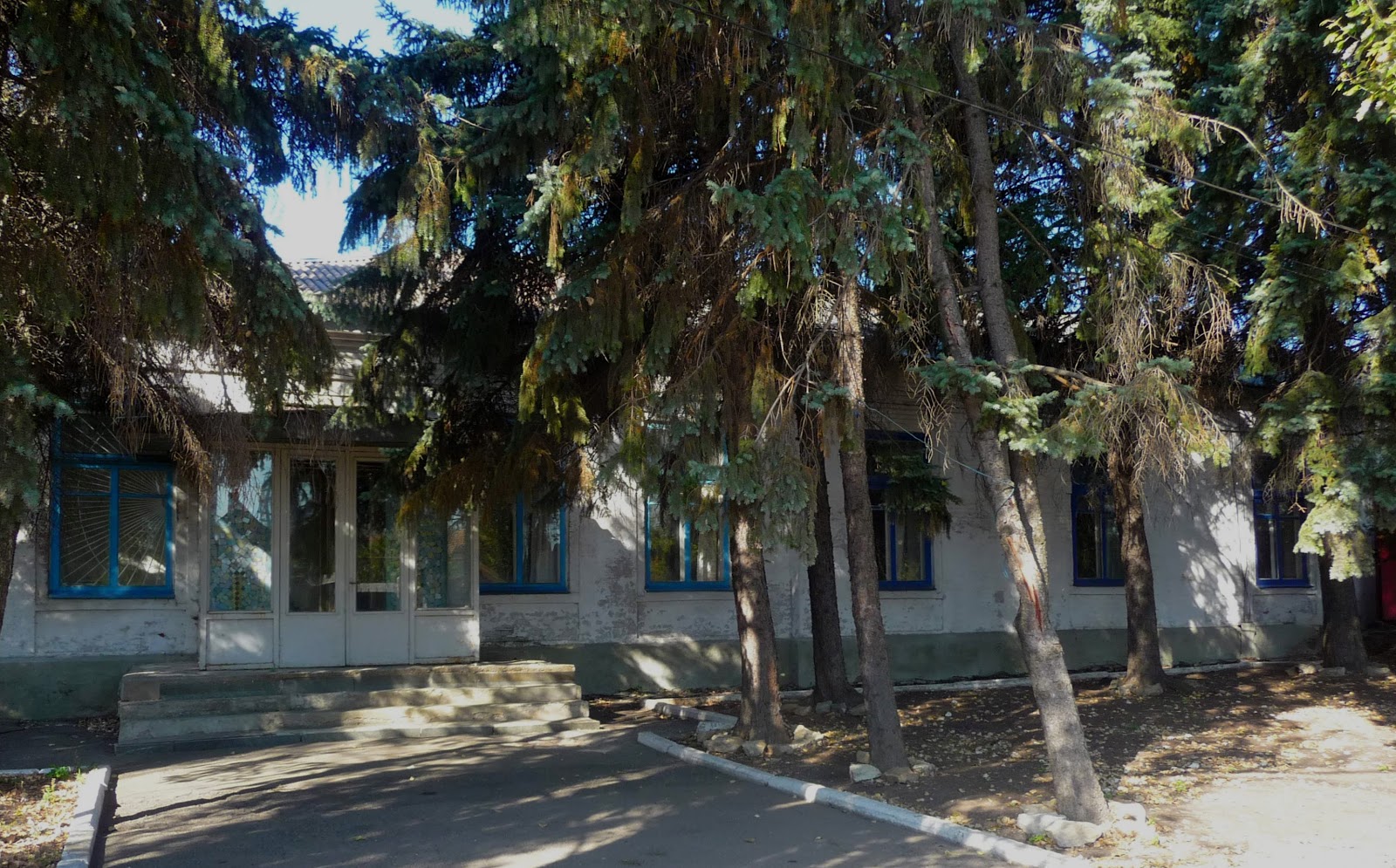
In the building, with its brick ornament and a cornice running around its perimeter, the settlement council once had its seat.
 |
| New York Street. The former settlement council |
The first settlement pharmacy, run by the Olivier brothers, offered a wide range of medicines. War invalids and the dependants of heroes who had fallen for the empire enjoyed social benefits. A pharmacist would travel out to the sick together with the feldsher and prepare medicines on the spot.
 |
| The former first settlement pharmacy of the Oliviers |
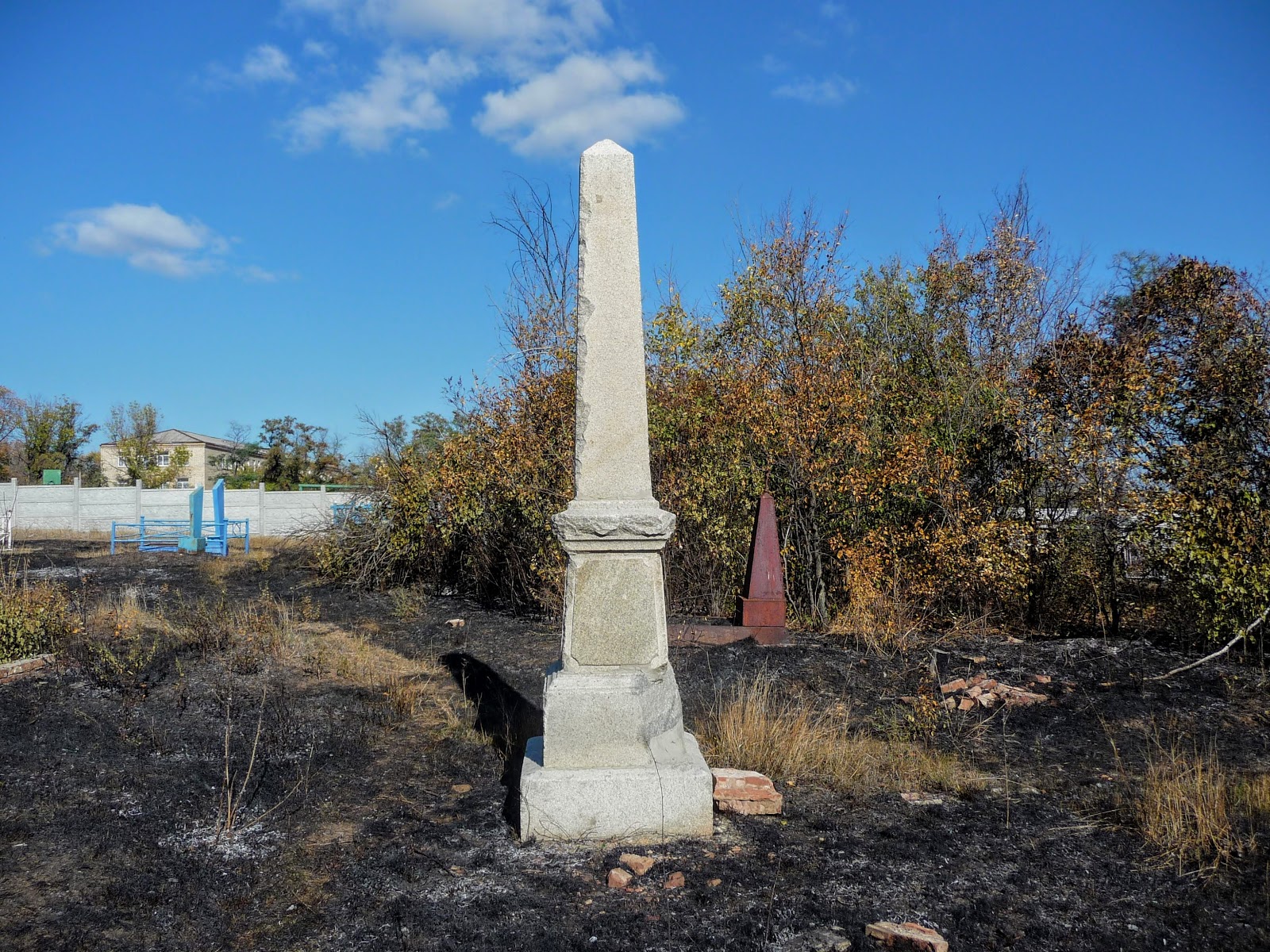
The historic centre of Novhorodske lies on hills, just like the core of New York — Manhattan. On one of them you can still see monuments to the first settlers. The cemetery in which the Mennonites are buried has been partly damaged by the uncontrolled burning of deadwood. Lovers of fire shows light bonfires on the hill, and the flames destroy the gravestones, crosses and railings.
 |
| The old cemetery. A monument to a German Mennonite |
From the hill a panorama of Novhorodske opens up.
 |
| Novhorodske. The former New York |
One of the settlement's districts is called Petrovska Hill.
 |
| Novhorodske. The descent and ascent to Petrovska Hill |
The houses built on the slope have two storeys on one side and three on the other.
 |
| Petrovska Hill. Poshtova Street, 16 |
One of the largest enterprises of Ukraine's chemical industry has, since 1917, produced about 30 kinds of products.
 |
| The Phenol Plant |
 |
| The Phenol Plant. The trade-union committee |
The administrative building of the Phenol Plant dates from 1929. The clock set on the facade of the plant's management office shows the correct time.
 |
| Novhorodske. The Phenol Plant. The administrative building. 1929 |
The House of Technology, which houses the plant's museum and a library with a unique scientific and technical collection, is sadly closed to visitors. In the building humanitarian aid is handed out to the residents of the front-line zone.
 |
| The Phenol Plant. The House of Technology, the museum, the library |
 |
| The Phenol Plant. The House of Technology. A mosaic panel |
The House of Technology is decorated with a mosaic of the Socialist Realism era, and the grounds of the management office with concrete planters in the shape of goblets and bowls, fenced off with a filigree railing.
 |
| The grounds of the Phenol Plant. The planters |
Original railings can be found on Molodizhna Street and Ozersky Street.
In the 19th century a park was laid out by the German Mennonites, and it was developed in the 1950s, when the settlement still bore the name New York and centres of leisure for the Phenol Plant's workers were built in it.
In the club, built in 1950, amateur art clubs are active, and in the gymnasium, besides the sections, there is a fan club of supporters of the football club 'Shakhtar'.
 |
| The park. The Phenol Plant club. 1950 |
 |
| The park. The gymnasium |
 |
| The park. The gymnasium. The decor |
The summer cinema has lost its lovers of watching films in the open air, but the building has been plastered on the outside and painted, like the other buildings, in the traditional brick-coloured tones.
 |
| The park. The summer cinema |
It is a pity that the busts of the writers, one of whom is N. V. Gogol, have been destroyed.
On the contrary, the sculptural images of A. S. Pushkin, V. V. Mayakovsky and A. M. Gorky have been restored, and the likeness is obvious.
 |
| The park. The bust of A. S. Pushkin |
 |
| The park. The bust of V. V. Mayakovsky |
 |
| The park. The bust of A. M. Gorky |
The Sun of Russian Poetry, the classic of Russian free verse and the stormy petrel of the world revolution were never in Novhorodske. No libraries or creative organisations were named after these poets. But the busts of the writers have adorned the park, although the names of the sculptors are unknown and there are no inscriptions on the stepped pedestals.
 |
| The park. The Writers' Alley |
Mass-produced pieces were cast from moulds sent from Moscow and Leningrad and filled the squares and parks.
 |
| The park. A sculpture |
A man holds a child on his shoulder and shows it the world around. He has raised his right hand in warning, as if protecting the future.
The monument to the Hetman of Ukraine has been unlucky. The abandoned bust of Bohdan Khmelnytsky stands not in a memorial place — though on a symbolic hill — but in a thicket of weeds, far from the paths and the busy spots.
 |
| The park. The bust of Bohdan Khmelnytsky |
Besides the park sculptures and the elegant planters, a couple more objects of Stalinist architecture deserve attention. The public toilets are closed, but not demolished — like monuments of a bygone era.
 |
| The park. The closed toilets |
What else recalls the settlement's former overseas name? In the 'New York' bakery-cafeteria an authentic interior has been created, and letters and documents of the plant's first owner, Jacob Niebuhr, have been gathered. Motorists fill up with petrol at a filling station bearing the same unusual foreign name — a name native to those who stood at the source of the settlement of Novhorodske's development.
 |
| Novhorodske. The 'New York' filling station |






No comments:
Post a Comment
Leave your impression