Vorokhta. The Leader Among Carpathian Health Resorts
Anyone who has been to Vorokhta has been rewarded with the beauty of the Ukrainian Carpathians, walked the mountain trails, and taken many memorable photos against the backdrop of natural and architectural landmarks. Wonderful scenery and climatic conditions fostered the birth of tourism in the Carpathian region in the 19th century, and today Vorokhta feels no lessening of attention from travellers. In 2024 the village was included in The Best Tourism Villages list of the world's 55 best villages.
Vorokhta, Ivano-Frankivsk region
One-day and longer routes start in Vorokhta - to the Kukul ridge, the Kostrych ridge, the mountains Yahidna, Shpytsi, and Lake Nesamovyte, with views of the Carpathian peaks and meadows, an overnight stay, and lunch in a kolyba.
Vorokhta, Ivano-Frankivsk region
As long as 100 years ago this Hutsul village was called a skiing paradise, and even in 1922 the Polish ski-jumping championship was held here.
Ukraine's highest ski jump stands 90 metres high and is used for training the Ukrainian national team, as well as by children's and youth teams.
Vorokhta. The ski jump
Near the entrance to the training centre, along the road, a souvenir market has settled in, with a rich assortment of folk-craft goods - wooden toys, embroidered and knitted items, dried berries and mushrooms, honey, and Carpathian herbs.
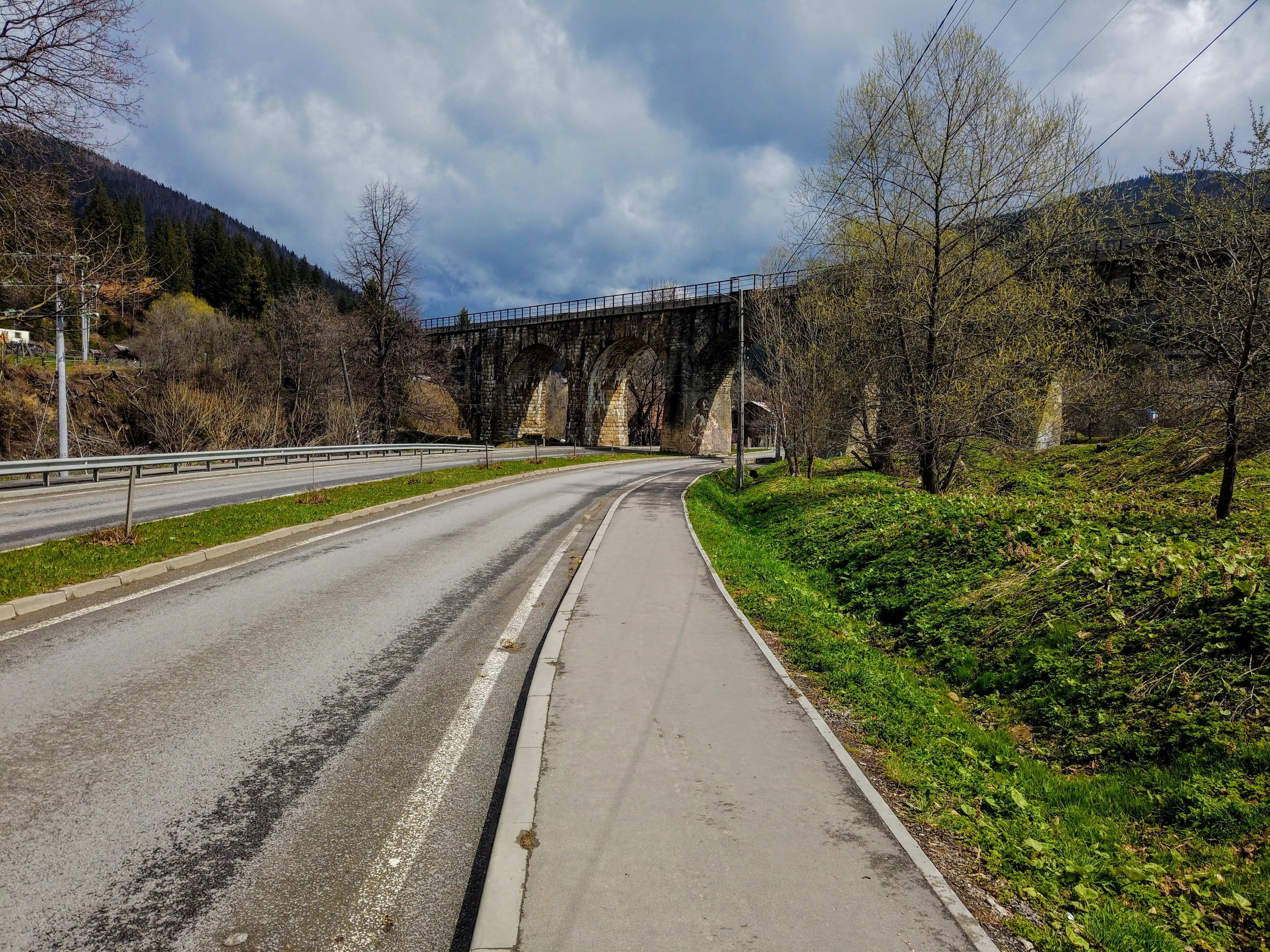
Rail traffic in the Carpathians was opened in 1895, and across the Prut River the steel line ran over arched crossings. In Vorokhta you can see 2 of the 6 stone viaducts surviving in Ukraine. This railway landmark of the Austrian period, in the northern part of the settlement, is 130 metres long, with a central arch spanning 65 metres. In the southern part of Vorokhta, a bridge 200 metres long has a central arch 30 metres long. The Austrian overpasses are now out of use and could be used for viewing the mountain landscapes on railway journeys.
Vorokhta. The viaducts
The settlement stretches for 5 kilometres along the Prut in the valley, from south to north. The left bank of the wayward river exposes the layered surface of the steep slope, and the folded stone boulders are a reminder of the significant role of water in shaping the mountain massif.
Vorokhta. The Prut River
The people of Vorokhta deserve credit for preserving the architectural landmark - the Church of the Nativity of the Most Holy Mother of God, which is considered the spiritual talisman of the Carpathian resort. This wooden church dates to 1615; it was brought from neighbouring Yablunytsia, and its restoration was done without any newfangled excesses.
Vorokhta. Church of the Nativity of the Most Holy Mother of God
The new church on Danylo Halytskyi Street was built in 1924-1929.
Vorokhta. Church of the Nativity of the Most Holy Mother of God
The sacred heritage includes the Church of the Assumption of the Most Holy Mother of God, built in 1903-1905.
Vorokhta. Church of the Assumption of the Most Holy Mother of God
A wooden chapel was built on the site and in memory of the Christian beginning of the settlement in 1602.
Vorokhta. The wooden chapel
The chapel in the cemetery was built in Hutsul traditions.
Vorokhta. The cemetery chapel
Vorokhta has always been and remains among the leading Carpathian health resorts. At the turn of the 19th-20th centuries it was fashionable among the intelligentsia to holiday in Vorokhta, take up winter sports, and build up health and strength. The visitors' lists of this prestigious resort include Ivan Franko, Wilhelm Habsburg, Ivan Krypiakevych, Mykhailo Kotsiubynsky, Olena Teliha, and Maksym Rylsky. Students and lecturers, merchants and entrepreneurs, priests and business people came here. Guests spent their summer holidays in boarding houses and Hutsul grazhdas. At the station they were greeted by locals with trembitas and songs. Some holidaymakers had their own villas, where they stayed with their families and received friends.
Vorokhta. Residential and commercial buildings
The healing mountain air gave rise to the name of the sanatorium, which was visited by many writers and poets who popularised this paradise corner in their works. The author of the first design of "Hirske Povitria" (Mountain Air) was the famous Lviv architect Ivan Levynsky. In the cosy corners of the sanatorium park, sculptural images of the Socialist Realism era unexpectedly draw attention. The busts of national poets were installed later.
Vorokhta. The "Hirske Povitria" sanatorium
Another sanatorium in the centre of the village preserves details of folk wooden architecture.
Vorokhta. The "Smerichka" bone-tuberculosis sanatorium
The Alpine-style villas are being rebuilt as commercialisation grows, and after this the aesthetic character of the Hutsul village is lost.
Vorokhta. Residential buildings
You can get acquainted with the history, traditions, and cultural heritage of Vorokhta at the local history museum and the library, which are located in the centre of culture and leisure (76 Danylo Halytskyi Street).
Vorokhta. The centre of culture and leisure. Former theatre, St. Adalbert's printing house
Vorokhta. The centre of culture and leisure
A convenient location, comfortable guest houses, and marked routes to the most beautiful Carpathian peaks attract travellers, and for a century and a half Vorokhta has remained a popular tourist and recreation area.
Vorokhta. A sanatorium building
Vorokhta. The ruined overpass and railway embankment




No comments:
Post a Comment
Leave your impression