The mediaeval Sent-Miklosh Castle in Chynadiiovo is a monument of architecture of the 14th-15th centuries, a popular tourist site, and a venue for festivals and plein-airs. But the events of today were preceded by the centuries-long epic of the palace and its owners, and this chronicle is one of the most romantic and dramatic castle stories of Zakarpattia.
 |
| Sent-Miklosh Castle. The settlement of Chynadiiovo, Mukachevo district, Zakarpattia region |
The settlement of Sent-Miklosh (Saint Nicholas) has been known since the 13th century, and the nearby Verevetskyi Pass (the Rus Gate), through which the Hungarians crossed the Carpathians, contributed to its strategic fortification.
 |
| Sent-Miklosh Castle. An architectural monument |
In the 14th century, Baron Perenyi began the erection of a stone fortification structure with two towers, loopholes and walls one metre thick.
 |
| Sent-Miklosh Castle. A museum and a tourist pearl |
Having bought the unfinished stronghold for 22,000 forints, Prince Mihai Telegdi strengthened and put it in order. The castle's inhabitants — a family of aristocrats — rest in the crypts of the Church of St. Nicholas, which had a connection with the castle through underground passages.
 |
| Chynadiiovo. The Church of St. Nicholas. 15th century. There was an underground passage from the castle to the church |
From 1670 the owner of the residence became the Rakoczi family. The tales have carried down to our days the most romantic pages of the palace's chronicle, which are connected with the wife of the Transylvanian prince Ferenc I Rakoczi, the legendary Ilona Zrinyi.
 |
| Sent-Miklosh Castle. A portrait of Ilona Zrinyi |
The heiress of two famous families of Croatia was one of the most educated women of Europe; she knew a dozen foreign languages, medicine and military affairs, jurisprudence, ballistics. After the death of her husband, she continued the irreconcilable war against the absolute rule of the Habsburg dynasty and held the defence of the Mukachevo Castle against the hated Austrians for 27 months.
 |
| The Mukachevo Palanok Castle. 11th century |
She led a garrison of 2,500 soldiers and climbed the bastions with her ten-year-old son Ferenc II, for whom the fate of a national hero of Hungary was destined.
 |
| The Mukachevo Palanok Castle. 11th century |
The Polish king Jan Sobieski called Ilona "the most outstanding woman of Europe", and the Turkish sultan presented her with a charter for her defiance of the enemy. All the European powers followed the events in Mukachevo and the romance of Ilona and the leader of the anti-Habsburg rebel army, Imre Tekeli.
 |
| Sent-Miklosh Castle. Ilona Zrinyi in her castle |
The King of the Kuruc was 14 years younger than the widow, who captivated him with her beauty and courage. The lovers met at Sent-Miklosh Castle, to which underground passages led from the Mukachevo fortress.
 |
| Sent-Miklosh Castle. The double walls and secret passages |
 |
| Sent-Miklosh Castle. The steps in the secret passages |
 |
| Sent-Miklosh Castle. The stairs from the second floor to the first |
At first secretly, because Ilona's mother-in-law was still alive — Sofia Batori, known for her vampiric manifestations and for taking baths in the blood of young beauties. Later the rebels stopped concealing their relationship and held a magnificent wedding.
 |
| Sent-Miklosh Castle. The Castle of Love |
The Western European high society could not accept this union, and Ilona had to choose love or the throne. It is not hard to guess what is more important for a woman in love. She renounced her titles, lost her possessions and riches, but spent the last years of her life together with her beloved husband.
This extraordinary story gave the palace a second name — the Castle of Love.
After the end of the Thirty Years' pan-European war with the Habsburg dynasty, the Mukachevo-Sent-Miklosh domain came to belong to the Austrians, and the Schonborn family, loyal to the emperor, received the castle as a gift, which they owned for two centuries. At this time the structure lost its defensive significance and acquired the features of a palace.
During the Second World War the Hitlerites set up a prison in the castle.
 |
| Sent-Miklosh Castle. A fortress, a palace, a prison, a warehouse, a military unit, a ruin, a museum, the Castle of Love |
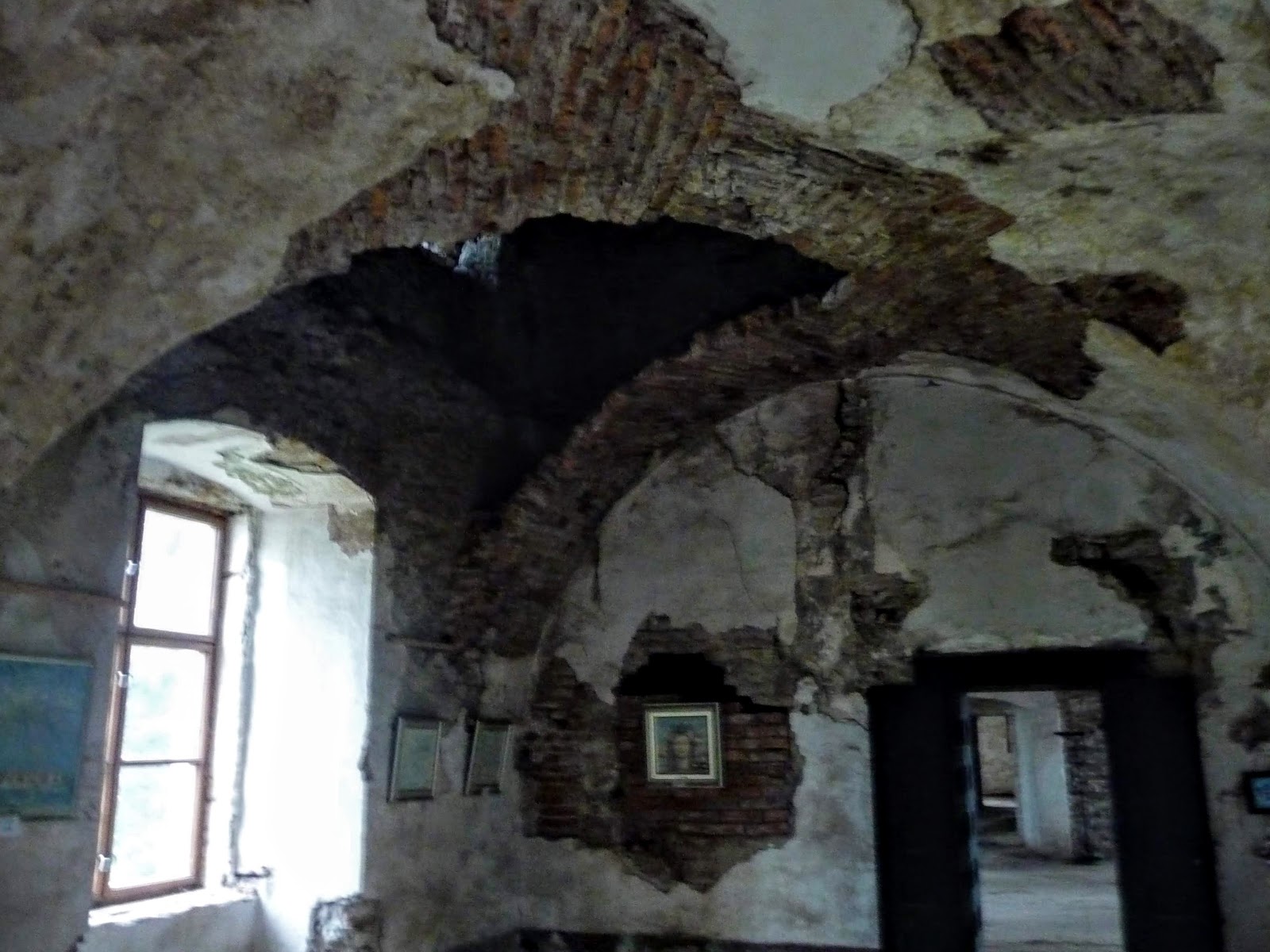
The Soviet authorities used the premises of the noble nest to house various offices, a warehouse for spare parts for cars and tractors, a military unit. In the 1990s the palazzo looked like a gloomy ruin with a collapsed roof.
 |
| Sent-Miklosh Castle. The restoration of the second floor |
 |
| Sent-Miklosh Castle. The legacy of the Soviet past |
 |
| Sent-Miklosh Castle. The vaults above the windows |
But some heavenly forces helped the neglected historic building to become the Castle of Love again. Unearthly and human love prompted the Zakarpattian artist, composer and poet Yosyp Bartosh to take on the restoration of the stronghold.
 |
| Sent-Miklosh Castle. The artist and Master Yosyp Bartosh |
He was inspired by a local artist from Chynadiiovo, Tetiana Petrychko, who later became the Master's muse and wife.
 |
| Sent-Miklosh Castle. The halls on the second floor |
 |
| Sent-Miklosh Castle. The stairs |
 |
| Sent-Miklosh Castle. The mediaeval walls |
When Bartosh took an application to the village council with a request to lease him the castle, they laughed at him.
 |
| Sent-Miklosh Castle. The Castle of Love |
 |
| Sent-Miklosh Castle. Mysterious and enigmatic |
 |
| Sent-Miklosh Castle. The artist and his wife settled in the castle to look after it constantly |
For three long years the artist sought a resolution of the matter, travelled to Kyiv, knocked on every door. Finally, in 2001, he managed to arrange a concession — a type of contract where the investor reconstructs the site at his own expense.
 |
| Sent-Miklosh Castle. Hunting trophies |
 |
| Sent-Miklosh Castle. Under the protection of the state |
The Bartoshes inherited a heavy legacy from the last owners of the palace. Rolling up his sleeves, the artist, who had never held anything heavier than a brush in his hand, took up heavier tools of labour. He cleared out the piles of rubbish, carried bricks and logs, and bought up roof tiles from the local population to repair the roof.
 |
| Sent-Miklosh Castle. The restored halls on the ground floor |
 |
| Sent-Miklosh Castle. The interiors of the palace |
 |
| Sent-Miklosh Castle. The artist bought the furniture from collectors and woodwork masters |
In time he managed to install windows, even if of plastic, but the mediaeval walls had to be saved. Together with like-minded people, Yosyp and Tetiana restored the interiors of six rooms on the ground floor, where archaeological collections of the Celtic and Scythian periods are presented.
 |
| Sent-Miklosh Castle. The Castle of Love. A museum and a tourist pearl |
Bartosh acquired all the exhibits with the proceeds from the sale of his own canvases, or in exchange for them.
 |
| Sent-Miklosh Castle. Master Yosyp Bartosh himself plays the piano |
 |
| Sent-Miklosh Castle. A bust of the national hero of Hungary Ferenc II Rakoczi, the son of Ilona Zrinyi |
The artist painted the portraits of the castle's former inhabitants, gathering the material and information bit by bit in ancient archives.
 |
| Sent-Miklosh Castle. Portraits of the castle's inhabitants |
Tetiana is the author of a unique technique of decorating pysanky, when the eggs are boiled in onion skins and then decorated with the help of a blade and a needle. Talented people are talented in everything.
 |
| Sent-Miklosh Castle. Tetiana Bartosh's collection of pysanky |
Yosyp Bartosh headed the public association "Kalhan-A" and, together with historians, local-history scholars and other artists, breathed a second life into the stronghold.
 |
| Sent-Miklosh Castle. The artists display their canvases in the mediaeval halls |
The castle has become a tourist pearl; exhibitions, concerts and plein-airs are held in it.
 |
| Sent-Miklosh Castle. The Castle of Love |
The international festival "Sribnyi Tatosh" (Silver Tatosh), with knightly battles, master classes, equestrian performances, a mediaeval disco and a fair, has become traditional.
 |
| Sent-Miklosh Castle. A venue for festivals |
 |
| Sent-Miklosh Castle. A workshop, a warehouse, a stable |
In May the best florists from various countries display their skill at the flower festival "Love in Sent-Miklosh".
 |
| Sent-Miklosh Castle. A venue for festivals |
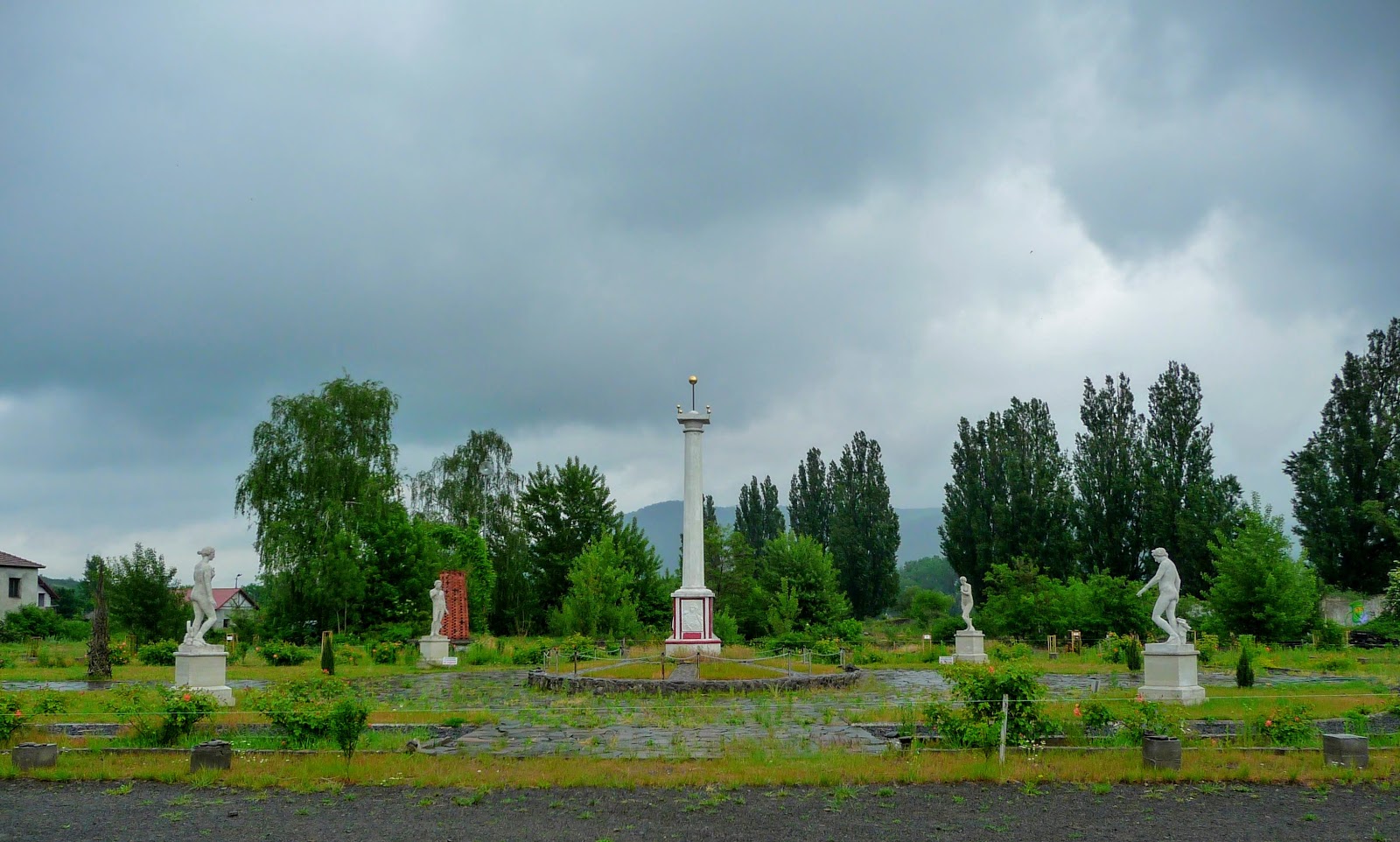
On the castle grounds, the park laid out in 1749 and destroyed in 1947 is being restored.
 |
| Sent-Miklosh Castle. The revival of the park |
The green zone's adornment has become not only rare exotics — Cunninghamia, Paulownia, pink acacia — but also several granite and stone compositions.
 |
| Sent-Miklosh Castle. The revival of the park |
The Monument to the Sword, with bas-reliefs of the castle's owners, is a reflection of the historical realities that unfolded by the walls of the Sent-Miklosh bastille.
 |
| Sent-Miklosh Castle. The Monument to the Sword |
The idea of the work "Unification" by the sculptor from Budapest Janos Drianyovski is to find consensus between the two sides of a conflict.
 |
| Unveiled in May 2017 during the III International Symposium of Sculptors. Drops of water are reproduced in two parts of a conical shape, in the middle of which is a granite "bridge". The shining surface of the granite reflects both sides of the sculpture. This effect symbolises the problematic moments that arise between peoples and cultures. For in a problem one must look for both sides of the conflict, a reflection of one's own deeds and mistakes. Only then will it be possible to come to a consensus. |
The monument "Flame of Peace", unveiled in 2018, symbolises peace, friendship, courage, strength and goodness.
 |
| Sent-Miklosh Castle. The monument "Flame of Peace" |
To the castle, wreathed in a romantic Love Story, couples come to confess their tender feelings in Ilona's apartments and to bind their hearts in lawful marriage. There is a belief that if you hold a wedding ceremony in a sacred place, long mutual love awaits the newlyweds.
At the information centre located on the castle grounds, they will provide free information about the landmarks of Zakarpattia, how to get there, where to stay.
 |
| Sent-Miklosh Castle. The information centre |
In Chynadiiovo you can visit one more palace —
the hunting house of Count Schonborn. Sent-Miklosh Castle is located in the settlement of Chynadiiovo, Zakarpattia region, 10 kilometres from Mukachevo, at 53 Voloshyna Street, which runs parallel to the E-50
Kyiv-Chop.
 |
| Sent-Miklosh Castle. The Castle of Love |
 |
| Sent-Miklosh Castle. A fortress, a palace, a prison, a warehouse, a military unit, a ruin, a museum, an architectural monument, a tourist pearl, the Castle of Love |
You can get here from Lviv by the suburban train
Lviv-
Mukachevo to the Chynadiiovo railway platform.
 |
| Chynadiiovo. The railway platform |
Coordinates: 48°29'5"N 22°49'52"E






No comments:
Post a Comment
Leave your impression