Bila Tserkva is the economic, cultural and educational centre of Kyiv region. Travellers include this district centre in their route to see the largest and oldest arboretum in Ukraine, 'Oleksandriia', which has amassed the country's biggest collection of plants. But it is not only this man-made green expanse that draws tourists to one of Ukraine's most ancient cities. Bila Tserkva has about a hundred architectural monuments, fifteen of them with the status of national significance.
 |
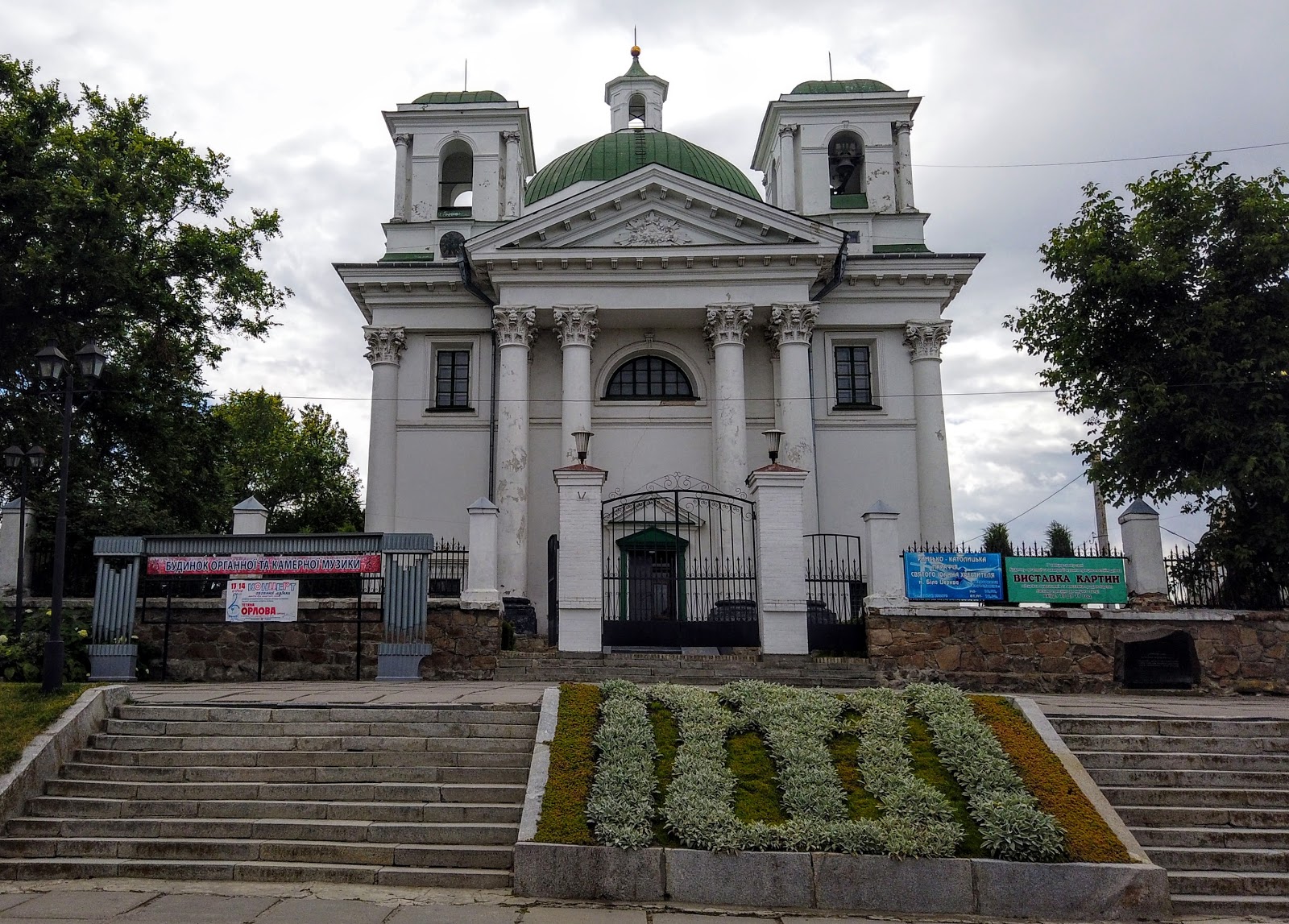
| Bila Tserkva. Church of St. John the Baptist. 1816. Hall of organ and chamber music. Architectural monument of national significance |
Soborna Square — the centre of the medieval town, which was surrounded by a defensive rampart with a palisade.
 |
| Druzhby Street and Soborna Square |
The historic core is Castle Hill; this is where Yuriv began, named after the Christian name of Yaroslav the Wise — Yurii, or Georgii.
 |
| Castle Hill. Monument of archaeology. On this spot, in 1032, Yaroslav the Wise founded the city of Yuriv — the predecessor of Bila Tserkva |
The Branickis left the city more than just the green riches of 'Oleksandriia'.
 |
| Oleksandriia arboretum. The 'Echo' Colonnade |
On the site of the princely citadel and the probable location of the church of unhewn birch logs that gave the city its name, in 1813 the estate's owners erected the Roman Catholic Church of St. John the Baptist.
 |
| Church of St. John the Baptist. 1816. Hall of organ and chamber music |
The exquisite architectural decorations, created by Italian masters, cost the client more than the construction of the church itself. The church was erected in memory of the deceased son Alexander and became the family tomb of the Catholic Branicki family. Nowadays services for the Catholic community of Bila Tserkva are held on Sundays. The shrine is occupied by an organ hall, where one can enjoy works of sacred and classical music.
 |
| Church of St. John the Baptist. 1816. Hall of organ and chamber music |
The enterprising Alexandra Branicka was of the Orthodox faith, and on her initiative, on the site of the ruined St. Nicholas Church, the Transfiguration Cathedral was built in the 1830s, where the countess found her final rest. During the years of persecution of the church, the premises housed a gymnasium and an archive. In 1941 a bomb destroyed the ceilings. After restoration, it proved impossible to bring back the unique frescoes.
 |
| Transfiguration Cathedral. Architectural monument of national significance |
The southern part of the rebuilt St. Nicholas Church is the oldest element of the religious building, founded in 1706 by Ivan Mazepa on the site of an earlier wooden church. According to the plan, the three-altar church was not completed because of the hetman's flight and the spread of Catholicism.
 |
| St. Nicholas Church. Architectural monument of national significance |
In 2013, next to the remains of the foundation of the ancient church laid down in 1032 together with the citadel by Yaroslav the Wise, the Church of the Holy Great Martyr George the Victorious was built.
 |
| Castle Hill. Druzhby Street. Church of the Holy Great Martyr George the Victorious |
 |
| Castle Hill. Church of the Holy Great Martyr George the Victorious. 2013 |
The founder of the Yuriv hillfort-fortress gives a hospitable welcome at the foot of Castle Hill.
 |
| Monument to Yaroslav the Wise |
On Castle Hill, next to the churches and the archaeological digs, stands the local history museum with a rich collection and a holding of 78,000 exhibits.
 |
| Castle Hill. Local history museum and archaeological site |
From the church courtyard a wonderful view opens onto the Ros River, the opposite bank and the road bridge.
 |
| The Ros River |
On Soborna Square stands the teaching building of the agrarian academy — in the past, the former largest gymnasium in Ukraine, built in 1843.
 |
| Soborna Square, 4. National Agrarian Academy |
In the former Jewish school, built in 1901, the House of Artistic Creativity was opened.
 |
| Khmelnytsky Street. House of Artistic Creativity |
If you hear the word 'BrUM' from the people of Bila Tserkva, do not be surprised, and be sure to visit this place. The former trading rows that belonged to the Branickis are called by the townspeople after the initials of the Bila Tserkva District Universal Store. The shops built at the beginning of the 19th century housed trading stalls, warehouses and small enterprises. Buildings of this type are very rarely found in Ukraine. Now the premises are occupied by shops and cafes.
 |
| Torhova Square. Trading rows. 'BrUM'. Architectural monument of national significance |
Trade was of great importance in the development and building of Bila Tserkva. Let us walk through the historic centre of the city and look at the buildings that have survived from the end of the 19th century.
 |
| Torhova Square, 10 |
 |
| Torhova Square, 7 |
 |
| Torhova Square, 5 |
 |
| Torhova Square, 5 |
 |
| Heroes of the Heavenly Hundred Street, 38 |
 |
| Heroes of the Heavenly Hundred Street, 38 |
 |
| Heroes of the Heavenly Hundred Street, 36 |
The former residential houses of Jews who concluded an agreement with the Branickis and brought the trade craft to the city now house institutions, shops and residents' flats.
 |
| Heroes of the Heavenly Hundred Street, 28 |
 |
| Heroes of the Heavenly Hundred Street, 19 |
 |
| Bohdan Khmelnytsky Street, 3/23 |
 |
| Bohdan Khmelnytsky Street, 7 |
 |
| Bohdan Khmelnytsky Street, 10 |
 |
| Bohdan Khmelnytsky Street, 16 |
 |
| Bohdan Khmelnytsky Street, 13. Children's library |
The history of Bila Tserkva is linked with many outstanding personalities. In 1845 and in 1847, together with Engelhardt, a relative of the Branickis, the 'Oleksandriia' arboretum was visited by T. H. Shevchenko. The Kobzar described his impressions of the trip in the story 'A Stroll with Pleasure and Not without a Moral'. In memory of the great poet-prophet, a bust of Taras Hryhorovych has been erected in the city.
 |
| Monument to T. H. Shevchenko |
To make it easier for tourists to find their way around the city, signposts to the landmarks have been set up at the intersections of the main streets.
 |
| Signpost on Soborna Square |
You can reach Bila Tserkva by train from
Kyiv,
Dnipro,
Lviv, Zaporizhzhia,
Truskavets, Kherson,
Uzhhorod,
Novooleksiivka, Kharkiv. A suburban train runs between the capital and Myronivka.
 |
| Bila Tserkva. Railway station |
Coordinates of Castle Hill: 49°47'28"N 30°6'34"E


No comments:
Post a Comment
Leave your impression