For a traveller journeying by rail, getting to know a city always begins at the railway station, the city's calling card. The station is the gateway to the city, the first and last impressions of a stay in it. A harbour for trains and passenger terminals with a waiting hall, ticket offices, a restaurant and shops — this is part of the history of cities and of the state. Let us look at some of them, the large and small stations of Ukraine. The station in Chernihiv can be considered a very striking landmark.
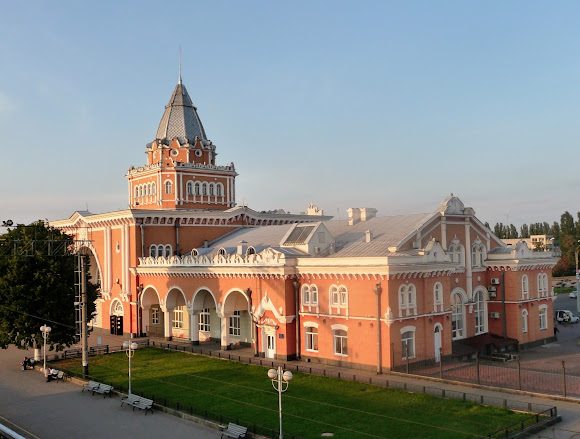 |
| Chernihiv. The railway station. An architectural monument |
After the Second World War the ruined building was restored to the designs of a German prisoner of war who did not return to his homeland because his family had perished.
 |
| Chernihiv. The railway station. An architectural monument |
The station in
Nizhyn has been serving passengers for 150 years already. In 1943 the station was bombed by fascist aircraft, in which 3,000 people were killed.
 |
| Nizhyn. Chernihiv region. The railway station |
Just as in Nizhyn, in
Konotop the station and railway workshops were opened during the construction of the Kursk-Kyiv line, but the present building dates from 1953, to a design by the architect P. F. Krasytsky.
 |
| Konotop. Sumy region. The railway station. 1953 |
 |
| Konotop. Sumy region. The railway workshops, 19th – early 20th c. |
Customs control is carried out at the station; trains run to Belarus, Russia, Moldova and back.
 |
| Konotop. Sumy region. The railway station |
Some small stations can be made out from the window of the train during a journey, and they leave pleasant impressions in the memory. At the Lypiv Rih station of the South-Western Railway the clock on the station wall showed the correct time.
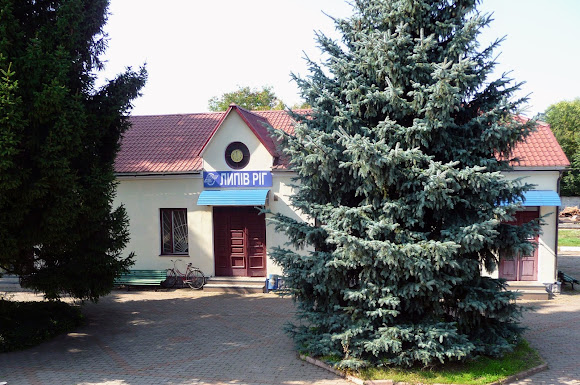 |
| Lypiv Rih. Chernihiv region. The railway station |
The former Drozdivka station bears the name of the first head of Ukrzaliznytsia, Borys Oliinyk.
 |
| The Borys Oliinyk station. Chernihiv region. The railway station |
The station of
Berdychiv of the South-Western Railway serves the passengers of 12 long-distance trains and 24 suburban services.
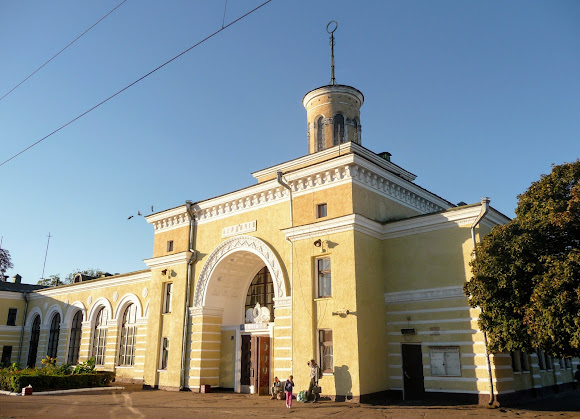 |
| Berdychiv. Zhytomyr region. The railway station |
The most musical station is in
Odesa. Trains pull into the station as into a dead end, and passengers on the platform are greeted by a recording of Leonid Utyosov's song about "the city amid blossoming acacias by the Black Sea". The former station, erected in 1883 during the construction of the Odesa-Balta Railway, was blown up in 1944. By the method of public construction, in which the whole hero-city took part, in 1952 a new building was opened with the architectural features of its predecessor.
 |
| Odesa. The railway station. 1952 |
Sadly, not all stations can be called hospitable. Arriving in
Mykolaiv early in the morning, when the city was still asleep, I could not find a place to sit down in the waiting halls of the glass-and-concrete building. At night the station becomes a refuge for persons of no fixed abode. I did not want to photograph the sad, cold and dirty premises.
The station at Mykolaiv-Vantazhnyi was rebuilt after the war in 1954, but the building is closed and does not serve passengers.
 |
| The Mykolaiv-Vantazhnyi station. The railway station. 1954 |
 |
| The Mykolaiv-Vantazhnyi station. The railway station. 1954. Bas-reliefs |
Another station in the south — in
Novooleksiivka in the Kherson region.
 |
| Novooleksiivka. Kherson region. The railway station |
On 27 December 2014 the rail link with the Crimean peninsula was severed, and the station became the terminus for trains coming from Kyiv, Minsk, Lviv, Dnipro, Kharkiv, Zaporizhzhia, Poltava and Kovel.
 |
| Novooleksiivka. Kherson region. The railway station |
The magnificent station in Koziatyn, in the Vinnytsia region, was built in 1889 and is one of the oldest in Ukraine and in the CIS. The building impresses with its striking finish and the originality of its design. This architectural monument has the look of an ocean liner flying between the Kyiv and Shepetivka platforms.
 |
| Koziatyn. Vinnytsia region. The railway station. An architectural monument. 1889 |
Not infrequently monuments connected with the work of the railways are installed near stations. In the inner courtyard of the station there are 2 sculptures — of a worker and a peasant woman, potential passengers of the 78 trains that pass through Koziatyn station.
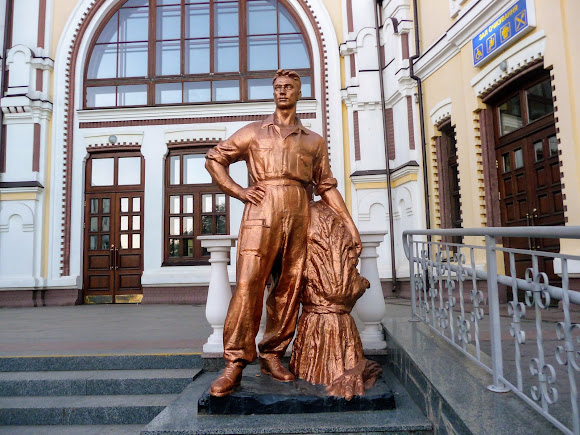 |
| Koziatyn. Vinnytsia region. The railway station. A sculpture of a worker |
 |
| Koziatyn. Vinnytsia region. The railway station. A sculpture of a peasant woman |
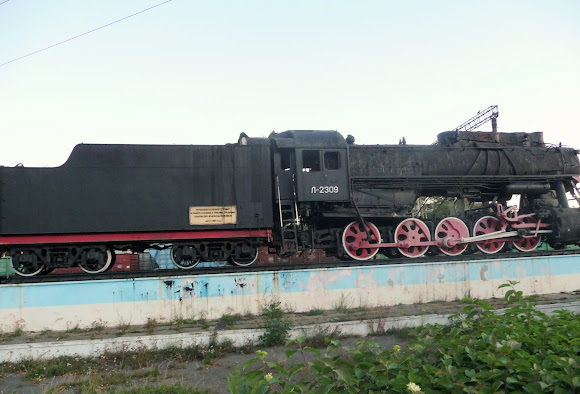 |
| Koziatyn. The railway station. The monument locomotive L-2309 |
Also drawing attention at the station is the old water tower with patterned brickwork, which served to supply steam locomotives with water.
 |
| Koziatyn. The railway station. The water tower. 1890. An architectural monument |
From Koziatyn one can travel in every direction; let us now go to the west of the country. The Lviv main line is the very first railway on the territory of Ukraine, laid in the 1860s. The West Ukrainian lands at that time were part of the Austrian monarchy. A station is an object of strategic importance. The railway junction in
Ternopil suffered during the world wars. Rebuilt in 1952, it serves the passengers of 56 long-distance and suburban trains.
 |
| Ternopil. The railway station. 1952 |
The construction company of Archduke Karl Ludwig, the father of Franz Ferdinand, whose assassination was the pretext for the start of the First World War, encountered great difficulties caused by the terrain on the Ternopil-Zolochiv section. The town is
Zolochiv, while the station is Zlochiv, from the old Polish name of the area meaning "to hear evil", and there is no confusion with the station of the same name, Zolochiv, in the Kharkiv region.
 |
| Zolochiv. Lviv region. The railway station of the Zlochiv station |
 |
| Zolochiv. Lviv region. The railway station of the Zlochiv station |
The station
Sokal was at first a dead-end station; after the First World War it became an intermediate one, and now it is a junction with the Rivne directorate of rail transport. It is located within the settlement of Zhvyrka, since wars and destruction shifted the town of Sokal to the right bank of the Western Bug river.
 |
| Sokal. Lviv region. The railway station |
 |
| Sokal. Lviv region. The railway station |
At the turn of the 19th and 20th centuries, one after another the stations of Galicia were built.
 |
| Strilky. Lviv region. The railway station |
 |
| Sambir. Lviv region. The railway station |
On the station square of
Sambir a monument has been erected to the Ukrainians deported from Zakerzonia, the former historical and ethnic Ukrainian territories. A mother with three children, having abandoned her cottage and her belongings, walks along the sleepers as if along her own Way of the Cross, into the unknown that the Bolshevik authorities prepared for half a million of her compatriots.
 |
| Sambir. Lviv region. The railway station. A monument to the deported Ukrainians |
The station in
Stryi, like its brethren, was destroyed during the fighting. In 1950 a new two-storey building was opened.
 |
| Stryi. Lviv region. The railway station. 1950 |
The Morshyn station — a place of arrival and of parting for holidaymakers who got to know one another at the resort.
 |
| Morshyn. Lviv region. The railway station |
The station in
Zhydachiv serves only the passengers of suburban trains.
 |
| Zhydachiv. Lviv region. The railway station |
 |
| Zhydachiv. Lviv region. The railway station |
In the small premises of the station of
Bolekhiv in the Ivano-Frankivsk region, the passengers do not freeze but warm themselves by the heat of stoves faced with old tiles.
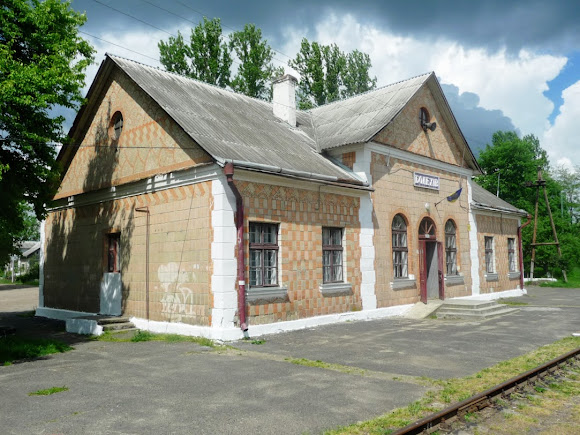 |
| Bolekhiv. Ivano-Frankivsk region. The railway station |
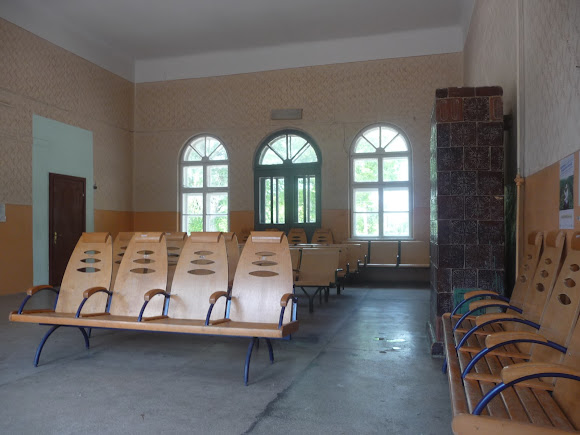 |
| Bolekhiv. Ivano-Frankivsk region. The railway station. The waiting hall |
If you go still further west, crossing the blue ribbons of mountain rivers on numerous truss bridges, passing through passes and tunnels, then amid the wonderful Carpathian scenery it is impossible not to admire the railway stations, so necessary for those awaiting their train.
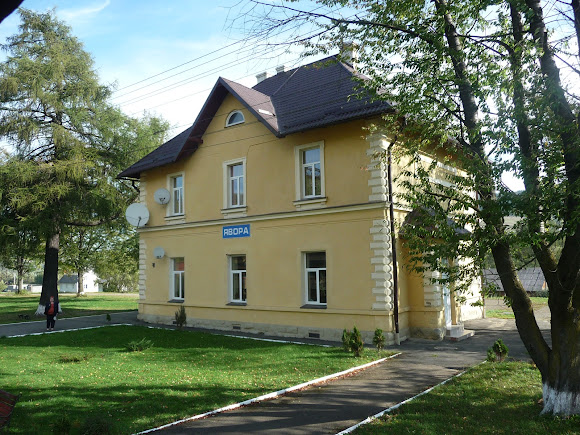 |
| Yavora. Lviv region. The railway station |
 |
| Hrebeniv. Lviv region. The railway station |
 |
| Verkhnie Synovydne. Lviv region. The railway station |
Most of them were built more than a hundred years ago by Austrian companies.
 |
| Skole. Lviv region. The railway station |
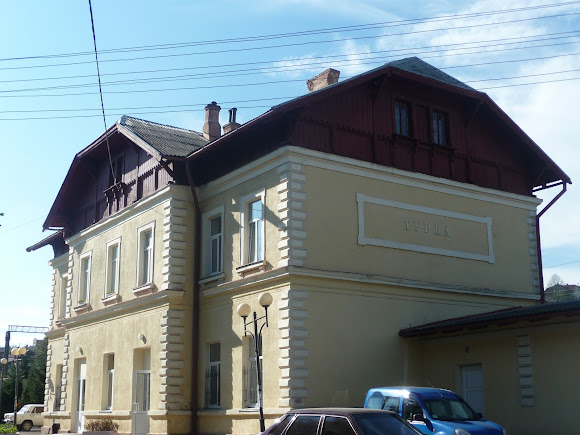 |
| Turka. Lviv region. The railway station |
To the station in Svaliava, lovers of alpine skiing and those wishing to drink the waters of the healing springs will get from Kharkiv on the night express Kharkiv-Uzhhorod in a single night.
 |
| Svaliava. Zakarpattia region. The railway station |
To see the famous
Schonborn castles and Saint Miklos, one can go by suburban train from
Svaliava,
Stryi and
Lviv to the Karpaty railway platform, whose station resembles a fairy-tale cottage.
 |
| Karpaty station. Zakarpattia region. The railway station |
The station in Chernivtsi could be called a palace on rails. This priceless architectural monument with a dome-shaped roof was built in 1909 in the Art Nouveau style, adorned with stucco, and it resembles the station in Vienna. A sculpture of the goddess Iris, messenger of the gods, warmly greets the guests of the city.
 |
| Chernivtsi. The railway station. 1909. An architectural monument |
In Bukovina, the station that looks neat and well-kept is the one in
Luzhany,
 |
| Luzhany. Chernivtsi region. The railway station. 1902 |
 |
| Luzhany. Chernivtsi region. The railway station. 1902 |
, while a neglected and sad one is the 1905 monument of history and architecture in
Novoselytsia.
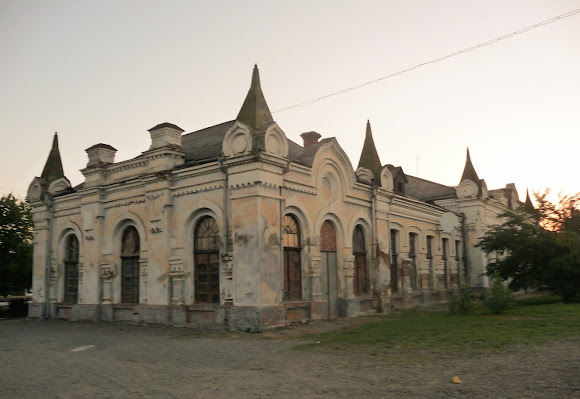 |
| Novoselytsia. Chernivtsi region. The railway station. 1905. An architectural monument |
 |
| Novoselytsia. Chernivtsi region. The railway station. 1905. An architectural monument |
From the west let us move to the east. Two stations of the Prydniprovska Railway at once are located in Synelnykove, opened in 1873. The station Synelnykove-1 was designed by the engineer V. L. Hlazurin, as a memorial plaque attests.
 |
| Synelnykove-1. The railway station |
 |
| Synelnykove-1. Dnipropetrovsk region. The railway station |
At the Synelnykove-2 station several non-working electrical sockets turned out to be there. To the question, "Why are there 5 useless sockets in the waiting hall?", the station attendant replied: "It's dangerous. Children travel here."
 |
| Synelnykove-2. The railway station |
The station in Prosiana is the most ordinary; an electronic board on the facade records the air temperature and the date.
 |
| Prosiana. Dnipropetrovsk region. The railway station |
Attention is drawn by the neglected service building of natural stone at the station, which since 2011 has borne the name of the former head of the Donetsk Railway, V. V. Pryklonsky.
 |
| Prosiana. The railway service building at the Pryklonsky station |
The development of the economy in the Donbas, the building of factories and the working of mineral deposits led to the opening of new branches of the main line in the industrial regions.
 |
| Demurene. Dnipropetrovsk region. The railway station |
The stations in Kostiantynivka and Kramatorsk are located 20 kilometres from each other.
 |
| Kostiantynivka. Donetsk region. The railway station. 1926, 1955 |
 |
| Kostiantynivka. Donetsk region. The railway station. 1926, 1955 |
They were built in the 1950s to a single design. Since 2015 these twin stations have taken on the entire load of the Donetsk region's passenger flows in the direction of Kyiv, Dnipro, Kharkiv and Odesa.
 |
| Kramatorsk. Donetsk region. The railway station. 1952. The waiting hall |
 |
| Kramatorsk. Donetsk region. The railway station. 1952. The winter garden |
In front-line
Avdiivka only the suburban train stops, and this station is its terminus.
 |
| Avdiivka. Donetsk region. The railway station |
 |
| Avdiivka. Donetsk region. The terminus of the rail service |
The ancient and the modern, the small and the crowded stations of Ukraine — this is part of the history of the state and a page in the life of each of us.




No comments:
Post a Comment
Leave your impression